- TPU V8's training-inference split signals a market shift.
- Google Cloud's enterprise growth fueled by a 1000x sales force expansion.
- AI adoption is accelerating faster than the internet, driven by cost efficiency.
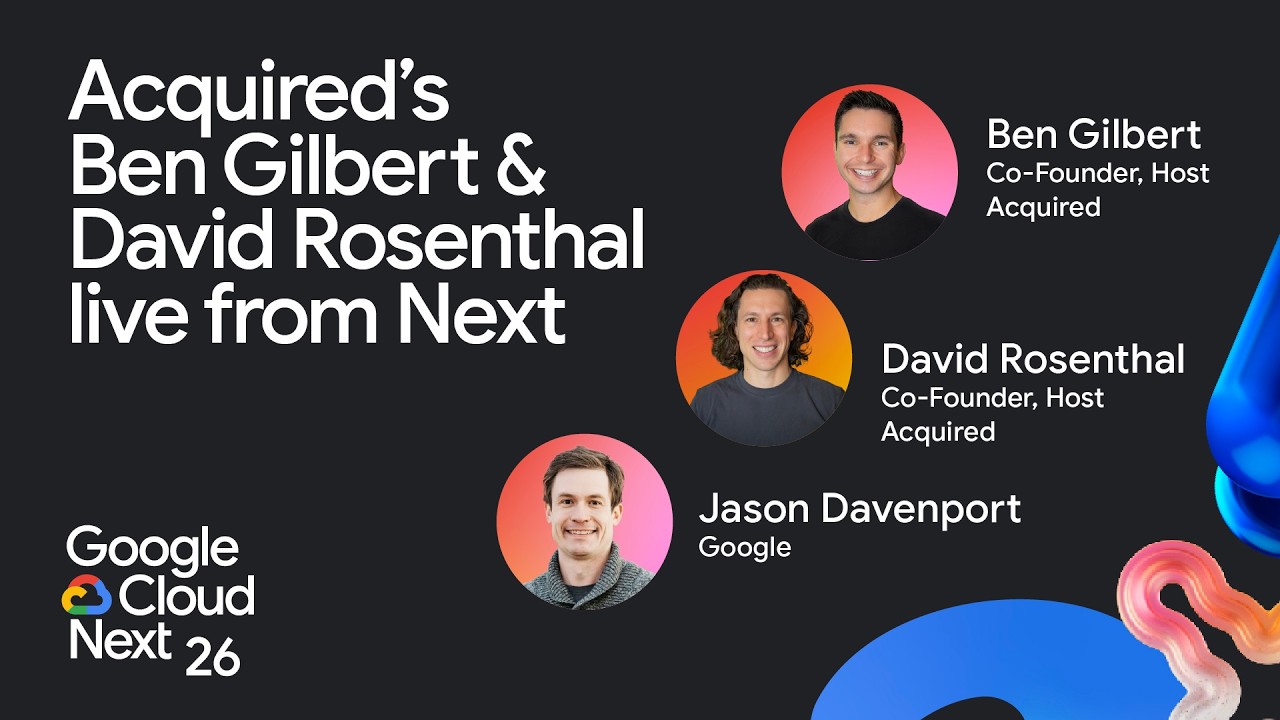
At Google Cloud Next, Acquired podcast hosts Ben Gilbert and David Rosenthal offered a compelling analysis of Google's AI advancements and the dramatic evolution of its cloud division. Their insights highlighted a pivotal moment for artificial intelligence, marked by significant hardware innovations and strategic enterprise shifts.
A key takeaway from the conference, according to Gilbert, was the introduction of TPU V8, featuring a dedicated split between training and inference chips. This architectural change underscores a fundamental shift in the AI landscape, where inference workloads are now eclipsing training in volume. Rosenthal emphasized that this trend validates the real-world value AI is delivering, moving beyond mere hype to tangible revenue generation and operational efficiency.
The discussion also delved into the rapid pace of AI adoption, which Gilbert and Rosenthal likened to the internet's growth, but on a significantly compressed timeline. Unlike the internet, which primarily focused on creating new business models, AI is immediately driving enterprise adoption through massive cost efficiencies, as exemplified by advanced customer service solutions. However, they noted that the biggest barrier to widespread AI integration remains the lack of 'muscle memory' and intuitive user interfaces for agentic AI applications.
Google Cloud's remarkable transformation under Thomas Kurian was another central theme. Gilbert recounted a Harvard Business School case study detailing Kurian's audacious decision to scale Google Cloud's sales force by a thousandfold, a move that fundamentally reshaped the organization from a developer-centric model to a customer-focused enterprise powerhouse. This strategic pivot, combined with Google's unique advantage of integrating its own chips, cloud infrastructure, and AI models, positions Google Cloud as a formidable player in the hyperscaler market.
Looking ahead, the duo expressed excitement for the 5x speedup in inference time with TPU V8, predicting a future where AI tasks feel synchronous rather than asynchronous, unlocking unforeseen applications. They also highlighted the burgeoning potential of real-time voice AI and the increasing integration of AI into everyday tools like Google Workspace, where Gemini is already learning user writing styles and generating complex content with surprising accuracy.
“Google's the only company that has a chip, a cloud, and a model. All integrated.”
- Jason Davenport, Host, Google Cloud