Unleash AI's Full Power: Snowflake's Radical Platform Overhaul!
Snowflake's 2026 Summit keynote delivered a powerful vision for the future of data and AI, focusing on transforming the 'agentic enterprise.' Co-founder Benoît Drouville and EVP of Product Christian highlighted a suite of innovations designed to break down data silos, amplify creativity, and accelerate progress by seamlessly integrating AI into every facet of the data cloud.
“Snowflake takes you from the era of can we to shall we. And my ask of all of you is to dream about what you want to accomplish. And with Snowflake, you can make it happen.”
- Benoit Dageville, Co-founder and Chief Architect
Discover how Snowflake is revolutionizing data management with AI, breaking down silos, and accelerating innovation. Learn about the new tools and architectural advancements powering the agentic enterprise.
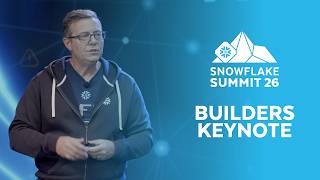
good morning. Wow. Good morning. What you just saw wasn't magic. It was Cortex Code collaborating with R Tyler, our live coding GJ. A few years ago. Yeah. A few years ago that would have felt like science fiction. Today that magic is reality and it's exactly what we are here to talk about. Turning your ideas to production and doing that fast. As Shria explained yesterday, the agentic enterprise is the ultimate path to get there. I now want to dive into the architectural foundation that makes this entire vision possible. Back in 2012, microphone and I knew that
working with data was fundamentally broken and it really came down to two reasons. First, data was siloed. structured data was tried trapped in traditional data warehouses while semistructured data was relegated to Adoop systems and to make the matter worse neither could scale beyond one single cluster the moment you run out of capacity you had to spin up a separate system creating yet another silo second because data was scattered maintaining a consistent security and governance was a near impossible task. Plus, this legacy system were inherently complex, buried in endless performance knobs that requires an army of specialists to tune. With Snowflake, we set out to fix this by creating one fully go platform built on three foundational um principles.
First, all data. We engineer a system that could seamlessly equate structured and semistructured data together, effectively unifying data warehouse and big data system with unprecedented performance at multipetabyte scale. Next, all compute. By pioneering a revolutionary architecture that decouples compute from storage, we completely eliminated workload interference and redefined the economics. And the math is simple. Basically, scaling your compute by say 10x delivers nearlinear performance gains without increasing the cost. And finally, all users. We deliver a zero maintenance, fully managed service that simply works for everyone. In 2016, we published our architecture at Sigmod, the premier conference for data management. This year that paper received a test of time award and it's really a validation that the founding principle continues to shape today's modern data cloud data systems and if you think about it this paper was
a milestone but it was really only the beginning of our journey. For over a decade, we have remained relentless in pursuing this original goal. Basically breaking down silos and eliminating every underlying reason for them to exist. And he started by breaking down geographic boundaries. We went global making snowflake crosscloud and cross region so that you ne your data is never trapped by a cloud provider or a physical location. From there we enable frictionless data sharing. We built a global data network and marketplace where collaborating with external data is just as seamless as working with your own data. Then we embrace Apache ice bed and this ensure full interoperability and unified governance for your entire data estate even when that data lives in open formats outside of Snowflake. And finally, we expanded to unstructured data. Thanks to AI, documents, audio, images, and even videos are now native citizens of the Snowflake platform, living seamlessly alongside structured and semistructured data.
But data is only half of the story. Even if your data is perfectly unified, silos will still creep in if your platform can't support a broad range of spectrum uh broad spectrum of workloads. So we expanded our compute capabilities in several ways. One, by breaking language boundaries, we introduced NOPA to complement SQL, giving Python, Java, Scala developers full access to the platform with the exact same performance and governance. Two, by unifying transactional and analytical workload, we build Unisto and Snowflake Posgress right into the platform. So you no longer need separate operational databases. and free by fully hosting applications. With Snowpack container services, you can now run any containerized application or even complex AI workloads directly inside the platform right next to your data.
Bringing all data, all workloads and all users together under one unified governance model was a massive expansion. And through all of it, we doubled down on making it as easy as possible to use. But we didn't stop there. As I mentioned, we have now entered the era of the agentic enterprise. And to thrive in this new era, you really need two things. First, the foundation. First, the foundation. The world best AI agents must be powered by the world best data platform. Second, you need a unified architecture. Both AI and data must live on a single integrated platform. building an isolated AI stack. Repeat the exact same mistakes we talked about earlier. Basically recreating silos, fracturing your governance and driving up cost and complexity. What's more, having a platform unifying AI and data unlocks the ultimate flywheel. Your data makes your AI platform incredibly smart, which in turns make your entire data platform faster, simpler, and infinitely productive. By uniting AI and data, the Snowflake AI data cloud delivers the ideal foundation to power your agentic enterprise. Now to show you how all this magic comes together, I want to conjure up our executive vice presidents of product Christian. Please appear. That's better. Thank you for being with us today. Super, super excited to see you all. Many of you know me. It is true. Snowflake Summit is my favorite week of the year. I was running up a little bit earlier. Uh it is my favorite time of the year. We get to reconnect. We get to share with you the innovations that we've been making and we get to learn from one another. We get to see the cool things all of you are building with Snowflake. And I want to start with a quote today.
This quote is older than I am. And that's a lot. Any sufficiently advanced technology is indistinguishable from magic. And I've been saying this for years because when you see a great product, it's magical. And we all live in a time where this seems to be true almost every week in some new way. It's exciting times. AI is changing what is possible for all of us and is expanding the opportunities for all of us to innovate and us at Snowflake are surely innovating. Hopefully all of you see the pace at which we're going because we love building technology to help all of you be more productive and help your organizations be more successful. We do hundreds of launches every quarter and we keep picking up speed. We innovate with AI. We're leveraging AI ourselves, but we're also innovating to help all of you get the benefit of AI. We have a number of Snowflake members, engineering team, product team here. Many of them are watching online. I want all of you to give it up for the Snowflake product development team. Thank you to everyone. And among all that innovation, two products have sto stood out in the last 6 12 months. Shrier talked about it. Ben mentioned snowflake intelligence and snowflake cortex code. The instantiation of that control plane that helps all of you and everyone in your organization be more productive. When we introduced cortex code very quickly many of you started saying oh coco and you hear us even saying coco. So Denise who is here said ah we should just be done with the cortex code. How about we just call it koku. What do you all think? Good. >> Yeah. >> Yeah. So from here on no more cortex code. It is officially snowflake coco. And throughout the rest of the conference is coco. And then snowflake intelligence seemed to be standing out. So we're like, okay, the scope of snowflake intelligence is so much broader than when we started. It's changing how we work. So we're also renaming it to Snowflake Co-work. >> Yeah, I'm gonna cover a ton of innovation and I left a ton out. That's how much there is going on at the conference. So, I want you to at least remember one thing when we're done. We want you to rethink what is possible. The art of the possible is changing. And I want you to know that Snowflake will help you empower everyone in your organization, everyone to leverage AI to be more productive with the context of your company with a peace of mind on governance and security. And our goal for the next hour or so is to showcase, share with you some of the latest innovations that we have and give you evidence that we help you leverage AI again with security and compliance in mind. And we're going to do this in four acts. So let's get started.
So, it's no secret we all live in a very complex world and complexity in any dimension you look at it there's a lot going on data technologies new systems new models AI keeps evolving and what Benuan tierry set out to do and we continue to do to this day is focus on making the complex easy when we talk about snowflake ease of use we truly mean it we want all of you to focus on adding value to your organization not wrestling with the technology And in the last six plus months, we've seen a massive inflection on ease of use. Anyone knows what has changed ease of use for Snowflake and for data management? Okay, someone said Coco maybe unsolicited advice. When you're not sure, the answer is Coco and then you think about the question in any context. So yeah, it's true. Coco is truly changing how we think about Snowflake, the surface area, and how you're more productive and more agile at getting things done. And it's crazy that we all talk about Koko, which has been around for just over six months. And here you see a timeline of the evolution and the pace of improvement of Koko. started with CLI and a snowside experience. Had knowledge about Snowflake and we expanded it to Airflow, DVT, Spark, other concepts, MCP, ACP. We did an SDK agent teams and of course at Snowfllex Summit, we will continue to show you improvements in Koko. So today at at the conference we're announcing cloud agents almost in general availability and what this lets you do is for snowside you have a sandbox in the back that lets you run commands. So a lot of the power that you see in the CLI now it's available in Snowside. Similar we're introducing a sandbox for the local development environment for CLI. We're introducing automations and the ability to have autonomous agents through scheduled operations through async APIs and we're introducing a skill catalog that lets you share skills and plugins discover them and reuse and that also works with snowwork. And I want to acknowledge a number of partners that are leveraging Koko to help many of your organizations achieve results faster. If your company is here in the the screen, thank you. If your company's not on this the screen, let's get going. Coco is going to help you. And Koko has transformed the entire life cycle of what we do. You've seen this schematic. I've shown it before. It's have simplified data sources, processing and consumption. And I'm going to walk you quickly left to right through some of the innovations that we're producing and many of them come with just Coco at the forefront. Let's start with what we're doing on on sources. A year ago here at Snowflake Summit, we introduced Snowflake OpenFlow, a way to manage service to do data integration, structured and unstructured data. We're launching at at summit an APIs and programmatic way object model to program uh open flow. Why do you think we did that? Koko I said told you Koko is the answer. We're also many of you told us you want private connectivity. We're introducing a data connectivity proxy to have private connectivity to openflow and we keep adding additional connectors. the Oracle connectors, GA, Viva, Shopify. Many of these are now part of OpenFlow, but sometimes you don't want to ingest data that already landed somewhere else. Someone sometimes you want to capture it up front. Many of you I I I know from talking to many of you have complemented Snowflake with a streaming solution, most commonly Kafka. And probably some of the names that are on the screen you say, "Oh yeah, I deal with all of that." So we said, you know what, we want to
help you capture events upstream but not deal with all of this complexity. And that's what today I am very excited to introduce to all of you Snowflake Data Stream. What is Snowflake Data Stream? a fully managed streaming service built directly into Snowflake in true Snowflake fashion. Has a separation of storage and compute. It does zero copy streaming which lets you stream data to and from Snowflake with sub-second latency. Most important is CFKA wire compatible. So all your clients and applications can stream into data stream directly. And of course we have unified streaming analy analytics where you can uh instantiate a topic into a snowflake table. This will be in private preview shortly. But also AI has changed how we think
about migrations. We've now unified all of our migration efforts under this term AIM AI powered migrations. And if you still have a number of legacy database platforms and you want to move on to Snowflake, Koko and the tools that we have help you go faster. If you have Spark workloads, you want to move them. KCO AIM help you move it faster. I just heard a story of someone took some RDD code, moved it to Snowflake, and it was like five times faster. And for those of you still waiting on when do you move off of a terod data system, we've introduced virtualization where you can move your workload still be terod data SQL and BTE compliant move it get the benefits of Snowflake and then later on you convert whenever you want. But we also keep looking at how do we improve the processing phase of this life cycle. And often times when we talk about unstructured data. The first answer that we think of is AI functions. This is probably one of the most common ways where many of you are leveraging AI in the context of data. We're also adding additional capabilities. For example, AI complete now takes audio and video as inputs and lets you reason and think through all of those. The number of use cases, sentiment, classification, all of that keeps compounding. And today we're introducing the public preview of something called Cortex Function Studio that lets you create your own AI functions where you can specialize it. You can create create a function eval do evaluand control of what AI operations users of your platform do. your platform do. One of the key things out of AI functions is AI complete which is how do you interface with models and one of the first parameters or actually the first parameter it's a model and our commitment to all of you and said it yesterday is to always have the latest and greatest models available in snowflake. We want to make sure that you have choice when it comes to models. If
tomorrow something else is better our commitment will bring it. And that's why I am really excited that we're bringing SpaceX's AI models available into Cortex. Yeah, I don't know if you're following all the different leaderboards, benchmarks, evals out there, but these models are making really good progress and they're quite compelling both from a price and a performance perspective. We're very excited about the collaboration between Snowflake and SpaceX. And this went into private preview as of yesterday. We're also announcing a public preview of something we call agentic search. And I think of it as something super cool, which is is the best of unstructured world. Unstructured world and structured world. What this lets you do is ask questions via snow intelligence cowork and or or cortex agents but ask questions that require precise analytical answers. Imagine saying how many contracts are dated in 2025. You see three examples also on the screen. And what agentic search lets you do is instead of doing the rag which just give you a top k type of result. It will leverage AI functions extract the information from the unstructured data put it in structure form run analytical query and give you precise analytical results from unstructured data. This in public preview very excited.
Any of you ever had a Python file that you developed elsewhere and you want to bring it onto Snowflake and you want to just run it in Snowflake? If you've done it, I'll guarantee you you've encountered friction. You had to wrap it, copy paste, you put in a sort of procedure permissions. So today we're also introducing code bundles, a simple concept. take code Python or Java and deploy it and run it in Snowflake directly from the file that you have. No wrappers, no copy paste. You can just execute SQL directly or execute the code directly or schedule the operation. And as I mentioned, this is now in public preview. Some of you may may say someone liked it. Good. You deserve a t-shirt. I I don't have anything to give, but you deserve a t-shirt. Some of you may be thinking, oh yeah, Snowflake never got into this ML thing and machine learning. The reality is we have a full stack offline, online, whatever you want to do with machine learning. Snowflake is there for you and the results are amazing. Our training APIs two times faster, three times cheaper than let's call it other platforms. And guess who has skills that makes all machine learning easier? Now you know, right? Coco. But we're also announcing new innovations for machine learning. Today we're introducing Cortex training, which lets you customize and train foundation models and do fully managed experience for fine-tuning or reinforcement learning. We're also introducing extensions to VS Code and cursor if that happens to be your preferred development tool. We're also announcing the G generally available streaming features so you can do serving featur serving feature vectors in real time as low latency as you need it tens of milliseconds. And last but not least, we're helping you safely evaluate new models through the introduction of online AB testing. We can do control experiment experiments diverse traffic eval and if you like it deploy it. Now in terms of transformation how many of you have been wanting snowflake to add a visual pipeline editor? No one. No one. Okay JB I'm we built it for JV and for someone that's a woo back there. We're also introducing a new project
type in Snowside which we call it Snowside pipeline builder and what you see is exactly what you get. Yeah. Yeah. Yeah. I'm sure you want it even though you didn't understand my words visual representation and editing of pipelines. You can make changes. You can bootstrap it from a notebook from an MML package and you can see errors, make changes. And this is in prior preview. We'll roll it out soon as soon as we get some validation. And last piece on the consumption part of the life cycle. Of course, the marquee way to consume data is co-work. And we'll talk more about it in a second, but for now, Streamlit is a framework that makes you uh so much more powerful relative to your organization. You can have build beautiful data experiences. We have 1.7 million de monthly active developers on streaml and gaining momentum and we're announcing the general availability of streamlid hosted in snowflake through a new integration. It gives you workspaces integration git integration runs in containers faster cheaper and you can just build amazing amazing experience on data. But if you want a little bit more control someone liked it. If you want more control, some of you said, "Oh, Streamlit is good, but I want just my own code, my own React app." So, we are introducing a Snowflake app runtime. It's in public preview at Summit. It lets you run NodeJS, very soon, Python, which means you can run a full React application. And once you've built it, the easiest way to deploy it is yes, Koko can help you. We also have a oneline command as part of the Snowflake CLI. You can just do snow app deploy and we take care of every single detail. We're also introducing something we call snap and ask, which is a way to visually give context to Koko and ask questions about it. I'll show it to you in a second. All in all, we're trying to look at the entire life cycle of data and with the help of AI helping all of you be more productive. But some of you said, I also use AI in
other form factors and I want to make sure I can get the value of Koko. So, we're introducing a number of new form factors for this. A new Koko plugin for Excel, an extension for VS Code, and in the marketplace of Cloud Code. And last but not least, what if you could have the power of Coco in the CLI with the usability and excitement of Coco in Snowite? And that's why today we're introducing Koko for desktop generally available today. And I'm not going to say anything else. I want you all to see it. You want to see a demo? >> So, okay. So, Dash is here behind me.
He's going to show you some of the technology we just talked about. Take it away, Dash. >> Awesome. Thank you, Christian. Thank you so much for being here. Who's excited to see some live demos? >> Come on, let's go. Awesome. So our demos today will focus on a fictional company called Snow Music. Now they operate live tour operations and also high traffic applications. Now my first demo is going to focus on data engineers and app developers who is excited even more now. Let's go. Come on. Awesome. So let's get started. So what you see here is Koko desktop application. Here I can click on this button to build an app, create a skill or I can also actually type a custom prompt for it to build out a plan for my application. Now in the interest of time I have already built the application. So let's go ahead and look at the deployed application built by KCO. Here we go. So you will see there's four uh cards at the very top. This is a live streaming application. You will see there is some data coming in and I want to have Koko fix this data pipeline for us. Okay. So I'm going to open this panel on the right hand side, my right hand side. I'm going to paste the prompt. All I'm asking it to do is basically see what's wrong and help me fix it using natural language. This is amazing. You will see the data is flowing in. Koko is trying to figure out what exactly is the problem here. You will look at existing tasks. Are they suspended? Are there any columns missing? If you look at my prompt is very generic. Now, while Koko is cooking, yes, I just made that up. While Coco is cooking, let's look at where the data is coming from. So, data is being streamed live using data stream and also inserted into an iceberg table. Now, that data is joined with Salesforce using Salesforce zero copy data connector. All of that happening right in front of us. And you'll see on the right hand side it's figured out that there is device type missing in one of the tasks. It's already altered the task and it's trying to verify what else can it do to fix the pipeline for us. Now let's go ahead and also look at couple of other things down below. You will see that there is a selection uh a selector if you will for selecting different models. What I've chosen is auto, but depending on your use cases, you can select one from the dropdown. Now, let's go ahead and see what Koko is cooking. It's asking me to run some of these commands. It's uh it's doing it so that destructive commands are not executed automatically. It requires user permission before it can move forward. So, let's go ahead and see what else is going to run. While Coco is cooking, I'm going to show you where the data is coming from. This is a direct share that's streaming the data from Salesforce zero copy connector. These are the tables that are being joined live. Fan profiles and ticket history. These are coming from Salesforce zerocopy data connector. Now the task has executed successfully. I believe it's diagnosed and fixed the problem. We will see that the cards will actually flip green here in just a second. If not, I can always verify the data pipeline. Go ahead and click that and let's see what Koko does in addition to what we already asked it to do. Now, Christian mentioned that there's a cool feature called snap and ask. I'm going to show you next. But let's wait while Koko is cooking and I will show you on the desktop app to see what the plan it's built out. Here you will see every single step is laid out as part of the plan using KCO desktop. Now I can either go ahead and edit the plan or also click on build where it will start building the application very similar to what we just saw in uh in Snowside. Let's go back and identify lowest row count, no data loss. Let me go ahead and just refresh here really quick and see what it has done now. So there are two things in common between AI and dash decai. My last name has AI and Dash and AI can both make mistakes. Okay, now I want to show you something really cool. Now I'm going to go ahead and say please fix the cards. Now while Koko is cooking, I want to wrap up what we just saw. Okay, app developers and data engineers can use Coco from either Snowside or also from Coco desktop application. We saw live streaming events being populated uh along with Salesforce data and we also saw how Koko does not run any destructive commands without user giving permission. I think that's all the time I have right now. Back to you Christian. I hope you think it's cool. Okay, so recap what we've seen so far. We are in the friction elimination business. If in anything you do, you encounter friction and you want us to help you, find any of us, we truly see all of that as opportunity to help all of you. Let's move on.
Daniela and Street spoke yesterday about trust and trust is probably one of the most important things in what we do. Your companies trust you. your trust snowflake and trust is something that takes some time to build. It expects consistency on a number of fronts. Security of course, consistency of performance, observability, cause governance, business continuity. So let's see what we're doing to continue to further that trust. And for us, trust and governance comes together through the Horizon catalog. It's a built-in universal governance solution. And you're going to get tired of this, but there's a lot of skills in Koko that help you manage governance dramatically easier than you've been done been doing in the past. Today we're also introducing the concept of intentdriven governance which is again AI and Koko driven but you can say take all the PII data in my database and make sure that it is protected and this will trigger classification find out what's PII data create the right policies and make sure that it continues to be well governed all the time. So you express the intent, we take care of the details. It's not just governance, it's also security. And in the era of agents, we want to make sure all of you can secure your agents and you have multiple levels of protection and of course built-in security so that you can make sure that you can sleep well at night. We introduced earlier in the year Horizon AI guard rails which is protections into both cocoa and co-work to prevent high risk threats jailbreaking or prompt injection type of attacks and this is built in detecting zero day attacks. It gives you some policy some control but we want to make sure that you all are protected. Today we're also introducing the concept of agent identity. So you can tell when some piece of code or some activity in snowflake is happening under an agent context for and we give you a a context function what you see here. So for example in a masking policy or in a row policy you can say if it is an agentic context maybe you give it less visibility or maybe you give it more whatever you want to do but we want to give you that control over what agents are doing. We're also introducing data movement policies. So you can say this data that has this tag shall not move to a stage internal or external or shall not be downloaded in the snowside UI. You are in control. Policies are to help you be in control of what you want AI and agents to do. We also have a detection package in Trust Center in public review now that helps you monitor unusual data transfers because we all want to know is data moving outside of my secure perimeter. A few months ago, we introduced the concept of backups as a way to create an immutable point in time snapshot of I don't know an object, a schema, database. And we introduced the concept of a retention lock which makes it impossible to delete. Not even an account admin can delete it. Why is that useful useful? Part of a cyber resiliency strategy part of an anti- RAM ransomware. Today we're also introducing multi-party approvals where for certain highly sensitive operations, you decide which ones you can require a mandatory second person verification. So even a a a rogue insider admin or an agent trying to change something cannot make highly sensitive operations like disable MFA from everyone. It cannot be done without two administrators in the system agree on this. this in private preview now and we're adding a number of AI security checks to trust center to enable all of you to check for what we consider best practices in both the configuration of agents and the configuration of AI. But you may have heard from us and from others that what really makes AI work especially in the enterprise context is exactly that understanding your data understanding context. And that's why today we're introducing Horizon context.
Intelligence alone is not enough. And oftentimes what you really miss is that context. And what Horizon context does is is the part of Horizon is not a different technology. It's just a part of Horizon uh catalog that helps collect signals, enrich those signals and make them available to Cocoa, Co-work or Cortex agents for you to get more context and more semantic information. A lot of what we we've been doing in semantic views continues to move forward and it's part of Horizon context. We keep innovating. I think the team has done dozens of launches on improving the expressive power of semantic views. And we're also introducing a number of metadata connectors that become part of Horizon context where you can get context from BI tools, data transformation tools or other databases. All in all, Horizon is the place where we innovate to help you govern your data and govern what AI does. But I can talk about governance and trust a lot. What I think is way way more uh visceral if you hear it directly from one of our customers uh from Tom
Reuters, probably one one of the companies that has some of the most stringent regulatory requirements. Please join me in welcoming Kaitlyn Hufferty. Kaylin, welcome. >> Thank you for being here. Welcome to Snow Snowflake Summit. Snow Snowflake Summit. >> Thank you for having me. Great to see everyone. >> Okay, so correct and trust is a big deal for you. I think you're trying to build this fiduciary grade standard. Tell us more about it. >> Absolutely. So at Thompson Reuters, we serve our customers are lawyers, tax, accounting, audit professionals. So as you can imagine, uh their name and reputation is on the line. They can't be wrong. So we uh they carry professional liability in every decision that we make. And so we build our products and services to uh hit that bar of trust. Uh there's an acronym I like to use. You're welcome to take it back with you. Win. What's important now? And for us, I think about it as keep our data and our products safe. um invest heavily in innovation and M&A activity and just really make TR a fantastic and great place to work. Um maybe like some many of you we're builders. So as you said Christian we build to a fiduciary standard and by that we mean there's the content there's a commitment to data privacy and security there's enlisting the help of all of our subject matter expertise uh uh leveraging our expertise and then there's making sure that our output is transparent and we can validate uh that piece of work. So co-consel is our flagship AI capability and we have more than a million professionals using it in their day-to-day work every day. >> So some people think of governance as a constraint, something that holds you back and you told me something cool that governance is an enabler. Tell us more. >> That's right. That's right. Governance for us has uh enabled us to derisk and accelerate our AI transformation both internally and externally. So this fiduciary grade standard that we deliver to must be built on a trusted data foundation and we've really leveraged our partnership with with Snowflake and are our uh very appreciative of that. Things like our centralized access controls, our curated content and data sets um really enable us to to build with with speed and scale. One um one initiative that we've been focused on is our semantic intelligence. So for anyone else who's building out semantic, I'd love to talk. It's been an incredible opportunity to really take uh business intelligence across all of our data for the firm. We have more than 1,500 internal users across our finance and business communities and they're using it for all our most critical business and financial decisions every day. Um and that's been an incredible initiative for us and a reflection of our partnership. H >> how does tell tell us how does Snowflake help you rolling out and leveraging AI throughout your organization? Yes. So, Snowflake's really given us what we've needed, which is the governed, consistent, curated data. Uh, the foundation on which we're building um both our internal data and AI capabilities and products and the way in which we um we ship our AI capabilities to market. So, we've been able to pull across many different data sources. For us, it's Reuters news, business, product, marketing, financials, HR data. really pull that together inclusive of structured and unstructured data data with the right governance and access controls in place. Um, and it's it's really enabled us to move forward with speed. >> You said you're a builder and you're building some apps. Can can you say more about those applications? >> Yeah, absolutely. So 26 is year of uh customer obsession for us and we're fortunate in that we have some longstanding really loyal customers that have been with us for a long time. We also know it's an incredibly competitive environment out there. Uh there's competitive threats at every turn and so we have to do better to continue to deliver exceptional customer experience. One example is we've pulled together our product usage data along with customer sentiment, billing collection renewals. So we have this real uh holistic customer 360 experience. We're able to do alerting uh campaigns, grow a digital business and really activate that enriched customer experience. So it's been incredible example of what we've been able to deliver for the business. And super briefly, Fred mentioned we want to help people put AI in production. Your AI is not a demo or a trial. It's production. Right. >> Right. And and and maybe that's what's different uh than some is we've moved beyond pilot to production. This is uh finance validated metrics embedded in our key workflows. And one of the ways in which we ensure that we meet this fiduciary grade standard is we have responsible AI. Uh so every AI capability before it integrates into market into product and ships to market runs through this process. So it's another way in which we um ensure the responsible AI threaded uh throughout throughout our work. >> Kaylin, thank you so much for being at Summit. Give it up for Caitlyn. >> Thank you. Thank you. >> Thank you.
Last year at Snowflake Summit, we introduced adaptive computes as the next generation compute paradigm for Snowflake where we figure out what is this right amount of resources and it varies depending on workloads. Since last year, two things have happened. One, we put a ton of performance innovation and enhancements into adaptive compute. you see on the screen some of the benefits you can expect. I've learned to always caveat that mileage varies, but roughly a mental model is adaptive compute is roughly twice as fast as the original warehouse generation one warehouses. And the second thing is we're super excited about bringing adaptive comput now into general availability rolling out soon. We also introduced not long ago snowflake posgress most popular open source database out there. It went general availability in February and we've been busy innovating. We added private link support or customer manage keys or try secret secure because we want to make sure that a lot of the safety and capabilities that you known Snowflake for are available in snowflake postress. Earlier this year we introduced PG lake or we open source an extension that helps synchronize data from Postgress into an open lake interoperable lake. We've now taken that extension we put it part of the service. So there's a managed version of PGA and this will be going out GA later this year. Today we're also introducing Post data mirroring which you can say okay PG is more powerful. You can move things with a lot more flexibility. But if you just want to mirror a table from Postgress into Snowflake, you just flip a switch, you turn on mirroring, you get Snowflake to do all the heavy lifting, the change data capture, the synchronizing on the other side, very low latency, and this is going to public preview.
We also have introduced the concept of interactive interactive workloads which come to life with interactive tables running on interactive warehouses and again the innovation is not stopping here. We're changing the the size of the cluster and key which brings a massive performance boost for most use cases. We're doing pre-caching and in case it's not clear that everything these days gets simpler and easier via Koko, we have a number of skills that helps you with optimization, clustering, key selection, and so on. But that was not enough. Aided by AI, today we're we're very very excited to share with you the introduction of a new interactive compiler, which is a new query compiler for Snowflake. If you are familiar with how we run queries, we first spend some time compiling this does some time executing it. It's more memory efficient. And again with disclaimers on absolute performance but early workloads that we did with one of our largest customers shows a 40 times 40x faster compile time which roughly accelerates this customer's workload by 3 to 4x. The engineer in building the engineer building this told me with this interactive compiler hopefully you'll never have to think about compile time in Snowflake again. Does that sound cool? >> And because we want to share with you all of these performance enhancements, Unisto is not left behind. We're introducing a massive new engine optimization that improves latency and throughput by roughly 8x and you see a schematic on if you tried hybrid tables in the past you should retire because it's gotten materially better. This is also in public preview now and if you have not this may be a good chance for you to go and try it. Yeah.
Also earlier this year, we completed the acquisition of Observe, a platform that combines logs, application performance monitoring, and infrastructure monitoring all into a snowflake native solution. And it has a very competitive cost structure. And of course, we keep innovating, we keep making it better. Observe has now introduced a CLI. Anyone can guess why even though the penguin is giving it away. >> Coco. Okay, the front line knows Coco. So yes, we're we're introducing a much simpler experience for observe for you to configure for triage, investigate alerts, anything you need to do in observability all through a Coco interface or a command line interface. And also we've done the work to support observe on snowflake iceberg tables. Now, let me switch to something that I know creates or erodess trust and is important to all of you and it's cost governance. I've said it. Yay. I've said it many times. We do not want any of you spending money with Snowflake in any use case if you're not getting more value in return. And we're Yeah. Yeah. Yeah. And we're committed to giving you full visibility, controls, and optimizations to make sure that your spend is all efficient. AI cost controls. Many of you told us, make sure that everything you've done with budgets works and your wishes are command. AI works with budgets as you would expect. We're introducing per user quotas. We're introducing the capability to do cost governance on a shared warehouse if you have different departments or different users. And we're introducing budget custom action so you can invoke a store procedure or perform some activity when some threshold is reached. And last but not least in this section of trust,
I want to talk about business continuity. I'll challenge anyone to say we have the best solution in the industry for uh business continuity. When there was an outage from from the cloud providers last year, over 300 workloads fail over and there was nothing to see here. Business kept going. And today we're introducing the next generation of account replication. It uses logs and you see the numbers is roughly 20 times faster. It gives it the opportunity to offer you an SLA backed RPO assurance which is we stand behind the latency and the data. uh gap on a failover because of the performance in hand that we've seen. Is that cool? And this is a good time to get Dash to show you the next demo. Give it up for Dash. >> Thank you, Christian.
Okay, so before I move on to the second demo, I want to show you what Koko was cooking while I was gone. So, let's go ahead and see what happened uh to our pipeline that we asked it to fix before. So, let's go ahead and look at the screen again. You'll see that the cards have been flipped green. What do you guys think? >> Pretty cool. And look at the root cause. It actually figured out that there was a device type, one of the columns that was missing, one of the tables, and it it diagnosed and actually fixed it. Now, I want to show you one of the coolest things you're going to see today that uh even Christian mentioned earlier. Snap and ask. Okay. So, I'm going to go ahead and refresh this page and we'll see that there's going to be a chart hopefully here. Engagement chart. What I can do here is drag this section and click on explain. This is going to give Koko context into what I'm asking it and will give us uh deep insights into what exactly is causing this drop in engagement. Pretty amazing. Yes, it's pretty awesome. One of the coolest things you're going to see today. Now, let's move on to demo two and let's have Coco cook for now. So, for that, I'm going to switch my tabs. This is co-work. Christian just introduced this. And what I'm going to show you here is how we can leverage data movement policy, masking policies, and agent identity right at the agent layer. So, as a tour ops employee, what I'm going to do is ask co-work to export or get me a list of VIPs with their contact information. Now, I'm not allowed to access this information. So even though agent has the u ability to look at the table, it's not going to actually be able to give me the values that I'm looking for. For example, contact information for each of the VIPs. We'll see when the data comes back, either it's going to be masked or it's going to say I can't provide that information. That is pretty amazing. Now, how do you actually set up uh DMPS for example uh data movement policy and agent identity? These are first class snowflake objects just like as you would create a database or a table in your account. So here you'll see that I have some create statements and I can also actually look at all the DMP violations right here or also as a security officer you can look at trust center where you have a holistic view of everything that's happening within this account through horizon catalog and trust center. Here you'll see violations, manage scanners. Now these are constantly looking for things that it can help you either fix or remediate. Data security and AI security. This is where as a security officer you have a holistic view of who created which agents, what kind of security scanners have been enabled. And AI guardrails is one of the top things that security officer would look for. Basically, it's going to in runtime protect against prompt injection. Thank you. Let's go back to cowwork and see what it did. So here it said that I have all this columns in in the data in the table, but it's not able to actually give me actual values because of the policies put in place. Now let me also ask to export the data. So as a torups employee I'm asking it to export the data to an external stage. Now again data movement policy will stop this data exploitation and we'll see that here in just a second. Even if I expand this, you'll you look at the actual thinking behind this and then we'll see that it will run into a data movement policy down below that that many records are in here. And there's a failure. Thank you. This is a real failure, not a user error or not an AI error. Uh and here you'll see that it's being blocked by data movement policy. Pretty sweet. Thank you. Thank you. Okay, so let me wrap up. What we just saw is pretty amazing things that a security officer is able to do using either trust center and also apply these data movement policies, agent identity at the agent layer and that trickles down all the way to where your data lives in Snowflake. With that, I'm going to hand it back to Christian. Thank you. >> Thank you, Dash. Okay, TLDDR of this section. We work very hard to earn and maintain your trust and we will continue to innovate to make sure you get the best of AI but with security and governance at heart. Let's keep going.
If you think from the very beginning of Snowflake when we were like we want to tear down silos, a lot of silos have been created just because technology made us do it, not because anyone woke up and said, "I feel like creating a new silo." Right? So, we have a number of vectors of innovation to make sure that you get access to the data that you need, people in your organization get access to the data you need, and AI and agents get access to the data that they need. First in the topic of interoperability, we are as committed as anyone can be in making sure that nobody feels locked in with Snowflake and we are at the forefront of investing for and implementing the Apache iceberg spec. We have the broadest implementation of the V3 spec and we're working to shape the V4 specification. We've also taken the iceberg rest catalog interfaces from Apache polaris folded them into the horizon catalog and I think we are the only vendor that has full birectional support and interrupt between cataloges engines allowing reads and rights to any data whether it's managed by the snowflake horizon catalog or by an external catalog. And the other piece we've also introduced snowflake managed storage for iceberg tables. It is at summit generally available for both AWS and Azure and is coming shortly for GCP. And we are also committed to the interoperability of semantics. That's why we led the creation of the open semantic interchange group. The number of companies that are signing up to say I want interoperable semantics keeps growing and I want to make make sure everyone knows we're committed to making sure that Snowflake is open and interoperable. Now data sharing we introduced it in the market in 2018 a long time back. Half of you in the room roughly are using data sharing on a regular basis whether it's internally to your organization or across organizations. And we keep investing in what you can share and collaborate with Snowflake. Whether it's semantic views or agents or models, we want to make sure that collaboration is essential. There's no silos at the data, no silos on the business logic. And I think we've addressed every single request that you've had for us over the years at Summit this year. First one, you may have had data listings and you said, "But I want to make sure that they plug in easily to AI to Cortex agents and your wishes are command." At this point, I'm not going to ask you again, but you know who is making it super easy to create a semantic view, create an agent, and update the listing or the data share to say my data is AI ready. Yeah, someone liked it. your guess. When we first introduced sharing, I think a week later, many of you tried to do this, which is you took something that someone had shared to you and you try to reshare it. And those triangles with this little bubble saying, "Ah, you cannot do that happens." And it's a interesting problem, but we're incredibly excited to say now and generally available you can freely reshare data with other people.
And the other thing that all of you were very clear with us, I want to share with someone that doesn't yet see the light on his snowflake and we are introducing what we're calling open sharing. And we're leveraging iceberg and the iceberg rest catalog to share with those public platforms. What this lets you do is effectively take data, make it available to non-stop consumers and through iceberg and the iceberg rest catalog APIs, they become consumers of that data. And it's a way where you see two of the technology we have sharing and interoperability coming together and delivering a great story. This is in public preview now. Okay. And then the other thing you all told us, oh but sharing is only between two parties and it's unidirectional. So today we're happy to introduce multi-party collaboration. As the name implies, multiple parties can now collaborate in a single secure uh environment. What does this mean? You can have different roles in a single environment and you can say I may be someone that contributes data or I may be someone that just does analytics. This starts with our clean room technology but it has been built on the foundation of broader global collaboration. Anyone here from Netflix? I know that's a long shot. Anyone here watches Netflix? So I I mentioned it because they are the forefront of adopting this collaboration technology. They're building clean rooms, collaborating with a number of partners is super cool and all of this is now generally available. The other thing we've been doing and and Freda mentioned it yesterday is zero copy partnerships. There are many application platforms that have important data for you but you want to unsilo it. We started with Salesforce. We've now announced an a partnership with workday with the data cloud. We talked we're introducing at Snowflake IBM what's on X data so you can get mainframe another DB2 data to zero copy with Snowflake and the same thing with Aviva connect if you're using them for industrial data. One of the most requested partnerships we ever got from you was SAP and we're obviously incredibly aligned and excited to say that our integration with them is generally available. And last but not least, sometimes you just have data in other systems and you want to be able to query across from those systems. The key use case that we're focusing on enabling is getting Snowflake co-work to give you all the power of Snowflake and Snowflake AI on data that may sit in Red Shift or Postgress and other sources. And we're enabling the query across
So, I want you to hear from another one of our customers, Under Arour. They're doing amazing things with Snowflake. And for this, I want you to watch the following video. Let's roll the video. At Under Armour, we use the power of sports to expand every playing field. We are obsessed with athletes who strive for more in sports, in life, and in the world. And our mission is to inspire athletes with innovative performance and design solutions they can't live without. I am Patrick D. Roso. I am the chief data and AI officer at ONAM. My responsibility is to really deliver and drive an AI strategy to enable outcomes for the organization globally across the enterprise. The biggest challenge that always showed up was the fragmented data that had always existed. It wasn't until that we actually aligned as a strategy to bring that into one consolidated place so that we had a uniform view, a trusted view way of looking at data. >> The biggest challenges that we faced were the data was unstructured and the attributing wasn't as consistent as it is now. In order to find those insights, you really had to do a lot of manual work with the data in order to find them. So we ended up spending more time pulling the data and less time available to actually use the data for the insights. you really kind of miss the opportunity when a leader or someone was trying to make a decision, their attention and insight is at that very point in time. So if you're missing that opportunity to have the right information, you know, you really lose that momentum. We have a concept that we consider critical to partnership, what we call a monument. What Snowflake was fulfilling for us is this idea that I'm not locked in from a technology perspective, but I am able to grow and scale as technology evolves and grows. After Snowflake, we were able to bring data into our platform much easier. We had a lot of capabilities to enable traditional BI advanced analytics and also share data within our ecosystem at a fraction of the time. So once we got rid of the bottlenecks of really just finding the insights within the data, we were able to move faster with decision-m. We work in a business that's super fast-paced, especially within our direct to consumer business where things are happening sometimes every hour. What conversational AI has really unlocked for our leadership team is they're able to ask that first initial question and then be able to surface like the deeper insight we really should be researching to understand how to drive a decision or an action. Our ability to really innovate at the speed that the technology is moving. The next chapter is important. So, I love what Under Armour is doing, and you saw Patrick on the video, but he also happens to be here at Snowflake Summit. So, why don't we all just welcome Patrick on stage. Patrick, come on. >> Okay. Awesome to have you here. >> Thank you for having me. >> You and I had lunch at Summit a year ago, and you told me you were doing do these crazy things with AI. Uh so tell us a little about the initiatives that you're doing and you trust Snowflake for AI, right? >> Definitely trust Snowflake with AI. We started we've been part of the Snowflake family for seven years. Uh I would say probably five, six years ago is when it transitioned from a transactional relationship to a true partnership and that's what made the difference. That partnership is what enabled us to go beyond the great technology that you all deliver but ultimately uh meeting you or meeting us where we are as a full business. So that's what transitions to our our partners, our our functional business partners, and making sure that they trust what we're doing because we trust what you're doing. As we relate to what we've been doing with that, we've actually been enabling, you saw in the video, all the conversational AI with our functional partners. And there's a concept we call the signal strength. And that signal strength is when we've delivered data, it's gone through a rigorous process that is fully trusted. And if it's trusted, all the things associated with that have been taken care of. And that really starts the foundation of the data. >> Yeah. So we we are very committed to open and interoperability because we want data to be accessible. How does that architecture and those design choices that we make help you and play out for your teams at Under Armor? >> The the key thing with the interoperability is now that they we trust and we've built a platform around our data platform and our data architecture. Our business partners have applications that they want to bring and engage with that data at an enterprise level and we don't al ultimately own that ecosystem. So the fact that we're able to operate with them, leverage things like hybrid tables, dynamic tables, ensuring that we have TT TSS enabled, running at the speeds, the things that you were talking about earlier to make sure performance mets the business needs. Ultimately, that's the outcomes that we're all aiming for and shooting for >> and and what does that enable you to create? What what do you end up with? >> So if you could imagine, we've built uh assistance with uh so you saw the conversational assistant that was done yesterday with Seni. We have a version of that internally for ourselves where our teammates are able to talk chat and engage with our agent that we refer to as ADA to enable and answer questions that they haven't been able to answer quickly on their own by themselves. >> So, one of the things that struck with me, stuck with me last year was you told me, you know what, there's all these SAS apps that I actually I can build something more personalized, more streamlined. How's that going? What's happening? >> So, one of the key things and I and the real takeaway is about partnership. And in that partnership, we were trying to really adopt Agentic capabilities. Elementum really showed up as that a partner of Snowflake really became a partner of ours and that unlocked for us was to really reimagine what transformation looks like to not only just have the data but really to uh repurpose workflows disengage uh just look at applications as just applications but delivering business outcomes. So with that partnership with Elementum and Snowflake, that transition, that trust that our our teammates are looking at us to actually execute on and for sure one of the things that come out of that is as AI gets more evolved and more engaged, the more opportunities to transform workflows, not just adding more data or creating more reports. >> Okay, Patrick, you're at the forefront of the revolution and leveraging AI. We are so proud and happy to partner with you. Thank you for all the the Thank you once again. Thank you. >> Give it up for Patrick. Loud. >> Okay. Take away from this section. We are very committed to helping you on silo data and make sure that Snowflake, your data and semantics are interoperable.
Every time that I think about the times that we're in and I think about what AI is doing, I keep going back to how this datadriven intelligence was not too long ago. Many of you will remember the age of it. you you would ask it for a report or someone some of you may be on the receiving side of those requests and then it takes days or sometimes weeks to produce that report. Then business intelligence comes and truly democratize democratizes access to data and information. But now you think of where we are. It's it's completely mindboggling that we are in a world or in an age of ubiquitous intelligence. Now each of us can have like the power of a data scientist, an analyst, a statistician and you have someone that will follow up on your behalf. All of this at our fingertips and that is what we see with Snowflake who work. We're we're incredibly excited about the opportunity. Our goal is for Snowflake Co-work to help everyone in the organization from the CEO to every single frontline employee. If you're into F1, imagine each person has its own pit crew. If you're into Iron Man, each one has its own Jarvis. And think of the level of optimization and pace of business that that's going to enable. Everything is going to be evidence-based. No more gut feeling decisions. You just have information at your fingertips to make decisions in context. And of course, we continue to innovate for co-work. Last month, we introduce skills, MCP, deep research. If you have not tried deep research with with I keep saying intelligence with co-working the type of insight information you get. We introduced a mobile app. We introduced reusable artifacts and all of it is now generally available. So before I move on to some of the other innovations, I want you to hear from one more of our customers about the impact that Snowflake co-work is having. We have Jung Su from Samsung. Please join me in welcoming Jung. John, come on over. Thank you. >> Okay, welcome to Summit. >> Thank you, Christian. I I'm loving the vibe here. >> No, it's a strong vibe. Show an amazing vibe. >> It's great to be here. >> Okay, Samsung launches flagship devices, the Galaxy S26. And when that happens, a lot happens in your world. Tell us how those launches, how launch day goes. >> It is intense. Uh when we launch a flagship, we are simultaneously tracking massive streams uh streams of data from global market share and uh granular customer segments to online traffic and hourly sales and pricing and customer reviews. The volume we could handle, we've always had volume. The real challenge has been velocity. By the time a traditional analytics team uh surfaces why a conversion is down in a region uh and they come up with a reason why we already missed the window of action. We already lost the attention of our target uh customer audience and we need to move with the launch not behind it. >> Yeah. And this is where AI changed things for you right? Fundamentally, yes. We built what we call the shoppers
inside action Asian also known CIA on Snowflake co-work. The difference is that the Asian doesn't just retrieve data, it reasons uh and acts across it. For example, I can take the data. I can uh ask the Asian to compare the launch performance of Galaxy S26 compare against the last model that we launched in Amazon. It doesn't just pull the a number. It plans a set of steps and reconciles the signals and gives me a synthesized answer. Work that uh that took my team hours now takes seconds. And those seconds matter when you're trying to troubleshoot an issue in a real time. >> Yeah. So I visited your office in Korea earlier this year and you told me about AX which is AI based process transformation. Can you share everyone about AX? >> Sure. AX uh we didn't just AI on uh add AI on top of existing reports. We redesigned the process. Before AX, a simple question about performance uh would bounce between regional marketing, e-commerce, supply chain finance. People were emailing spreadsheets and waiting for dashboard and sitting in meetings, review meetings. By the time that we agreed on what the answer is, the moment had passed. And with the with AX, the agent sits in the middle of the process. It continually watches signals and proposed actions and routes them to the right teams. So a spike in a region or in a country can trigger a new creative budget shift and inventory reallocation in hours not weeks. >> Yeah. >> So we're trans we're transforming seasonal pro uh promotion management from a sequence of manual head off into a continuous AI assisted flow. And and and this is core to to our message here which is this is not just a dashboard. It's a different way of working. >> Exactly. AX is about changing who can act and how fast they could act. We embed the agent directly into the daily tools and workflows of our teams. So the recommended uh next best action is right there and it's not hidden in a report that someone needs to analyze later. And this is not just for your data team. It's broader. >> That's what I'm most proud of. Today, approximately 1,000 executives and sales and marketer at Samsung globally using this agent. They are not data scientists. They are business leaders uh who own regional targets and promotion strategy and product roadmap decisions. people who are completely dependent on analysts uh to answer their questions before that shift from the data team as a bottleneck to every leader as their own analyst operating in an AX model. That's the transformation we came to Snowflake. >> Yeah, we we love the story. So, where does your road map take you? Uh so we're moving from an operational efficiency that's where what we're where we are at right now to discovering entirely new business opportunities. AX for us means integrating new signals product edge data competitive intelligence into a single AIdriven view of where the market is moving before it moves. We want our agents not only to optimize a seasonal promotion, but to suggest new promotional strategies, new segments, even new experiences we would have not seen on our own. I I think we're just getting started. >> Yeah, it's an amazing story. Jung, thank you so much for being at Snowflake Summit. >> All right, give it up, Christian.
When we first introduced Snowflake Co-work, Co-work, we made it easy for you to create agents and then you would have a drop down of agents and then your users in your organization would have to choose what they wanted. But today what we're sharing at Snowflake Summit is we're evolving co-work towards a more personalized perspective, a more user centric because what we've seen is each one of uses the tools in slightly different ways. And we've also seen h that each one of us has a different way that we want to work and collaborate and share. And we want to make sure also that it is possible to shift from just answering questions to just taking actions to getting work done. That that's what John was saying. It's a different way of working. That's why today we're very excited to introduce a personal work engine in co-work. What does this do? It makes it simpler. Your users in your organization don't have to choose which agent. There's a personal agent. It does multi-edge agent orchestration so it knows how to route different requests. We're also introducing user memory so that it learns and knows patterns. What do you like? What do you not like? What was useful? And it informs future responses. And of course, anyone in your organization that you put this in front of is still with a peace of mind that governance and security are held to the standards that you define. We're also doing a number of other enhancements as part of this. It's a personal assistance. So now you have personal skills, personal MCP connectors, and we're introducing scheduled tasks similar to what I mentioned with Koko. You can say, you know what, this analysis, I like it. Can you send it to me once a week or once a month? Whatever your needs are, the needs of your users are. We're also introducing the next generation of artifacts which lets you create, yes, dashboards, but as John said, it's not just a dashboard. It's a governed view of live data, trusted data. And this is where things come together super nice. You can create one of these experiences in Koko and say I want to certify that solution and make it available to business users in my organization and it shows up in snowflake co-work. So you publish the snowflake co-work and it enables collaboration sharing anything you want. I truly think that this is the future of datadriven agentic enterprise. We have one more announce. happen. We have one more announcement for you today and is that how do we make agents be more effective, higher accuracy out of the box and as part of that I'm very proud to introduce cortex sense. So what is cortex sense? Think of it as runtime capability that automatically enhances agents. It gathers context and it makes them more trustworthy and useful. It builds signals automatically from data and activity already in Snowflake. For example, if it knows that I'm a data scientist and knows that data scientists usually take these type of answers as positive, it knows how to contextualize things. For me, it works both for Koko and co-work. Very important. And I want to be careful. This is one eval set. So it's not going to be for everyone in the same mileage. But if you compare a coding agent with Coco and co-work out of the box and Coco and co-work with Cortex Sense, the accuracy shoots up to 83% from 24% in the other one. It's pretty impressive.
And last but not least, Shrar mentioned it yesterday. This is an important part of the Aentic Enterprise. How do we connect to enterprise systems? We are extremely excited about the acquisition of NATO which lets Coco and co-work connect with over 100 different business systems. Very exciting. Ready for the last demo? Yes. No. Yes. No. Okay, Dash, take it away. >> Thank you, Christian. Okay, so I'm back. You're welcome. So for demo three, I'm
going to be working smarter as a VP of sales using personal work agent that Christian just introduced. What you see here on my screen right now is basically co-work. Okay, Okay, he also mentioned that there used to be an agent picker in Snowflake intelligence. Snowflake co-work takes that picker away because everything that's happening interaction-wise is actually personal to me. Here I can start my day by saying start my day. What do I need to know? It's going to look at all the MCP connectors that I have, my email, my Slack messages and what have you. It would also look at the current data uh in my in my account as a u a VP of sales and gives me information about the revenue engagement and what have what have you. Sorry. Now I don't need to actually ask co-work every single day the same prompt. That's where automations come into play. Let me show you what that looks like. So here I've set up a daily brief that delivers an email in my inbox at six o'clock. I can actually show you the email that was sent this morning about uh let's say four hours ago. This is power of co-work and automation working together. Pretty sweet. Okay. So the next thing I want to show you is how do you collaborate and share artifacts with different team members within your organization. So let me go back to co-work. The third menu item on the left says artifacts and in the middle it says shared with me. These are the artifacts that other team members have shared with me. I can see them right here. Not just that, I can actually interact with these uh dashboards or artifacts if you will. Now, we'll see that there was a Miami um VIP surge about 45%. I can go ahead and ask a follow-up question saying what is driving this VIP surge? We really need to know I can extend this by enabling deep research. Now, this is going to give us a really deep insights into why this is occurring. You have the option to do this within cohort. Okay, this is pretty neat. Coco is cooking right now. So you can clap. It's okay. Now let me show you one more thing here. Now deep research is going to take some time. This is the output that I've already run. What it actually does, it's going to create a team of sub agents to give us deep insights into the questions of prompts that we have asked. You will see up here, it's the exact same prompt. And we'll down below, you will see that there are sub agents being spawned. And that's how we get deep insights into anything you'd like within um your your data. Now, this is pretty amazing. So, check this out. Christian mentioned cotex sense. Now earlier in my first demo, you saw that there was a drop in engagement in San Francisco. Come on, San Francisco, you got to you got to uh bring it up a notch. But we also just saw that there is the VIP surge in Miami. What we can do is ask a generic question, a generic prompt. with cities had strong fan engagement but underperformed on merchandise sales in the last quarter. Now what coowork is going to do is basically take different artifacts give us the insights even though they're not related in any way and this is what the insights look like. Okay, pretty amazing cortex sense. Now one more thing before I wrap up you can easily share these artifacts and conversations you're having within co-work with your team members. All I have to do is basically click on this link. It's going to give us the link and I can say share this with the team on Slack. Now this is where cowork mcb connectors everything comes into play. Now this can take some time. Let's see what happens. Okay, let's go back and see other insights. This is my start my day. Here's my response. But like I said, these things are really easily automated. Let's go back here. It's using the tool. I can click on this to actually see what exactly it is doing. Now, we will come back to this, but I want to wrap up so that Christian can come back on. What we saw right now is really three powerful things. Being able to personalize your agent for your daily use cases. We also saw sharing artifacts, collaboration, and also MCP connectors. Here you will see that the Slack message has been sent. I'm actually going to show you what that message would look like. And here we go. This was just delivered just now, 10:44. Your team members can actually click on this and look at the artifacts that were shared. Thank you so much for your time. Have an awesome summit. Thank you, Christian.
So, we talked about eliminating friction and ease of use. We're committed to that. We talked about trust, very important to all of us. Talked about being open and interoperable. And we talked about a control plane for everyone. And now tying it to what said yesterday about the agentic enterprise. We have the data, we have the models, we help you connect with software and applications. And then Coco and co-work are the control planes. We think of Coco and co-work as the tool that you need to get in front of everyone in your organization. Let me finish with one last quote, which is an invitation to rethink what is possible. We're in that age where it is different. Snowflake takes you from the era of can we to shall we. And my ask of all of you is to dream about what you want to accomplish. And with Snowflake, you can make it happen just like this. What? You're still there. You're going to be late for your session. Come on, explore base camp and enjoy Summit.
Top Moments
Your personal AI agent!
Unbreakable data backups!
Technology is magic!
Unstructured data no more!
Super cool search!
Collaborate without limits!
Fundamentally broken data?
Up Next