- Agent harness engineering is proving more impactful than fine-tuning model weights.
- Google Cloud's Gemini and LangSmith are critical for scaling and evaluating AI agents in production.
- The future involves 'meta-harnesses' where agents can automatically rewrite their own code.
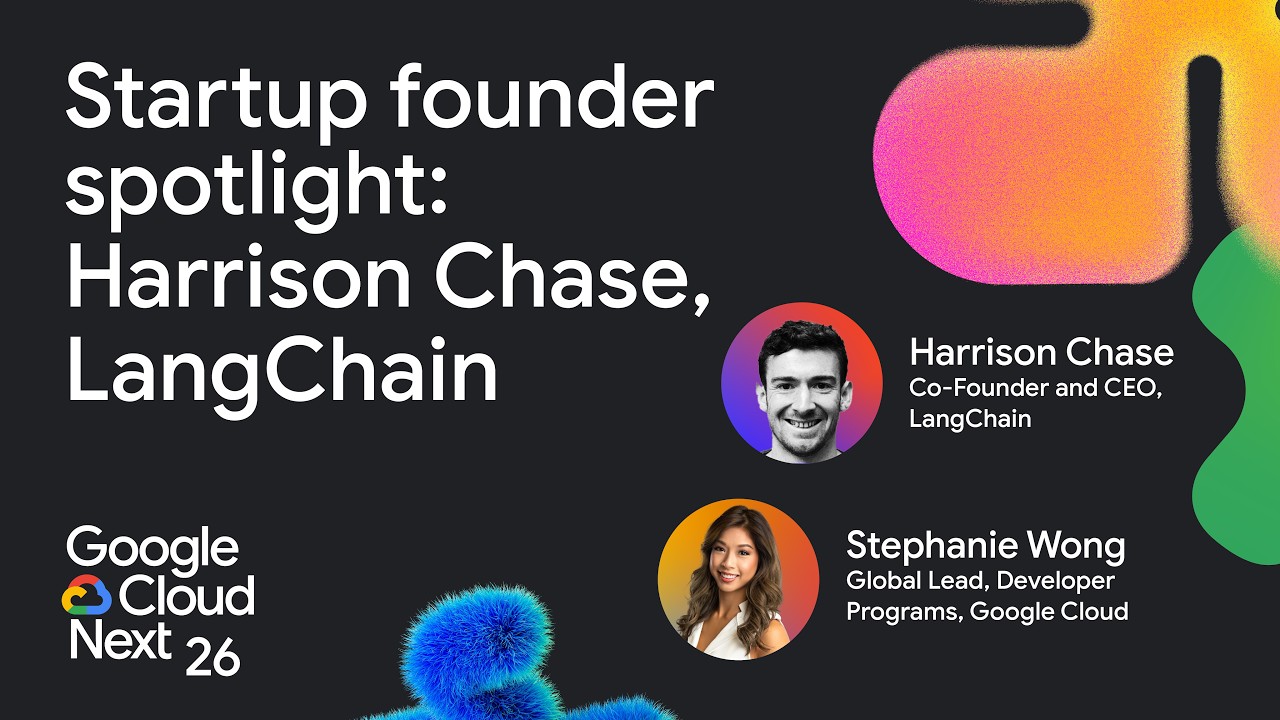
In a revealing session, Harrison Chase, CEO and co-founder of LangChain, highlighted a paradigm shift in AI agent development: the 'agent harness' layer is where the most significant performance gains are being made, often surpassing the impact of model weights.
Chase emphasized that while model weights capture significant attention, the true 'alpha' in AI agent performance lies in the agent harness—the scaffold that connects an LLM to its environment, tools, and orchestrates its actions. He cited a compelling example where tuning their open-source Deep Agents harness improved performance on a coding benchmark from 30th to 5th place, without any changes to the underlying models. This flexibility and agility at the harness layer, including innovative concepts like virtual file systems, offer developers unprecedented control.
The journey from a prototype agent to a production-ready system is long and complex. This is where the synergy between open-source frameworks like LangChain and LangGraph, and managed infrastructure such as Google Cloud's Gemini Enterprise Agent Platform with its Reasoning Engine, becomes invaluable. Chase explained that managed runtimes address critical challenges like scaling thousands of parallel agents, managing long-running stateful applications, and ensuring resilience, allowing developers to focus on core agent logic rather than infrastructure.
Observability and evaluation are non-negotiable for agent improvement. LangSmith, LangChain's dedicated platform, provides the infrastructure for ingesting, querying, and gaining insights from agent traces. Chase detailed how 'online evals' and 'inferred errors' – where a model like Gemini Flash can detect mistakes from implicit user feedback like "No, you did it incorrectly" – are revolutionizing debugging. Furthermore, the ability to create custom, domain-specific evaluators is crucial for tailoring agent performance to unique application needs, ensuring reliability in diverse use cases.
Looking ahead, Chase presented the concept of 'meta-harnesses,' where agents analyze their own logs and evaluation results to suggest and even implement code changes, automating the AI engineer's improvement loop. This vision, supported by tools like Gemini Code Assist, points to a future where agents can self-optimize. Central to this evolution is 'memory,' which Chase described as the bridge connecting agent harnesses with observability and evals, enabling agents to learn and improve from past experiences over time. This continuous improvement flywheel is set to redefine the SDLC for AI applications.
“You can't really improve what you if you don't know what happened and that's where observability comes in. And then when you do improve, these LLMs are great, but like they're they're not robust at all.”
- Harrison Chase, CEO & Co-founder of LangChain