- Multi-agent orchestration and enhanced governance redefine enterprise AI development.
- New ADK capabilities and the GEAR program empower developers to build and scale AI agents.
- Google Cloud emphasizes community, accessibility, and open-source contributions to foster innovation.
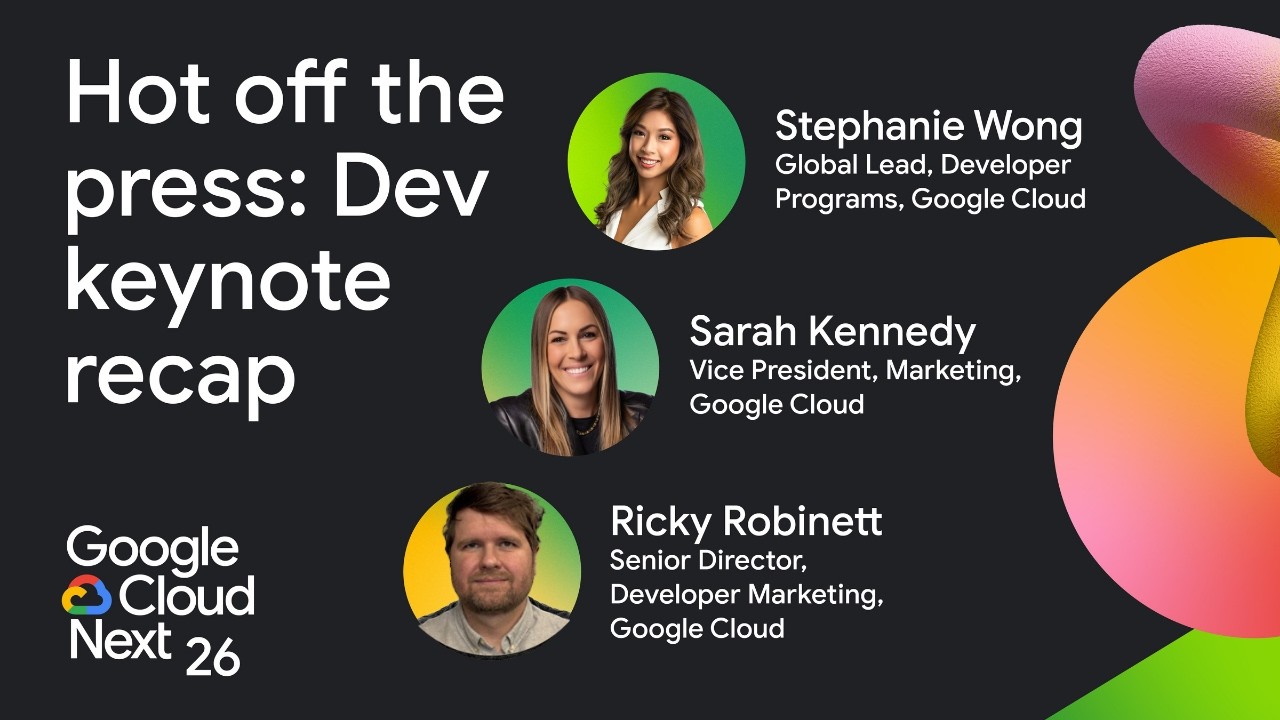
The Google Cloud Next '26 Developer Keynote delivered a wave of innovations, signaling a pivotal shift towards more accessible, powerful, and collaborative AI development. Leaders Sarah Kennedy and Ricky Ravenet highlighted key advancements designed to empower developers across all skill levels.
A central theme of the keynote was the acceleration of developer velocity, particularly through advancements in AI agents. Sarah Kennedy, VP of Marketing, emphasized the immediate impact of multi-agent orchestration, enabling large organizations to build complex, trustworthy AI solutions with robust governance and security. She also highlighted the synergy between high-code developers and business partners, fostering an organic team-building environment via Gemini Enterprise, even for those with a 'no-code vibe.' Ricky Ravenet, Senior Director for Google Developer Marketing, echoed this excitement, singling out the new skills repository for token optimization and enhanced observability tools as crucial for debugging and managing agents efficiently.
For developers eager to dive in, the ADK (Agent Development Kit) was positioned as the ideal starting point, offering a low barrier to entry with just a few lines of code and support for multiple languages like Python and JavaScript. To further support developer upskilling in the rapidly evolving AI landscape, Google Cloud introduced the GEAR (Gemini Enterprise Agent Ready) program. This initiative provides essential tools, learning paths, and monthly credits to help developers not only get started with ADK but also scale their AI agent solutions on Google Cloud, reflecting a commitment to continuous learning and production readiness.
The keynote also underscored Google's deep-rooted legacy in fostering strong developer communities. Both Kennedy and Ravenet celebrated the explosion of new builders joining the ecosystem, driven by the democratization of technology where natural language is increasingly becoming the preferred programming interface. This accessibility allows individuals, regardless of their coding background, to shape their world with software – a sentiment powerfully illustrated by Kennedy's personal anecdote of building a no-code household management app. Google is actively cultivating these communities through Developer Groups, hackathons, and online programs, ensuring personalized experiences and lowering the barrier to entry for the 'next billion users' of the developer community.
Looking ahead, Google Cloud Next '26 serves as a powerful kickoff for a season of launches, with more innovations anticipated leading up to I/O. The commitment to open-sourcing keynote code further empowers developers to experiment and build immediately. The overarching message was clear: this is an incredibly exciting time to be a developer, with Google Cloud providing the tools, community, and support to innovate and create the unexpected.
“And we finally live in a world where that is true, which means like almost anyone has the ability to build.”
- Stephanie Wong, Host