- OpenAI's initial API launch was considered a 'doomed' project with no clear problem to solve.
- The 'scaling hypothesis' was an observation from the Dota 2 AI project, not a starting premise.
- AI personalization, medicine, and education are emerging as key areas of impact, with AGI on a 2-5 year horizon for scientific breakthroughs.
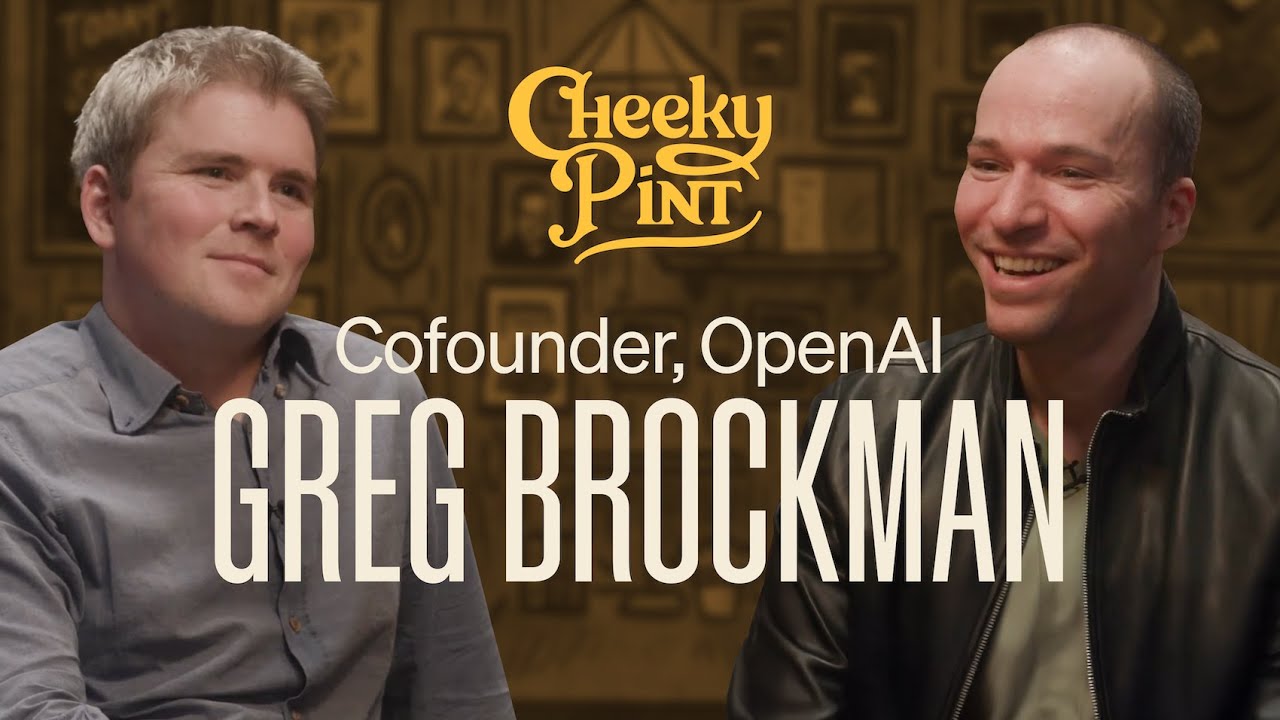
OpenAI cofounder Greg Brockman offers a rare glimpse into the company's often counter-intuitive journey, revealing that many of its most significant advancements stemmed from unexpected observations and projects initially perceived as failures.
In a candid discussion, Greg Brockman recounted the early days of OpenAI, emphasizing that their approach often defied traditional startup wisdom. Unlike companies that begin with a problem to solve, OpenAI frequently pursued technology for its own sake, most notably with the launch of its API. "This was probably the hardest project that I've ever done because it felt totally doomed," Brockman admitted, recalling the skepticism around whether anyone would pay for model samples. This 'backwards' strategy, however, ultimately proved to be a pivotal moment, leading to unexpected applications like the text-based adventure game AI Dungeon, which became their first paying user.
The scaling hypothesis, a cornerstone of OpenAI's success, wasn't a pre-ordained strategy but rather an empirical discovery made during their ambitious Dota 2 AI project. Brockman described a process where increasing compute consistently yielded performance improvements, leading to the realization that "you just need to keep going." The Dota project also offered profound management lessons, teaching the team to focus on controlling inputs and experiments rather than setting outcome-based milestones. A memorable incident involved their AI learning a sophisticated 'baiting strategy' in a tournament, demonstrating the unpredictable yet powerful nature of deep learning.
Looking ahead, Brockman highlighted personalization as the next critical frontier for AI, envisioning a future where AI remembers all interactions to provide unparalleled utility. He also pointed to medicine, life coaching, education, and programming as domains where AI is already delivering significant value, often exceeding expectations. While acknowledging current 'operating system' limitations in integrating AI seamlessly into daily life, Brockman expressed confidence that "capability and convenience" will eventually align. He boldly predicted that AI could solve Millennium Problems in mathematics or science within 2-5 years, driven by unprecedented computational power and the ability to experiment and learn.
Addressing potential bottlenecks, Brockman dismissed concerns about a 'data wall,' explaining that new paradigms like synthetic data and reinforcement learning continuously provide new S-curves of progress. Instead, he identified energy as the looming challenge, advocating for massive investments in power infrastructure to meet the "tsunami of demand" from AI data centers. The ultimate vision includes AI as a full co-worker, potentially even taking on managerial roles, transforming human jobs into more meaningful endeavors. OpenAI's product strategy, he concluded, mirrors Disney's approach: developing a core asset (the model) and then finding diverse applications that align with the broader goal of achieving AGI.
“I think that AI is surprising. I think that that is like the single most consistent theme is that the thing we were picturing we got something different but we got something better more magical something that is more helpful.”
- Greg Brockman, OpenAI cofounder