
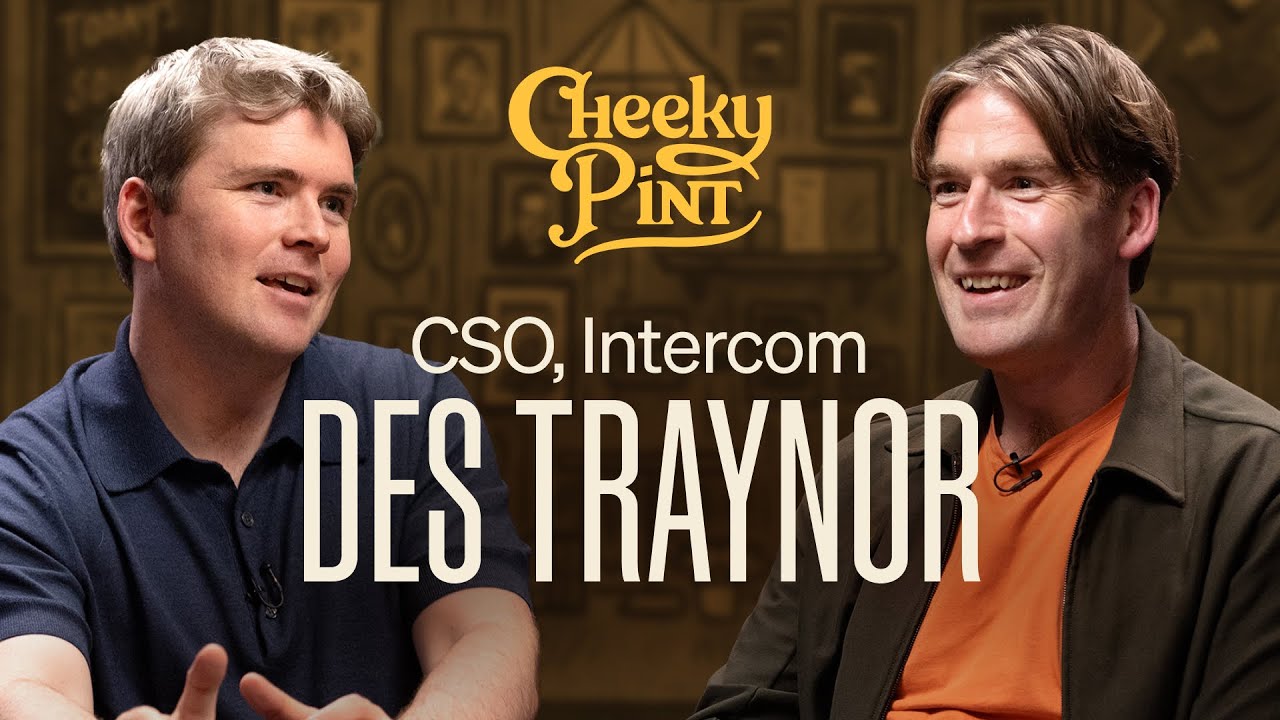
- Intercom's journey from website chat to an AI-first customer service powerhouse.
- Finn, their AI agent, resolves over a million conversations weekly with a 65% resolution rate.
- Des Traynor offers candid insights on AI adoption, product marketing, and startup growth pitfalls.
In a revealing conversation, Intercom co-founder Des Traynor details the company's dramatic reinvention, including a lightning-fast pivot to AI that reshaped its product and business model, offering a blueprint for navigating the new tech landscape.
Intercom, initially known for its website chat, has undergone two significant transformations: first into a comprehensive customer service platform, and most recently, into a frontier AI company. Traynor recounts the astonishing speed of their AI pivot, launching Finn, their AI agent, just days after ChatGPT’s public debut. This rapid shift, born from a weekend of intense decision-making, saw Finn quickly achieve a 25% resolution rate, which has since soared to 65%, handling over a million customer conversations weekly and generating substantial revenue.
Selling AI in today's crowded market presents unique challenges. Traynor highlights the prevalent 'build versus buy' mentality among customers who often underestimate the complexity of a truly effective AI solution. Intercom addresses this with bold strategies, including a 'million-dollar guarantee' that challenges competitors to outperform Finn. This confidence is rooted in a deep, multi-layered AI stack that goes far beyond simple 'reset password' queries, focusing on nuanced customer context and grounded inferences to avoid hallucinations. The company has also pioneered a usage-based pricing model for Finn, charging per resolution, a direct reflection of their belief in the product's tangible value.
Beyond Intercom's own journey, Traynor offers sharp critiques of common industry pitfalls. He lambasts 'marketers who love marketing' over clear communication, advocating for direct, specific messaging. He stresses the critical importance of listening to users, noting a 'Silicon Valley epidemic' of hiding behind data instead of engaging with customers. Furthermore, Traynor warns against 'premature expansion' in startups, arguing that many companies get stuck around the $10 million revenue mark by trying to do too much rather than perfecting one core offering. He champions the 'harsh discipline' of focus, citing examples like Figma and Nvidia, which achieved massive success by dominating a specific niche.
Traynor also shares a powerful framework for evaluating AI startups, dubbed the 'Four Horsemen': revenue backed by usage, usage tied to mission-critical business impact, deep differentiated AI (not just a thin wrapper), and positive unit margins (or a clear path to them). He laments the modern trend of founders chasing the 'trinkets' of startup life rather than being driven by a genuine passion for solving problems. Intercom's own R&D is evolving to be AI-native, with designers now shipping code and engineers leveraging AI tools for massive productivity gains, signaling a future where AI isn't just a product feature, but a fundamental shift in how companies operate.
“I think at the core of every great business, every great SaaS business but in the future AI business is something that they're just truly world class at.”
- Des Traynor, Cofounder of Intercom