- Government data often remains underutilized, with less than 3% impacting critical decisions.
- The FAIR data principles (Findable, Accessible, Interoperable, Reusable) are crucial for modern public sector data strategies.
- The Lakehouse platform, combined with open standards like Delta Sharing and MLflow, offers a comprehensive solution.
- Transparency in AI and data lineage is paramount for citizen trust and effective policy-making.
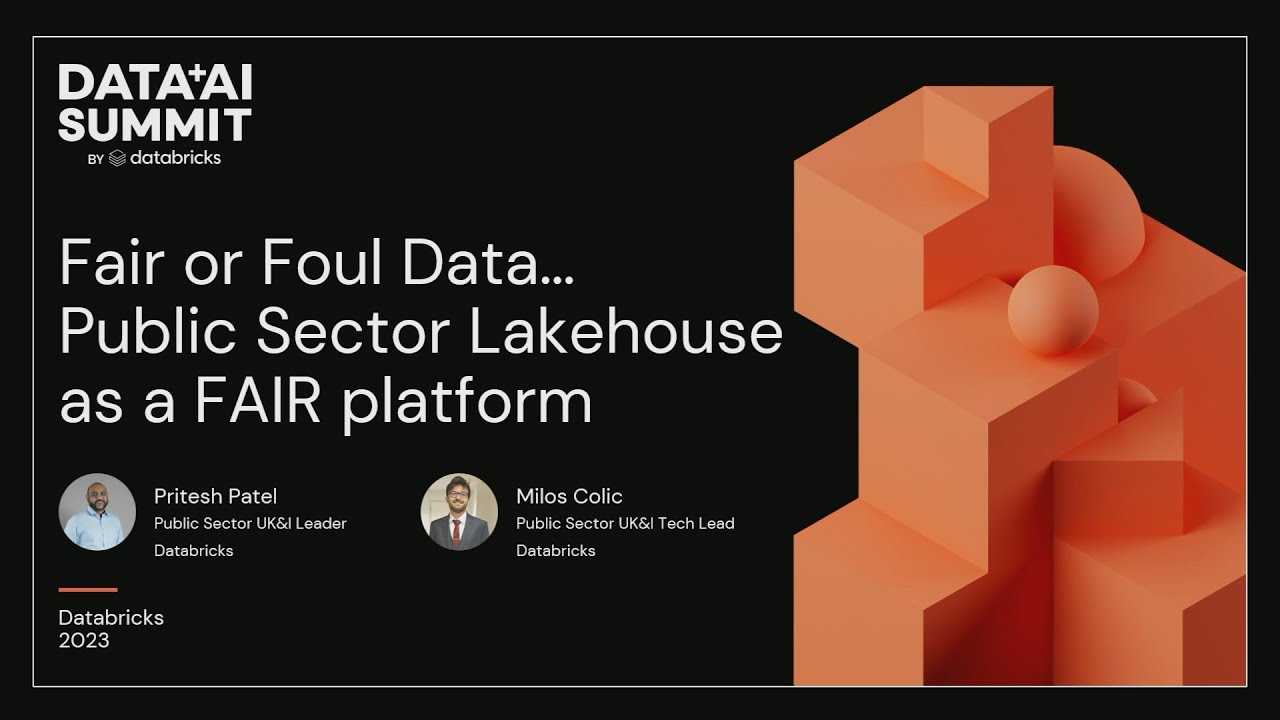
In an era demanding rapid, data-driven decisions, public sector organizations face immense pressure to modernize their data infrastructure. This session explores how the Lakehouse platform, built on the foundational principles of FAIR data, provides a robust and transparent framework for governments to transform their data into actionable insights, ultimately improving citizen outcomes.
The concept of "FAIR" data – Findable, Accessible, Interoperable, and Reusable – forms the bedrock of an effective data strategy, particularly within the public sector. Speakers Milos and Pritesh emphasize that data initiatives should move beyond a linear "extract, use, dispose" model to a circular one, where data products continuously generate new usefulness. This shift is critical for government bodies, which accumulate vast amounts of data for audit and historical purposes, making its long-term utility and interconnectedness paramount.
A significant challenge highlighted is the "findability" of data within complex organizational structures, often exacerbated by centralized bottlenecks or decentralized silos. The Lakehouse platform addresses this through centralized governance via Unity Catalog, which simplifies access patterns and permissions using SQL standards. This allows for the management of diverse data types—internal tables, external tables, and even raw files in cloud storage—all under a unified, scalable framework. Critically, the platform's commitment to open source and multi-cloud compatibility prevents vendor lock-in, fostering true interoperability across heterogeneous systems and an expansive partner ecosystem.
Beyond internal accessibility, the session delves into secure external data sharing. Delta Sharing, an open protocol built on Delta Lake, enables controlled and secure data exchange between organizations, even across different cloud environments or on-premise systems. For highly sensitive data, "clean rooms" provide a secure, disposable compute environment where code acts as a logical contract, executing against classified data without direct exposure, ensuring compliance and controlled insight extraction. This level of transparency extends to AI models, with MLflow providing robust governance, tracking lineage, parameters, and experiments to build trust in model-driven policy decisions.
The overarching message is clear: the value of robust data practices is recognized from the top-down in government, with national data strategies and AI safety initiatives reinforcing the need for transparent, explainable data products. By adopting platforms that promote these FAIR principles, governments can significantly increase the utilization of their data, drive modernization, and ultimately deliver more effective, trustworthy, and impactful services to their citizens. The goal is to move beyond the current state where less than 3% of data influences critical decisions, fostering a "habit generation" of data-driven excellence.
“Anything you build is easy to follow and there is a pool to follow because you know there is a value of those decisions and those actions.”
- Pritesh Patel, UK Public Sector Lead