משחררים את החדשנות הישראלית: איך סטארט-אפים כובשים אתגרים גלובליים!
בעולם המתמודד עם אי-ודאות ושינויים טכנולוגיים מהירים, מגזר ההייטק הישראלי ממשיך להפגין חוסן וחדשנות יוצאי דופן. פרס אטלס השנתי, שחגג את יום השנה העשירי שלו, אסף לאחרונה את היזמים, המשקיעים והכישרונות העולים המובילים של המדינה כדי לכבד את אלה שפורצים את גבולות הטכנולוגיה והרוח האנושית. האירוע, שנערך בבורסה לניירות ערך בתל אביב, הדגיש את מחויבותה הבלתי מעורערת של ישראל לקידמה, גם מול אתגרים פנימיים ובינלאומיים משמעותיים.
“אני מסתכל על צעירים שרואים את העולם שיש להם ואומרים שאנחנו יכולים לשפר אותו.”
גלו את הטכנולוגיות פורצות הדרך והסיפורים מעוררי ההשראה של היזמים המובילים בישראל. צפו כיצד חוסן וחדשנות מניעים שינוי גלובלי, גם מול אתגרים חסרי תקדים. זה יותר מטקס פרסים; זוהי עדות לרוח האדם.
Shalom. >> And we are beginning. So good evening to all of you distinguished guests. It's wonderful that you are here. Bazarad and entrepreneurs and investors and people who truly make things happen here in Israel. So, welcome to the Tel a Viv Stock Exchange and thank you for coming. There are evenings dedicated to handing out awards and some others for declarations of intent and tonight we mark a decade of the Atlas Prize which is one great declaration. You know, look around you. We're in a world filled with uncertainty and global turbulence and technological change happening at the speed of light and we are standing right here at the very beating heart of the Israeli economy when we are celebrating 10 years of uncompromising excellence.
When we talk about the Atlas award, um, we are basically talking about that sort of titan who carries or the heavens upon his shoulders. But in Israeli, you know, in Israel 2026, Atlas is no longer just a mythological figure, but it's really Atlas is every entrepreneur in this room who decided that no matter what happens on the outside, they will make things happen. They think people who push the boundaries of cyber security, robotics, AI, medicine just in order to leave their mark here in Israel and around the world. This year more than 100 companies were evaluated and our judging committee didn't make uh give it discounts to anybody because out of all those candidates only 16 remained the elite unit of the Israeli high-tech of 2026 and they competed across four categories and they've proven that the Israeli mind is the most resilient and creative and powerful resource that the world has to offer. So what are we going
to do tonight? We will announce the grand winner of the Atlas award. We'll host the the Atlas panel. Again, companies like Move It, Augury, Extend, and UVI. These are companies that uh had already won this uh award. And they are global giants that transform the way we live. And we'll present the moral courage award to the remarkable Roan Osman. And we'll hear from the United States ambassador regarding the strategic partnership that remains irreplaceable. But of course we have to look into the future because you'll see Atlas juniors which is the bas the great pride um of this event and these are young students who prove that um the Israeli future is not only between Gadera and Khadera they are from the periphery and they showed that wherever there is a dream um again you can make it come true. You know people always ask me about tomorrow's forecast but again um you know I'm happy you know I am always um um equivalent to forecast and the weather. This also has to do with what we are talking about today. But again we the people the reshaping reality itself I would say that my forecast for Israel is pretty simple. Clear skies an open horizon and technological strength that continues to to grow even in such times which is so challenging. Look at all the exits. Look at all again the um achievements that we've had despite the challenging time. So why don't we begin the celebration and to officially open this 10th anniversary event. I'm honored to invite to the stage the man who brought again this vision come true was um a ride director of the enran center and co-founder of the Atlas prize.
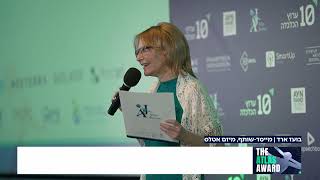
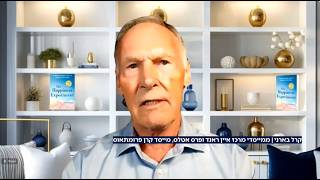
Um, good evening. >> Good evening everybody. I am so delighted and so excited to open the Atlas award and announce the winners for 2026. And when we set out with the Atlas initiative, it seemed to many like an impossible idea. The later artist Richard Mintz came up with this idea and he um again um dedicated and actually contributed this amazing um statute of Atlas which is given awarded each year and together with Mr. Carl Barney you'll listen to his blessing in later on this um evening and he supported this initiative. Now tonight after a decade
we have gathered here for an annual event that is taking place soon after Israel's independence day and I think we can truly say this with pride that the fact that this evening is taking place is a victory. It is a victory in a number of circles. First of all in the closest circle it's again the victory again over um lack of clarity and uh it is also the victory of the committee. We have 12 experts again headed by Mr. Moshe Kovalsski who's sitting right here. Thank you so much Moshe that basically they wrote down in their diary the meetings of the committee and they they came and of course there were sirens going on and they um put in so much time and effort and the the last um committee meeting lasted for five hours just you know to put this into perspective and in the broader professional circle this is the victory of all the companies that submit their candidacies and the finalists who are here with us and the the winning companies who will be with us later on. So again these companies also many of their representatives went to reserve duty. They didn't have enough manpower. They had to deal with again a very challenging reality and yet they continue to to grow to develop to move forward. Now as far as the national
circles goes this is a victory of the Jewish people and their friends and our friends around the world. Again this is a difficult historical time uh when we reached you know rock bottom on the 7th of October 2023. a day that will be remembered for generations to come. But also, you know, out of that day, we awakened out of our complacency and we did some soularching and we decided to build a better future. Now, as far as the global circle goes, I think the state of Israel has proven to itself and to the rest of the world that there's no power that can really break again any society that wants to advance and succeed. And while the stock market and and the value of the Iranian currency crumbled to dust along, you know, with the noose that that axis of evil plan to put around our necks, um, our stock market broke records. Our currencies is is getting stronger and stronger. I think we're drawing to us a lot of uh entrepreneurs and investors. A new world order is forming right before our eyes and we may not yet know what it will look like in future. But one thing is certain that Israel has reduced the threats to its survival and um um of course invested in um in various investors and entrepreneurs and the common and the kids all of these things is um insisting on life and human virtue and the ability to think and create and invent and uh act with courage. Now, the our ability to be able to support um and advocate those people um and allow a culture of freedom to thrive and stand firm in the face of barbaric um attacks. Now, a quote from Rand and as Walt
Disney engraved at the entrance to the innovation hall at um Epcot, which is in Disney World, this is the sentence. Throughout the centuries, there were men who took first steps down your roads armed with nothing but their own vision. So you who are all sitting here, you are those people, you are those visionaries, you are the entrepreneurs, um the innovators and we accompany you on this path to a good future. Thank you so much. >> Thank you so much to Boaz Arad. Now we will continue. I don't know if
some of you were here today or saw this earlier but again at least in channel 10 the economic channel we deal with um innovation agrch and and space and the global market and every day I come I um host 8 to 10 people the very best brains here in Israel again older people younger people people who've done it people who will do it and every time I'm fascinated time and time again again at the extent of the innovation, the technology, the wisdom that that this country holds and has amazing ideas that people have and only a small part again were exposed even in medicine and biotechnology. It's just unbelievable and you know I'm so very u moved when entrepreneurs or again development um centers and hubs that come to me from the periphery which is you know out of the Tel a Viv district those who do it despite the difficulty despite the distance and prove that in the state of Israel you can actually prove that you can do amazing things not only in the center in Herilia and Tel Aiv. If we talked earlier about the Titanics, the Titans of today, today we would like to talk about those who sometimes come and I host. I had a a child of 14 years old, not from the periphery, by the way. We'll talk about periphery in just a moment. And in his free time, um by the with the help of Claude and with the help of AI, he actually developed software that knows how to control drones from afar. And many companies around the world have shown their interest. again 14year-old plays with his AI after school has no doesn't get mentored or taught by anybody professional but he um actually developed this amazing um app software that can control drones from afar not even 14 years old so again it's it's
easy to look again at Israeli high techch and only look at Tel Aiv the center of Israel but you know the real value even when I met the sort of um this enterprise called the Atlas award is again our ability to reach every single corner because Atlas Junior is not just an education ational um again uh initiative but it's all about creativity. Think about young people from the periphery. They don't only learn how to be an entrepreneur. They go into the most advanced companies around the world as they are studying sorry in Israel not around the world. Then they work alongside the engineers. They work with R&D teams. They breathe that air of in innovation from number one. This is an amazing again growth engine to our country. So tonight we celebrate this unique partnership where the experience of the veteran entrepreneurs meets the hunger, the curiosity, the boldness of the younger generation. And these young people again are so hungry. They're so thirsty for knowledge. Amazing what their capabilities are. And again the sky is not even the limit. So in about in 10 years time in a decade maybe next in a decade this award that these young children might maybe present their exit of the company. So just to tell us about this magic, I'd like to call upon the woman who's again um is the director of the center for the gift of students and the student genius program with exceptional dedication ensuring that our next generation is prepared for every challenge and that is Dr. Alina Lusttov. >> So good good evening. Can you just imagine a group of students working again inside the technological workspace of a startup company developing a dronemounted system designed for example to improve the detection of hostile UAVs or another team of young students conducting research toward an innovative cancer treatment in the advanced laboratories of another startup company. And well again these are you know
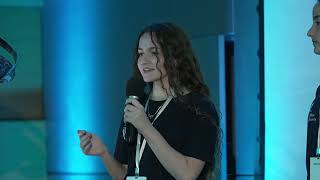
participants from middle and high school that have focused and developing a method of antibbody crystallization in space in order to improve the effectiveness of medicine. And again these students again have um go into some of Israel's leading startup companies for hands-on learning. They study alongside entrepreneurs and engineers become members of research and development teams. They lead their own practical project. Now it sounds like science fiction, right? So all this it happens really de facto at the Atlas Junior's program which is a program we founded four years ago and it's ever since it's just grown and it has evolved and branched out um to new directions. So, Atlas Junior's Media, which is again a media new communications track in partnership with Channel 10. We have the Atlas Juniors team leaders that again are graduates of the Atlas Juniors program who lead groups of younger students and gain real leadership experience. We have the Atlas Juniors Pro which is an advanced program in which students engage um in internship with startup companies. We have the actress juniors management which is the new dedicated track for school principles and educational leaders exposing them to the world of entrepreneurship and um innovation as well as to the modes of thinking and action that characterize startup um founders. Now we have developed uh now lead a program that enables school students to shape their future through direct exposure to the real world through practical experience, real challenges and again life itself. So next year we will open our fifth cohort and it's again it's the that fifth year of our program and I would like to invite all of the finalist uh companies that are sitting here tonight to please take part in developing and building the next generation of entrepreneurs in Israel. So, and now why don't we take again a short again peak into what takes place inside the program. So that's who we are and of course you know who can describe an experience uh the experience of the program better than the students themselves. So I would like to invite to the stage the Atlas Junior's students um and they spent their year working with UVI which uh was the recipient of the Atlas award for 2025 and the group developed what is called the UV rover which is a smart autonomous game which changes um sort of the rules of the game and put advanced scanning technology in your car um anywhere and with No need for fixed infrastructure. So students please come up to me. It's okay. Hello everyone. My name is run electricity and provide roofing. What happens if you're a small dealership with no space? What happens in a crowded parking lot where you can drive every single car through a central scanner? This clients really want to invest technology, but they simply can't afford the setup and the heavy
infrastructure. This is where we Atlas juniors step in. We decided to change the equation. Meet the UV rover, a smart autonomous robotic vehicle. It requires absolutely zero infrastructure and concrete installation. It's pure plug and play. You drop it in the lot and it starts working. We took all the scanning capabilities of UVI and pack them into a mobile robot. But just telling you how it works. Let us show you. Look at the demo. First, the rover receives the target license plate. >> Now, it autonomously navigates the lot. Watch how the AI adjusts the wheels in real time to lock onto the target. It detects the car and stops at the exact safe distance to avoid a collision. >> In the future, it will circleize the car, capturing every single angle and upload the data straight to the VI cloud. Zero human intervention. >> To create this prototype, we work together with UVI as a real R&D team. Each of us had a role based on our skills. From research to the physical build of the chassis and motors all the way to design and coding. This robot isn't just a remotec controlled car. It's a thinking vehicle. We use Python and computer vision technologies to teach it to read license plates. We programmed the navigation algorithm that changes the steering angle in real time to lock onto the target. And we created a smart braking system to prevent the robot from crashing into the cars. And we didn't stop at the software. We fully designed and 3D printed the robot outer shell, giving it the sleek, professional look that also protects the hardware inside. From a business perspective, the UV rower opens up a massive new market for UVI, a blue ocean. Think about car auctions in the US like Manheim, which have tens of thousands of cars parked tightly together. You can't drive every car to a scanning center. the rover will simply drive between them. Think about small dealerships or local rental companies. Now, everyone can get this service. But why would any company want this? For three main reasons. Number one, massive savings on manpower. You don't need to hire drivers to move cars to the scanner. The robot works completely on its own, even at night. Number two, reliability. The client gets the exact same legendary scanning quality of UVI. Number three, total flexibility. Need to scan cars at a different lot tomorrow? Just back up your robot and move it there. Zero infrastructure costs. We are Atlas juniors. We took an amazing technology, broke down the concrete walls, and made it mobile, accessible, and smarter. The future of vehicle inspection is no longer standing still. It's on the move. We changed the rules. Now, the car doesn't go to the scanner. The scanner comes to the car. Thank you, Thank you so much. >> Wow, that was amazing. Did you understand that you know even you know even the technology and you know and their creativity just you know even beyond that these young people are standing here without a teleprompter with the English standing with such confidence just in front of you. I mean just for that they deserve a round of applause, right? Very impressive. >> So we continue. Now if you really want
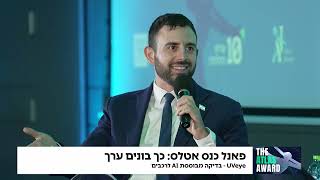
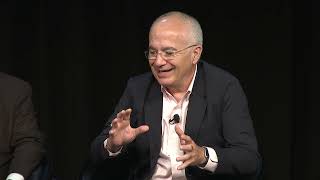
to understand what the Atlas Award is all about, you actually have to look at the people that I'm about to invite to the stage. So this is not just another panel. This is a history of the past decade of the Israeli high-tech and it's basically condensed into 45 minutes of insight. Um I call them the atlases and again these are companies that began like like as startup companies very promising startup companies like all startup companies they're usually very promising we usually know those who actually did the exit and they had big sales but there are some startup companies that we've never heard about but we usually do sort of place in the line like those who have succeeded but now we're talking about companies global powerhouses that everybody knows I would like to invite to the stage nerel who's the CEO of move it which So the very first winner in 2016, a company that I'm sure I mean it's a service basically that you use. I don't think there's one person in the state of Israel and around the world that doesn't use again move it even even I do when I take the train constantly by the way on a regular basis of course >> and Gala is a co-founder of Augury was the winner of the 2021 Atlas award now a unicorn company transforming global industry through the through AI Okay. Now, this is this is my chair. This is a moderator's chair. >> Okay. We have Matthew Shapiro, who's a co-founder of Extend, the winner of the 2020 2024 Atlas Prize, bringing the forefront of robotics and defense technology to some of the world's most complex operational arenas. And we have who's the co-founder and CEO at UVI, winner of the 2025 Atlas Award, which was revolutionizes the global automative industry. And to moderate this fascinating discussion, I'm proud to invite to a stage a man um I think you're all familiar with, one of the most, you know, prominent voices of Israeli public diplomacy around the world. I think we all got to get to know him during this this war and also today lead the battle um on the international public opinion um front. Elon Levy as the stage is yours. >> Shalom. Shalom. >> Shalom. Shalom. >> Hello and good evening one and all. Wow. Such inspiration from these young teenagers. Unbelievable. So it's a great privilege to be hosting and moderating this panel. This panel of executives who are really representing not just successful companies but those who have been identified at an early stage as ones who provide value and will continue to show that in the long run. And what's special about this panel is not only the people sitting in here but the line the timeline that they represent from 2016 to 2025 really just last year across different industries technologies and market conditions that have changed from end to end. So let's begin with a short quick round and we're going to dive into deeper questions later. So over the last two years, how have those two years have impacted your company and what trajectory? It can be a product. It can be timing. It can be anything. But what was the one crucial decision at the beginning of the road? >> Technology works. You can be heard well. But please put the mic next to your members. >> Okay. this if I go back 12 years to when
move it was uh founded and to remind you all of where we are. So if I go back to move it to the beginning of it or to or needing a public transportation app the people who needed to navigate from one place to another 12 years ago would come across great difficulty digitally. If you wanted to go from to Tel Aviv by bus, you'd go downstairs, you'd look for the bus station. You'd have no idea if you found the right bus station in the right line and the right route. >> And move it was established with a very clear vision. We wanted to take the public transportation experience and make it more digital. And if I now connect it to the first two years, in order to give a solution like move it at high volume, at big scale, you need to be able to get data that is very complex uh to create and to show it. So in its first years, Move It actually set up a community, a community of a million volunteers that helped us to map out every element of public transportation, the lines, the times, the places. Without that, it would not have been able to create this huge volume and this huge scale. So if you're asking what the big decision was at the beginning, it was to set up that community and to generate very unique data. Gal, what was the unique the special crucial decision at the beginning of your road? Well, hi. Thank you. >> So, my company was set up. Maybe I'll
take two decisions. Augury sells to enterprises. It deals with software and actually listens to noises and discovers and identifies malfunctions in the industry. And that was not a very popular decision at the time. 2011 2012 when we started out everyone was on social, mobile and geoloccation. So move it was like the end of that trend. Everyone was making mobile apps and we said we're not only going to enterprise we are going to go with hardware to the factories and that was the biggest thing we got was the people's eyebrows shooting up. They were saying you're weird go away. But we started with a handheld product for factories that was kind of like a stethoscope that was connected to phones. We would walk around with it and when we mowed went to a from a reheating ventilation system to having something permanent on the machine, suddenly our whole market feed was wrong and we had to pivot to beyond the yellow line in the factory to really go into the production lines. And it was both very scary but also it was like killing the revenue going right back to the beginning again. not really just starting a new but really taking the rational decision the unpopular decision and to work from that. So it worked quite well for us. Mateo, what was the crucial decision for you right at the very beginning? Well, actually the first two years connect symmetrically to these last two years. When we started out the idea of extend was how to actually take every person into a remote reality into a robot in such a way that you don't know that it's a drone or another robot. They just kind of leap into a different remote reality. We dreamed of architects who can supervise the building of other of build buildings in other countries and tourism. And in 2012, the kite um terror from the Gaza Strip made the four guys who were sitting in the office focus more on the fact that the IDF doesn't have a solution for that. And the concept that any person can now be brought into a flying machine, so to speak. We took all the soldiers on the ground on the line into drones and most of the balloons and kites, the terror ones that were used to bomb um the border uh were helped with that. And in recent years, in the last couple of years, we just see how this need is so urgent. So in terms of the product market feed, if there ever was one, this is it. So it all kind of fell into place for us. >> Oh, >> I think that we our journey began in
2016 in the world of defense from a very personal experience we had and as we were going along we saw that we could provide a much broader solution for a market that is first of all bigger that it sales cycle is shorter and it's a market that is hungry for technology that doesn't exist yet. So after two years of being in the defense market, we made a complete shift to the automotive world. We developed um systems that support that and that is what brought our company to where it is now. We created a kind of standard as to how you scan and test cars from the moment that the car was born as so to speak in the factory and until it is sold as a secondhand car. And that was really the big shift, the big pivot that changed the way we went to through from 2016 until now. So let's move from your first two years to the last two years that have been so challenging um on the global level, but especially on the Israeli level. When you look back at the last two years, what were the main changes that and the decisions that you made as entrepreneurs to conform with a dynamic reality and how can you compete on the international level and on the Israeli level? Well, I think we can divide the
changes into two. First of all, we did domestically and what should have been done internationally. So on October 8th, we were all caught I think it's an overlap in all companies. We were all caught in a situation that it was so extreme. We took our company and we split it into two. Part of the company went to reserve duty and disappeared on us. And the second half was in reserve duty on the home front, meaning covering for those people who are on actual reserve duty to be able to volunteer in the community to work in the Gaza um the Gaza envelope in the communities on the Gaza border. And it was so important for us for our DNA. That's where we wanted to position ourselves. So that was very challenging indeed to work inwards. And when we look outwards again, I take move it as a company that for the last decade has been creating and forging partnerships with hundreds of partners. And when you forge close partnerships with other players, the management of this process becomes very complex. And our partners can also be split into two, divided into two. Most of them supported us, understood our situation, continued to work with us very closely. But some we saw that we were going into this process where transactions and deals are being stopped and partnerships are stopping and we took them one by one. We had to deal with it. We realized we had to manage it and contend with it and it'll pass and hopefully by the end of the war we will have a long list of partners and customers that we'll have to do recovery with. But it's one of the things that we just have to realize and it's where we're at and that's what we did. So how did you steer this change? What was the change in trajectory for you to be able to continue these challenges? So you changed some of your business. Move it has activity activity uh selling tickets in countries in Europe. So we worked on a very intense campaign with one of the biggest actors in Europe. And this campaign we invested hundreds of thousands of dollars in it. And one bright morning it had to be on all the billboards in the same city selling tickets through Move It, a really close partnership. And suddenly on a Saturday morning I get a phone call from one of those local players saying, "Listen guys, tomorrow there's a rage day and you are being painted as an Israeli app. So probably most of the screens, most of the billboards will be shattered. There'll be lots of noise. So we have to stop." So okay, we understood, we managed it. We said, "Okay, we won't do it. We'll let this pass. It'll take a week or two or three. Things will calm down and we'll be back." And that's what we did. We navigated the transaction elsewhere. We realized that in those countries at that time we were not able to be active and in some of these countries we're still inactive because of that. You have to be able to manage your business to understand where to push more, where to push less and ultimately to work through it. I have no doubt that the Israeli companies are winning on an international level when they can compete with fair terms. But unfortunately you have to overcome the terms that were not fair. So Gal, what kind of changes have you been through in the last two years? >> Well, first of all, it's hard to analyze the last two years as you know just one unit. There were many ups and downs. Let me talk about three trends that have affected us. So there was the war and they talked about three months and six months and the very pessimists talked about two years but what's happening now is not exactly anything that was in anyone's mind. there was this one side of things on the Israeli part of the company and we've been a global company for many years but in 2023 to realize that you're going into this event and it's not the six day war or some sort of uh event that you know that the timeline of it and the other part is that due to political situation uh in the market that we were in the market was kind of going So Trump and his and his tariffs and all the CEOs around the world in the industrial companies gathered and said in the next 6 months we're not going to buy anything. We don't know what's happening. We didn't understand anything. Maybe the production is moving to the United States. Maybe they're going back. So for the next 6 months we're not approving any deals over $2 million for any technology because we don't understand if we need to build the factories here now or there or continue distributed. So the geopolitical situation and also AI AI that was the
third thing entering into a into the factories and within the three trends trends we had to juggle we had to understand what we're doing and just changing the company strategy and the entire tactics some of it was redistribution of the business and thinking about I mean there were some customers who asked us to sign that we are against the war here's a form and I'm like What? What? What does this mean? I don't even know how to deal with this. What does this mean? How how do I even I mean we have high ranking IDF offices on our team. How can we sign this? What are we going to do about it? >> So we had to kind of rethink things and to shift to sustainable growth rather than the hyperrowth that we were in before. So it happened a little before but it really has been happening the last two years. So we did this shift in business and we grew in a more sustainable way so that the company will go to profitability quicker and will still continue to grow. We actually did some fundraising. We we raised $80 million in order to complete this transition. We needed a buffer. We changed some of the executives and we built another site in India because we couldn't support our development only being in Israel. 40% of the team was on reserve duty and others whose partners or child or someone else in the family was also on reserve duty. So that reached about 60% of the team. Someone was away for long periods of time, five rounds, six rounds and also the exchange rate, the US dollar two shekele exchange rate. So we had a site in India. We also changed many people in the leadership. Some of us as entrepreneurs stepped back from the day-to-day management and became and started to think more innovatively because we figured that if the company is only going to be in operations, it'll be very hard for us to function. So these are very hard complex processes and you really come face to face with your values and decide where you go. Mateo, did you also have to contend with purity tests during the war while the entire company was fighting on the war front? Well, for us, I can say it was very clearcut two events. First, October 8th, so to speak, understanding where we are, realizing where we are in Israel, realizing that you can't be complacent in the defense industry in any way. And the second thing was the AI revolution that from what we understood and extend it's not just a competitive area business-wise that our rivals are trying to use everything they can in order to do what they need to do and that we need to be on the forefront of technology and thankfully Israel has a great advantage in that respect. on one hand, but on the other hand, as we can see now on the northern border, in many respects, the technology is still a little more forward, more advanced than we know with robotics. Robots are capable of more than the IDF is using them for, the customers are using them for, the market is still very conservative, but as at extend, it was very clear-cut for us. We had to take the concept of taking people, replacing people on the battlefield with as many scenarios and to really go full force with it. And we've been focused on that ever since. Maybe we won't need to draft the Heredes if robots can replace them on the battlefield. So, what's been happening with you the last two years? How have you overcome the challenges? Well, I share everything and agree to everything that my friends here have said with when it comes to October 7th and everything that we experienced over the last couple of years. We really had to do many adaptations. I don't think there was like a magic potion, a magic formula as to how to contend our company. We have a hardwarebased solution. At the time, we still had Israeli vendors. And as Gal said, when you have a hardwarebased solution, you need to see how you can make magic out of nothing in order to really make sure that you continue to manufacture and continue to sell. And we found alternatives. And now the system production is that's mass production. It's mostly in the United States, but it's something we had to contend with. And as Gal said is the whole world of tariffs. Ultimately, components come from around the world. and you have to deal with your manufacturer that has to pay the cost and there too you have to find alternatives and I can say that in the context of the war one thing was very clear and we could see that when you're a global company and when you have a very big Israeli site and a very big US branch resilience people have here is something you don't find anywhere an employee that goes on Zoom and during the Zoom there's a siren and they run to the safe room and they tell the people in the other the Zoom just wait five minutes, we'll be right back. And they come back five minutes, 10 minutes. No, no, you're right. The home front will be upset with me. But that's something that's really just so unique to us. And I want to touch upon one more thing as well. The matter of AI in the last two years, it's really accelerated. And I think that the dynamics have changed between the world of production and development and the product world. In the past in development, we had to characterize. We had to see how to build things and it took a lot of time and a lot of money. And now it's something that's quite quick and quite cheap. And now the bottleneck has become the product because there are so many opportunities that we can already implement. So that's what we've tried to do over the last two years. I want to ask you a question about a challenge that perhaps you talk about as something obvious. within all of these struggles and challenges, the tariffs, the AI, and everything else and the war on October 7th that you've all actually made this shift from startup to company, proper company, and it's a big cultural change. What was the hardest part for you from in the transition from startup to company? Well, first of all, I think that move it
moved from startup to company in 2020. We were bought by Intel under the umbrella of Mobileite and that de facto was the process that actually changed our company's status and as the executive as the leadership we were quite worried about how to manage within this and one or two weeks after the acquisition we sat with CEO of mobile Ammon Shashua and we discussed how to keep going how can we manage ourselves under such a huge corporation operation and not lose the ability to manage ourselves as a startup because that's how what brought us thus far and Amnan said look I was where you are five six years ago I was also bought by Intel and one of the things that we realized together with Intel is that okay guys you bought something this thing is working let it keep working enjoy it they know what they're doing and that's exactly what happened at the end of the day move it got under got under Mobilei and Intel the ability to continue being autonomous and independent. We are conducting ourselves as a company on our own. And if you're asking what it's like to transition from startup to company, I still tell my people we're a startup and all for all intents and purposes, continue to be agile, continue to try things. If we start being a kind of cumbersome, clunky, bureaucratic company, we will not be able to produce. So we need to continue being with a startup mindset. Gal, how did you save yourselves from the transition to something that is clunky and uh full of red tape? Not sure we did save ourselves actually. I think that we did want to grow and want to put on a suit and we even have someone who can make a tie knot. I don't know how to do tie a knot, tie a tie, but it's important to be able to do that. And I think that the one thing that we needed was because we we remained independent, we had to adopt some things because we didn't want to remain in the bubble and say everything else is around us. There were all sorts of decisions that we had to make along the way and it's just like in around your 10th year, 11th year, 13th year, you're like a teenager. you deal with all sorts of difficulties and I think that at some point the trust moves from personal trust between people to trust in the system and really if you look at it politically then you have to go back to trusting people but basically you need to have a trust in the system where you realize the processes themselves are very robust and they allow you to just run on ahead because the process is amazing not because it doesn't exist because it's small enough and you could gather everybody and just kind of shake them but because the system really has its own triggers that build it and the decision are very transparent and they can really let you go out to everyone. And this transition from okay there are founders and you can trust them and we can look to them and wherever they go you know everyone follows them with their eyes but really you need to have trust in the system at that point. You need to know that the mechanism can really generate itself and can really generate innovation on its own and you can have some competitiveness in the company. Which team worked harder? Which team brought more you know value? And I think that really connects to what happened in move to really preserve a founders mentality in the company rather than founders who tell you what to do and to take the part. And I think that really was easier said than done. But when we did manage to do it, then we could really see the motion, the movement where you take this mass of several hundred people running along together, but also moves uh you know in a speed that can only allow startups to move left and right. And what about you? Were you able to kind of preserve the startup culture or did you become sort of institutionalized? Well, we really are waving the banner of running to innovation, of remaining cutting edge. That's really our essence here at Extend. The challenges are still before us. We're going to go public in just over a month. Congratulations. Thank you. And really the way we see the challenge is on the one hand to conduct ourselves as a public company that can predict income revenues, report them, report problems in a transparent way, but on the other hand to also maintain that spark, the innovative spark. And as we promised our private investors to also promise the public that on the one hand we will continue to succeed on the dry from dry level of you know revenues but also to develop the next generation of technology which is a challenge and I'm assuming it'll be much harder under a public facade so to speak than a person or company doesn't have to report anything but we still have to see and how have you changed culturally in UVI? I well obviously as the company grows and develops and brings more contracts and grows in terms of the headcount it becomes a challenge but I think that the DNA of combat mode that when you need to get on board everyone's on board is something that we have managed to preserve and I do want to say that it's very challenging especially when there are two large branches both in terms of the cultural gap between them and how to bridge it to preserve something that has a startup DNA at its core and we always say that we have a kind of unwritten ten commandments and when you need to do something everyone gets on board and I think that's something that we have been able to preserve and obviously when you grow when you scale you have to adapt things because the technology changes and the market changes and so does the business model but it always becomes a challenge that you have to contend with but we're about to wrap up actually we're a bit over the time so please answer very quickly the next question. We have finalists here in the audience. When you won the Atlas Award and when you look back at companies in their
early stages, what is the one trademark, the one moment that makes you say, you know what, this company has the potential to become really big briefly, entrepreneurs, we are we are looking at many companies all the time. the companies that we see entrepreneurs in that are able to look deeper, stronger into the vision with great passion. These are the companies that have greater success potential. But I think that we really have to put that side by side alongside that passion because sometimes entrepreneurs fall in love with the idea. They fall in love with it and they go to all kinds of places and get to so many points because they're so passionate they can't make the adjustment. entrepreneurs that are also able to pivot, you know, on the way to make changes in the market, that will be a marker of success because if we see the entrepreneurs that are hungry and able to make a change, a combination of both these things, which is quite unique, that will create a very interesting company. >> I agree. I'd like to add that when you look at science fiction, often they will write exactly about the technology. If you look at Bladeunner, >> exactly that all the technology they said was coming came. All the use cases were off. They had no idea how the human race will change following what this technology will actually bring. And when you see entrepreneurs that are uh courageous enough that are a bit, you know, psycho, a bit halfbaked, but they do see this flip of what's going to happen to humanity due to the technological changes. And if there's anyone here who thought in 2022 that 70 AI researchers will bid for buying Chrome from Google, come to me later and talk to me. Amazing that we had this flip. We're going to buy General Electric. What do you mean? Those people who can imagine how this technology will flip and find value in it. That's where we're going to see something that's entrepreneurial. That's kind of very lonely because on the one hand, you sound halfbaked. you sound a little insane, but it's the only way to drive it forward. >> I agree completely. I just want to try and maybe expand on that. I think that ultimately the team the solution and the timing that's what you need the team in terms of when we look at the demand or the supply and aside from the entrepreneurs to know whether team is stronger whether team is weaker to make sure that there are no traces no replacing people moving them a little if you need to. It's very important for the company to have its team really united and a solution as we've said sometimes we need to pivot. Sometimes we need to change what we attack and how and to do it with courage and also in terms of this pivot the timing what is the timing for each thing and to try and you know direct yourself there. I think that none of us when we started out really knew what was going to happen. I mean, hindsight is so easy, but as you're going along, you need to challenge yourself. You need to be able to predict things as much as you can. As the time goes by, and if you're still working and developing, you need to be able to predict and look at into the future. And I think that entrepreneurs need to be able to see around them. There's always kind of the nucleus that you started with the beginning, but you need to also look at the changes. What kind of changes do you need to do? because the world is so dynamic and certainly in the Israeli market everything changes. So don't worry about failing. Failing is part of the road. It's part of the journey and that's perhaps one of the strongest things. Okay. Thank you very much all of you. We have really gotten a glimpse not only into success stories but also into how value is built over time and uncertainty and pressure. I don't know if Rand would have wanted me to say that your success is our success because your success is your success and we don't want to sort of call it our own. But thank you very much. Thank you to the audience and have a good evening. >> a huge thank you to the Atlas panelists for this very behind thescenes sort of look at success and thank you to Alen Levy for leading such this thoughtful and insightful discussion. I think you have once again proven that the Israeli vision is one of the most powerful engines of innovation in the world. Now
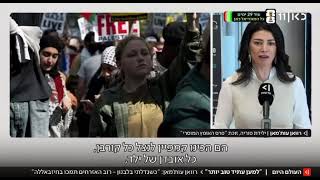
we move to a part of the evening where technology and e economics make room for something a bit different. human spirit uh spirit and the Atlas Prize celebrates innovation. But the Enran Center and the Atlas Prize also believes that that innovation cannot exist without freedom and without the courage to stand for truth even when the winds around us are stormy. Now the moral courage award now presented for the second year honors an individual who has demonstrated that words and values and moral clarity can become a powerful force against disinformation and hatred. This year the award carries particular deep significance as we present it to Rawan Osman for her brave and uncompromising stand for truth and for Israel in the face of immense pressure and hostility. Let us watch a short video about Rowan's extraordinary work. >> Freed from what? And from whom? From the Jews. Why are the Jews there? Because Jewish history presence, language, and religion originate there. Because Jews never disappeared from the land. Because refugees returned to their indigenous homeland after centuries of exile and persecution. That is not colonialism. That is return.
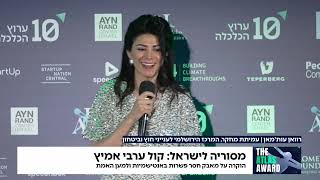
I'm half Syrian, half Lebanese. I lived in four different Arab countries. I speak Arabic and I speak Hebrew and trust me, Israel is not the problem. Israel is the source of pride for many Syrians, Lebanese, Iraqi, Yeites and Iranians who are grateful for what Israel is doing today. Thank God for Israel and Messiah. I ask Qatar, why didn't you arrest the Hamas chiefs in DHA and demand release of the hostages? Why did you finance terror? And I ask Iran, why do you send billions to Hamas and Hezbollah instead of liberating your own people who are suffering oppression and poverty? Egypt, you charged thousands, thousands of dollars to escape the war. >> Very impressive. So, let's present the award and speak about the meaning of moral courage in our times. I'm honored to invite to the stage Dr. Michael Kan who's an entrepreneur, physician, scientist, and longtime supporter of the Atlas initiative. Michael, please come up to the stage. the beginning of this Atlas Junior's project and the Atlas Award, which I've been involved in a long time, and to be a dual citizen of America and Israel. Uh, one of the heroes of tonight is Rowan Osman, who was born in Syria, uh, raised within a world shaped by deep hostility towards Israel and the Jewish people. And her life journey took a profound turn as personal encounters, thinking, independent thinking, moral reflection led her to challenge the assumptions and dogmas which she had grown up with. Over time, she transformed. You transformed from someone shaped by fears, prejudices, and anti-semitic influences surrounding her into one of the clearest and bravest voices confronting anti-semitism, Islamist fanaticism, and tribal hatred in the Arab and Western worlds alike. Through public speaking, writing, media appearances, personal testimony, and great bravery, she has become a force of moral clarity, illuminating the dark spaces where conspiracy theories, superstition, ideological fanaticism, and hatred of Jews continue to fuel violence and jihadist attacks against Israel and the free societies more broadly. Her story, your story, is not only political, it's deeply human. It is the story of an individual willing to question inherited beliefs, accept difficult truths, and stand publicly for reason, freedom, and moral responsibility despite intense pressure and personal risk. For this, you have been chosen as the recipient of the 2026 moral courage award. And I'd like to invite Boaz Arad and Ambassador Mike Huckabe up to join us on stage. We can say a word about this award. This is man shaping his own destiny sculpture by Bobby Carlile that man that actually represent what we honoring today. Raan please come to meet you. It's an honor. Congratulations. He wants me to say you got to have that. >> I hope it's not too much. So, we'll let Ran now have the stage and the mic. the mic. >> Thank you. >> Thank you. >> Thank you. Thank you all. Thank you all for being here. Thank you, Boaz. Thank you, Boaz. I'll come back to you in a second. Thank you, your excellency, for taking the time. Thank you all. I truly honestly do not
understand why Israelis always thank me. Even at the hotel where I'm staying, I found a huge plate of fruits and a lot of wine with a note thanking me. I rented an apartment in Jerusalem in August. People asked me why. Because every second Israeli give me their signed book. I have so many books. I had to rent an apartment and now I add statues. I do not deserve a thank you, but this award award is will be a reminder for my grandchildren of how absurd our reality was. I've been to Israel only after October 7th and I've been more than 20 times. My family is only My family's my son Adam who's at university now. university now. The first time I came to Israel, he asked me, "Why are you doing this to me? You're my only family. We have a big family. But they punish me for what I do for standing with Israel by not speaking to him. And I told them, I do this for you. For you. I will not live in a world where anyone can commit October 7 and get away with it. I've been living in Europe for 15 years. I will not live in a Europe where someone will dictate to my granddaughters how to dress and what to say for you. And now he understands and is a bigger Zionist than I am. I would like to seize the opportunity to emphasize the importance of social media up until October 7th. I thought it's a waste of time because most of the time it is a waste of time. Except when we wrote a paper on Hamas self-representation post October 7th and we realized how important social media is. I became an influencer. I do not post about my lifestyle, bikinis, nail designs and cakes. We can influence public opinion because this is exactly what the so-called axis of resistance is doing to us. Social media is so important. I'm here before you because thanks to social media. This is how I know Bhazahad. I'm sorry to give away your age, but we're both on Facebook still. I'm also elsewhere. And this is how I bypass something very interesting for you to learn about. Since Israel became a country and the Arab countries that waged war against it lost, they implemented a strategy to boycott Israel and they embedded in most of their basic laws and constitutions anti-enormalization laws and policies forbidding peopleto-people contact between the citizens of those countries and Israel. ies even abroad. I'll explain. A Lebanese, an Algerian, a Kuwaiti meet a an Israeli abroad, they're not allowed to talk to them in London, in Sydney. So, I do agree with Antonio Guterish. October 7 did not happen in a vacuum, but it didn't start in 1948. This systematic dehumanization to the Jews led to October 7. So social media is very important and it allowed us to reach out to the other side. This past Saturday we had a space on X an online event where it started with 1,200 1,200 Libanese and Israelis. The initiative was Libanese where we talked to each other. People had hard conversations because they're hurting. Be it in Lebanon or in Israel. They're not. The military intelligence in Lebanon cannot arrest everybody for speaking to Israelis. People cried. It's a start. We have a long way to go, but we are counting and we've been talking about this for a decade. We need the USA to help abolish the anti-normalization laws and policies so that people can start the dialogue and we are heading there although everything seems to be doom and gloom but it is not. I'm making a documentary again based on the request of some Libanese to introduce the Israeli narrative that's been omitted for decades in Lebanon. And this is a study case, not only the Lebanese will see it. So I discovered a few interesting people. I learned that you sir are the economic atache. Did you know that Israel had an economic attache in Lebanon between 1982 and 1984? I met him in his house in Herza and he told me many interesting stories including the Lebanese were importing Israeli bananas. The world was a bit different and all these efforts were aborted. But I'm going to tell you a story and I hope I was hoping more youngsters will be here. It seems they had enough today. But this is recorded. So are you here? I'm so proud of you. By the way, I want you when if you meet miserable older people who tell you, "We tried so hard for peace, it doesn't work." I want you to know that most of what we are fighting against is ignorance. You know, when I was your age, when I was a teenager, I was one of his biggest fans because Israel occupied South Lebanon. Nobody told me why Israel went and created a buffer zone in South Lebanon. So when I'm making this
documentary, I stumbled upon a story and I called this lady called Haran in Nahar and I asked her for an interview and she said I haven't given I was nobody was shushed ever. I'm a public speaker only here. Welcome to Israel. The Israelis cannot be controlled. So I called Sad Haran and she said no I haven't given an interview for 25 years and I wrote to her listen I grew up in a culture that celebrated Samir Kar when he was released in 2008. I'll tell you his story. I told her I grew up in that world. You will tell me your story because I have to tell it to the Libanese. Samir Alar in 1979 that cursed year infiltrated the Libanese borders by sea together with his terrorist colleagues. They went into Smadar's home. took her husband Danny at the s at the time and her four-year-old daughter. She hid in the attic with her two-year-old daughter and the neighbor. They didn't have electricity because of all the grenades that had been thrown in the building. So, she exited from a different place and she found a neighbor in distress. They crawled in the attic with a toddler. They tried to stop the toddler from crying. Smadar accidentally suffocated her daughter. She thought her daughter slept. Her daughter died. daughter died. Meanwhile, Samir Kar and his colleagues took her husband and daughter to the beach. They shot Danny in front of his 40year-old daughter and then they didn't shoot the girl. Samir, my apologies, but I am a storyteller. Samir smashed the skull of the fouryear-old with a rock. according to eyewitnesses. Then he was badly injured, taken to the hospital, treated since 1979. He stayed in Israeli prison until 2008. After 2006, after his kidnapped Israeli soldiers and thanks to that operation, Samir Countar was released. Samir Kar was celebrated a hero. I remember children lining up on streets waving flags celebrating his release. Al Jazzer threw him a birthday party live. They threw him a birthday party during this space on X. I asked the Libanese and I told the moderator, give the mic to everyone to speak. Do you know what Samir Kar did? Did you celebrate his release? Yes. Do you know what he did? Smada told me this story. You know, the most amazing thing about Israel, what Israel's enemies will never understand is really resilience. This is not a cliche. Smadar is a psycho therapist who remarried Yakov, who's a psychotherapist. She specializes in treating traumatized children and she had two daughters. Again, now this is Israel for you. I would like to briefly say I meet politicians, parliamentarians, diplomats. It it's always frustrating because as we say in French long dub bua they're like robotic and pariting. I want to say that it is an honor for me to be associated with your excellency with ambassador Mike Huckabe even if for a moment in Tel Aviv stock market not because not only because you're the American ambassador but because you are a mench. Thank God for you and thank God for all you do. Now to end, normally I'm allowed to speak for 40 minutes but not here. I just want to tell you that I have faith that I believe in Israel that I have thousands of friends in this country, not only Jews. I know that we are in a very, very, very low point, unprecedented. But I know that Israel will prevail. I know the same way I know my son will be fine when I bring him during wars with Iran. you said that it's not a coincidence that you are here whether you're religious or not. It's insane that you've survived all this. I know it's going to be fine because I believe in Israel. I'm proud of you. I love you. And I want to tell you recently, two days ago, an Israeli thanked me. I was on the phone about to take the train and he said, "I'm sorry. I'm sorry to to disturb, but I have to go and I'm not going to go without saying thank you for all you do. And I told him, you can't believe it. I'm on the phone with a Lebanese Christian called Paul who lives in Saudi Arabia. He prayed Christian prayed for the Rebe for something and it happened. So he wanted to reciprocate. So he made a website all in Arabic about the teachings of the Rebe. And I told him, "Paul just heard you." And he said, "It's amazing. It's amazing. This is the Israel that I'd like the world to know. I'm proud of you. I love you. I'm Isai. Thank you.
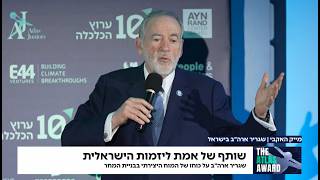
Ladies and gentlemen, distinguished guests, entrepreneurs, distinguished guests, entrepreneurs, students, and friends of the Atlas Award. I'm delighted to greet you this evening and to congratulate the Einran Center Israel and the entire Atlas Award team on this the 10th anniversary of this remarkable celebration. I want to acknowledge the presence of Ambassador Mike Huckabe. Mr. Ambassador, Mr. Ambassador, you honor us with your presence tonight. Thank you for your support and for supporting the values that make Israel such an extraordinary country. The Atlas Award has special meaning for us because Atlas is not just only a literary symbol but he also represents the individual who thinks, builds and carries civilization forward. That is what we honor this evening. We recognize entrepreneurs, builders, and value creators. The men and women who see a problem and do not merely complain about it. They solve it. They identify opportunities and pursue them. Tonight, we rightly honor those entrepreneurs as heroes. As heroes. Israel is a land built on heroes, defended by heroes, fought for by heroes. And you know who they are. They imagine what does not yet exist, then summon the courage, discipline, and the persistence to bring those ideas into reality. That is why this is not merely a business award. It is a celebration, a celebration of human achievement. And there's no better place than such a celebration than in Israel. Why? Israel is a nation of energy, intelligence, courage, and creative ambition. And that's why it's earned the title startup nation, but is more than that. Israel is a heroic nation. Now, that's a big word heroic nation, but I think that fits. It fits the resilience, the inventiveness, the aliveness, the alive purpose and unwillingness to surrender to a future of fear. I believe Israel has one of the most remarkable futures of any nation in the world. Not because of its natural resources, but because of the minds and the character of its people. The entrepreneurs recognized tonight are part of that future. They create wealth, but more than wealth, they create possibility. Entrepreneurs take risks. They endure uncertainty, setbacks, pressure, and sleepless nights. They accept responsibility. They accept responsibility. Even when success is is removed, is not guaranteed, they still keep going. That is the moral meaning of entrepreneurship. It is the independent judgment in action. It's intelligence made productive. It is courage applied to life. The companies represented here are solving real problems and creating value not only for Israel but for the entire world. Every startup, every breakthrough, every success begins with an idea. An idea and with the person who refuses to let that idea remain just an idea. I'm especially pleased that the Atlas project includes students from Atlas juniors. Young people need to see they need to see concretely what success is, not luck and not magic. It comes from thought, effort, discipline, ambition, and productive work. They need to meet the men and women, the tenacious men and women who are building companies, creating value, and shaping the future. To the founders, innovators and students here tonight, you are torchbearers of progress. You are helping build prosperity and a better future for people. That is the that is the spirit of the Atlas award. I want to thank you Boaz. I want to thank the Einran Center Israel for their leadership and dedication. Also, my thanks to Richard Mins, the judges, the sponsors, supporters, and everyone who's helped build this award over the past decade. I'm proud to be a founder of this marvelous project. Einrand was a great champion of the entrepreneur. She understood that producers, creators, and builders make the world a better place for people to live. she would be proud of Israel, proud of this award, and proud of the men and women we honor tonight. So, congratulations to the winners, finalists, entrepreneurs, students, and all of you who are part of this remarkable project. May the next decade of the Atlas Award be even stronger, more productive, and more inspiring than the first. Tonight we celebrate not only success but the remarkable men and women who created. Thank you and congratulations and have a wonderful evening. Thank you ladies and gentlemen, it is again my great honor to introduce introduce tonight's guest of honor and keynote speaker, the United States Ambassador to is to Israel, Ambassador Mike Huckabe. Throughout his public life, I should say your public life, Ambassador, Ambassador Huckabe has been a steadfast friend of Israel and a strong advocate for the values that unite our nations. Freedom, individual initiative, faith in human potential, and the belief that innovation and courage can shape a better future. Tonight's audience includes founders, entrepreneurs, scientists, investors, innovators, and young students just learning. People building technologies and companies that are transforming industries and improving lives around the world. I believe there is a deep meaning in having the ambassador of the United States with us this evening at a gathering dedicated to Israeli entrepreneurship and the power of free minds to create value and to improve human flourishing. At the time when the partnership between Israel and the United States is more important than ever, we are honored by your presence here tonight. Please welcome me. Please join me in welcoming the United States Ambassador to Israel, Ambassador Mike Huckabe. >> Thank you very much. Thank you, Michael. Thank you very much. First of all, I
want to just uh express to you that I've heard a lot of wonderful speeches in my lifetime. I don't know when I've ever heard anything as powerful as Raman. Thank you. Bless you. What an honor to meet you. I've been to a lot of awards ceremonies and I've watched many on television as have you. The Oscars, the Grammys, the Emmys, the Tony's, all of these awards and people come up and they're given a statue that looks very much like that. But I've never seen anyone receive an award that was more deserved, more appropriate, and more significant and more significant than watching Rowan get this reward tonight for her extraordinary courage. Thank you. Thank you. As soon as I finish speaking here tonight, I have to leave and head to the airport, fly to Washington DC for the next three days. We're going to be dealing with the people both of Israel and Lebanon and trying to see what kind of future could be built in Rwanda. realize you need to come with me because honestly I know of no one on the planet who has a more vital important and personal message that could change the atmosphere that we're working on. I look forward to introducing you to many of the people that I'm going to be working with over the course of the next few days because I honestly believe that your perspective is one of a kind. It's the one that we need to hear much more of. It is not a story of animosity and bitterness and hate. It is a story of reconciliation. But more importantly, it's a reconciliation that is based on truth and fact and reality. Right now across the world, there are people who blame Israel for pretty much everything. If something goes wrong, must be those Jews. I can say that I'm not a Jew, but I don't blame the Jews for what's wrong in the world. I certainly don't blame Israel. I blame the people who have believed a lie. A lie that is destroying entire nations, dividing families, and causing the death of many people for no valid reason other than they were just in the way of the hatred that some people have decided to live by. When I think about these incredible young entrepreneurs, and as I walked through tonight and met many of them, had pictures made with them, had them share with me their projects, I got to realizing I'm meeting some of the future billionaires of Israel. of Israel. Some of these young people, maybe they're 15, 16, 17 now, but give them just probably a very short period of time, and in their 20s, we'll all be wanting to borrow money from some of them. So, I want to go ahead and get their names and phone numbers now. And that way I can say, "I knew you win." Great things happen because people don't look at what is, they look at what could be. The great hockey player Wayne Gretzky was once asked, "Why are you so much better than all the other hockey players? How do you know where to where to be on the the ice in order to get the shot that wins the game? He said, "Well, I never skate to where the hockey puck is. I skate to where I think it's going to be." When I see these young entrepreneurs,
I'm not looking at people who are looking at the world that they have and say, "That's it." I'm looking at young people who see the world they have and say we can make this better. The world we live in is better because people didn't quit. Many people don't know that Thomas Edison who is credited with creating the light bulb and the phongraph and so many wonderful inventions that we take for granted and upon which became the foundation for some of the greatest technological advances in the history of the world. What people don't realize is that before Thomas Edison created the light bulb, he failed at creating the light bulb over 1,000 times. He was being interviewed and a reporter said, "Mr. Edison, do you feel like a failure for having failed over a thousand times trying to create a light that comes from electricity?" Edison looked at the reporter and said, "Oh, I haven't failed. You don't understand. I've already succeeded in showing a thousand different ways that it won't work. His persistence paid off and tonight we have light in this room. Not because of his success, but because he didn't quit due to his failures. how easy it would be for us to look at the world in which we live and say peace can never come between Israel and Lebanon, Israel and Syria, Israel and Iran. But rather than say it cannot be done tonight, Rwanda, I'm encouraged by you and realizing all we got to do is just skate to where the puck is going to be and look for the ways to see that people can come together and ideas can change the world. I wonder if everyone in Lebanon understands that if there were no Israel, they wouldn't have a cell phone. I wonder if they understand that every time they use a USB, every time they use car navigation, that every time they eat a cherry tomato or have a delicious bite of seedless watermelon, instead of saying, "I can't talk to those people," they should step across the border, shake the hands, and say, "Thank you. Thank you for helping create some things that have made my life better and easier." My first visit to Israel was in 1973 before pretty much anyone in this room was born. I think I've see one person back there who might have been born since I had just gotten out of high school. Two people. Okay. Nobody else wants to admit it because that means you're old like me. 1973 I came here. It was right out of
high school. That's when I fell in love with this country, its people, its resilience, its extraordinary potential. But I want you to understand in 1973, this was not the startup nation. This looked like the finished up nation. It was almost third world. There weren't problems with traffic because there were not roads of any consequence. Two-lane roads here and there. There weren't that many cars. People couldn't afford them. The economy was struggling. People sold a few Jaffa oranges and tried to bring some tourists over from America so they could look at the sites. People struggled. There was not vast forest groves, vineyards, and farms that produced magnificent vegetation, fruits, and all kinds of vegetables that the people could enjoy. My wife and I grew up in the deep south. And in the deep south, let's just say that the normal eating habits include a lot of fried foods, not known to be the healthiest thing in the world, tastes good. and we were sitting at the residence after having been here a couple of months after my appointment and after I'd gotten settled into the job of being the US ambassador. We were sitting and we were talking about how different the food was in Israel because it is so healthy, all these fruits and vegetables, all fresh. And I looked at my wife and I said, "You know, this healthy eating is going to kill us." But it isn't. But it isn't. Between 1973 and 1981, I couldn't wait to someday come back to Israel. And in 1981, I started bringing groups of people here. And over the years, I brought tens of thousands of people to come and see this land for themselves. I'd been to Israel over a hundred times. before I got that phone call from President Trump, he called and he said, "By the way, to to understand President Trump, he doesn't ask you, he tells you." And it's one of those things I get the phone call out of the clear blue. Never had the conversation with him. Wasn't looking for a federal job. Honestly, I was living in the private sector, living a wonderful good life. The last thing I thought about, needed, or wanted was to take on some job and move halfway around the world. I loved coming to Israel, but I like to do it two weeks at a time and bring people in and take them home. Had never thought about living here permanently. He calls, he doesn't say, "Would you or could you or would you think about No, he calls and he says, my Donald Trump, you're going to be my ambassador, ambassador to Israel. You're going to go, you're going to be ambassador there. You're going to be great. You'll be great. There was no way I was going to say no to him. Number one, you don't say no to President Trump. Number two, if he'd asked me to do anything else, be a cabinet secretary, didn't matter what it was, I would have said, "No, sir. Thank you very much. I love my life and I'm enjoying it and I don't need a federal job. But when he said, "You're going to be ambassador to Israel," I realized that it truly was, as said in the book of Esther, "For such a time as this." And I felt it was for me an Isaiah moment. Here am I, Lord. Send me. I came because I believe that there is an opportunity to see something that was not even visible in 1973, 53 years ago when I first arrived here because it was not the startup nation. It was anything but. It struggled and its people did not look like if you just looked around that they had a terrific future. Nobody would have imagined that in the economy facing war on every side of them, they would have an economy that actually had growth in the GDP. I want you to understand, nobody does that. It doesn't happen. Since October the 7th, the stock market, here we are in the Tel Aviv stock market. The stock market has grown over a 100% in Israel since October the 7th. That simply does not happen. Some of the greatest inventions, technological advances, and entrepreneurs live right here. And they provide and produce the things that change the world. And most people in the world don't even realize that it was here in the land that so many people want to point their fingers at and hate that their lives have been made better through better medicine, better agriculture, better technology, better defense mechanisms, better ways of living safely, better automobiles, all sorts of ways. An Israeli bought a farm down in the Ngev Ngev and it was back years ago. It was nothing but rock and dust and it was absolutely barren and worthless. But he believed in Israel and he believed that God had brought him here to make aliyah to do something special. He put in drip irrigation on this little farm that he bought. And within just a short period of time, that desert began to bloom, just like it says in the Bible. And what was nothing but rock and dirt became a lush farm on which he was producing beautiful and delicious vegetables and fruit. One day his rabbi came out to see him and the rabbi said, "Oh my son, what you and God have done with this farm." And the farmer wiped the sweat from his brow and looked at the rabbi and said, "Yeah, Rabbi, well, you should have seen it when God had it all by himself." It is a wonderful reminder to all of us that yes, this is the land God gave to the Jewish people 3,800 years ago. He gave them a place and a purpose and today we see it fulfilled every single day in front of us and it is something to behold. But I also want you to know that while God without a doubt has his hand on this land and I see miracles every single day here, I also know that he didn't do it without the sweat and the extraordinary heavy lifting done by the people of Israel. I hope that people like Rwan and I will be able to join handinhand with our Israeli friends and say we want to help you build a better world where if you born in Syria and grow up in Lebanon one day you wave the flag of Israel and you say to the people of Israel, "Thank you." And a kid like me who grew up dirt poor in South Arkansas in a family where no male above me, not one, had ever even graduated high school. To be able to live the American dream, travel the world, and one day serve as an ambassador to a country that I fell in love with 53 years ago. This is a remarkable place and tonight we honor those who will make it even more remarkable with the discoveries, the extraordinary dedication and hard work to build a better Israel and a better world. And I'm honored to be with you tonight. God bless you and thank you for letting me be here. Thank you. Are you going with the Trump with embassy anyway? You are both invited to the dinner. Thank you very much. >> Thank you. And we will now move on to the actual awards ceremony. I would like to invite Mr. Moshik. ask you who will be awarding the prizes, the awards until the big winner.
committee composed of 12 judges, each with an impressive record of entrepreneur. ersship and investment has gone through each candidate in detail. We asked each company to describe its innovation, execution, achievements and challenges. This year for the first time, we also asked them specifically to detail how AI is integrated in the product. Judges graded the company based on these criteria and the grades were integrated with quantitative data composed of valuation and revenues. That process produced the 16 finalists who are present here. All these companies came and presented to us in person or via Zoom in a special committee meeting held 10 days ago in Tel Aviv. Following this meeting, a final grading of each judge independently was submitted and these grades were averaged to produce the winners who will receive the award tonight. I'd like to thank my fellow judges for the great work they did and also apologize for harassing them to submit the results on time. I also think I also wish to thank Bazarad the energetic router behind the event and Talif Sheets my excellent companion in the selection process. We have a tradition we hold dear hearing from last year's winner. So, few more minutes of patience. I'd like to call again the 2025 Atlas Award winner he co-founder and chief operating officer of UVI to say a few words. Please part of this enterprise, the Atlas Award, including the Atlas Junior and Basin Elina, the founders. You are remarkable. So, thank you. So, thank you. It's always exciting to see how such a small country can export and create so much uniqueness, so many technologies and to conquer so many segments in the world and I think you'll agree that over the last few years it really only just hones our purpose and our banner goes before us all the time. and a little bit about UVI and how we have been progressing these last few years. We continue to um reach new heights with new segments, new clients, big PE, big companies like Herz, Amazon, companies in the auto industry like Toyota and Volvo and many others. And we are very happy to be part of this wonderful thing called Atlas and more than that to be able to provide the younger generation with the tools so that they will be able to keep going and they'll be the ones who will follow in our footsteps and we'll continue with all this very important work. And on this uh optimistic note, well done and congratulations to the winner and good luck to all the other contenders as well. Thank you. I'd like to invite at my side to the stage to share this exciting moment some of my fellow judges Gil Hod please in Bal Shanefield Dr. for Shaon Shaham and Tal Duri. I also like to invite Boaz Alina and Iran Bartal, chief editor of channel 10, the economy channel. So we all set. I will now invite Gilhod to announce the winner of the cyber and defense category. >> Envelope. >> Thank you. >> Yeah. All good. So I'm proud to announce uh that the
winner in the cyber defense sector is uh Remedio It's so exciting to receive this award. Thank you all so much. Being here is incredible. seeing all the speeches that were given here. We're very moved. Thank you so much for selecting us. >> Thank you. And I now invite Inbal Shanefeld to announce the winner of the transportation and st category. TR RSP. Next antenna.
Next antenna. >> Next tenna. >> I think the CEO is abroad, right? >> CEO is >> CEO is >> the CEO is in the Silicon Valley right now. >> Thank you very much. Thank you very much. It was an extraordinary evening especially uh the award of Ran which is something very touching u and we are very grateful for this uh award. We will uh announce the CEO which is in now is in another competition in uh in the states and they will be very happy. Thank you very much. Thank you, Nexenna. And I now invite Dr. Shaon Shaham to announce the winner of the healthcare and life science category. >> Okay. Excited to announce that the winner in this category is Navina.
>> Y Thank you so much. This award actually belongs to the 20,000 doctors that use the Navina platform copilot every day and to the incredible Navina team. Thank you and thank you for this. And for the last category, I'd like to invite Talori to announce the winner of the robotics and physical AI category. Thank you. And the winner for robotical AI robotical AI Halo technology.
So, thank you very much for this recognition and uh very proud to be here and represent the emerging physical AI scene in Israel, which I think is going to be one of the biggest waves uh that has come out of this country. So, thank you very much. >> I'd like for the final award, for the big award, I'd like to invite Dr. Michael Calfman to the stage. Such a >> such a big moment. I can't open the envelope here. Boy, you guys really >> This is like a joke. >> We need a We need a company to work on envelope open. >> Yeah. >> Yeah. >> Okay, >> Okay, >> there we go. >> We need IDF IDF training.
Well, they should never have sat down. Halo Technologies, congratulations, Halo Technologies, congratulations, Mazelto. Mazelto, worth waiting for. Well, uh, thank you very much. Okay. So, maybe I said a few words about the company. So, hello is a an Israeli semiconductor company. We develop AJI processors. So, bringing AI to the physical world around robotics, drones, which is mentioned here quite a few times, cameras, industrial automation, many other fields. This is a as I said before a big revolution that is coming and I think it's going to be one of the most impactful technologies that for society hopefully for the better and again thank you very much for this recognition. was an extraordinary moment. Congratulations to tonight's double winner. >> Will the judging committee members please join us for this photo op? You worked so hard. So, if you're not on the stage yet, please come up on the stage. So, this is uh we're about to conclude this inspiring evening. I would like to once again thank our distinguished speakers, United States Ambassador Mike Huckabe, Dr. Michael Kafman, the courageous Rawan Osman, Bazar and of course Dr. Elina Lusttov. Special thanks as well to the partners we have accompanied us on our journey to this 10th anniversary event, Tel Aviv Stock Exchange for its gracious hospitality, Kolkata TV, channel 10 for its media partnership, the Prometheus Foundation, and Ran Center and our sponsors IBI Capital, Phoenix Smart and Bzone. to everyone who continues to support Israeli entrepreneurship and above all thank you our audience here and at home for believing the Israeli mind and innovation without limits. So here are all the happy winners and the bas for a photograph and now we can watch the video with a credits that we've prepared. So thank you everyone. Thank you for coming. Thank you to all the companies. You are all amazing and extraordinary. And thank you Danny of course our moderator this evening. Thank you Danny for being our host and for the wonderful programs you do. Part of what we are honoring this evening is that >> for the >> for the moving moved moving moved um speech that you gave. Thank you. It was honor to having you here. Thank you. Thank you all very much. We'll see you next time. Good night. We'll see you in the Atlas Award 2027. You can go ahead if you want. I'll make sure that uh everything is such a good voice. >> Thank you, >> Thank you, LMA. What is wrong with your voice? >> Thank you. You have a lovely voice and I love working with you. Hi. >> Poor children. No, I'm sure you do. >> I do.
רגעים מובילים
עדות אישית עוצמתית!
אפס תשתית, פשוט חבר והפעל!
משפחה מנודה בגלל ישראל!
מסתגלים למהומה גלובלית!
חדשנות בלתי מתפשרת, השפעה גלובלית!
מטפחים את חדשני העתיד!
הבא בתור