
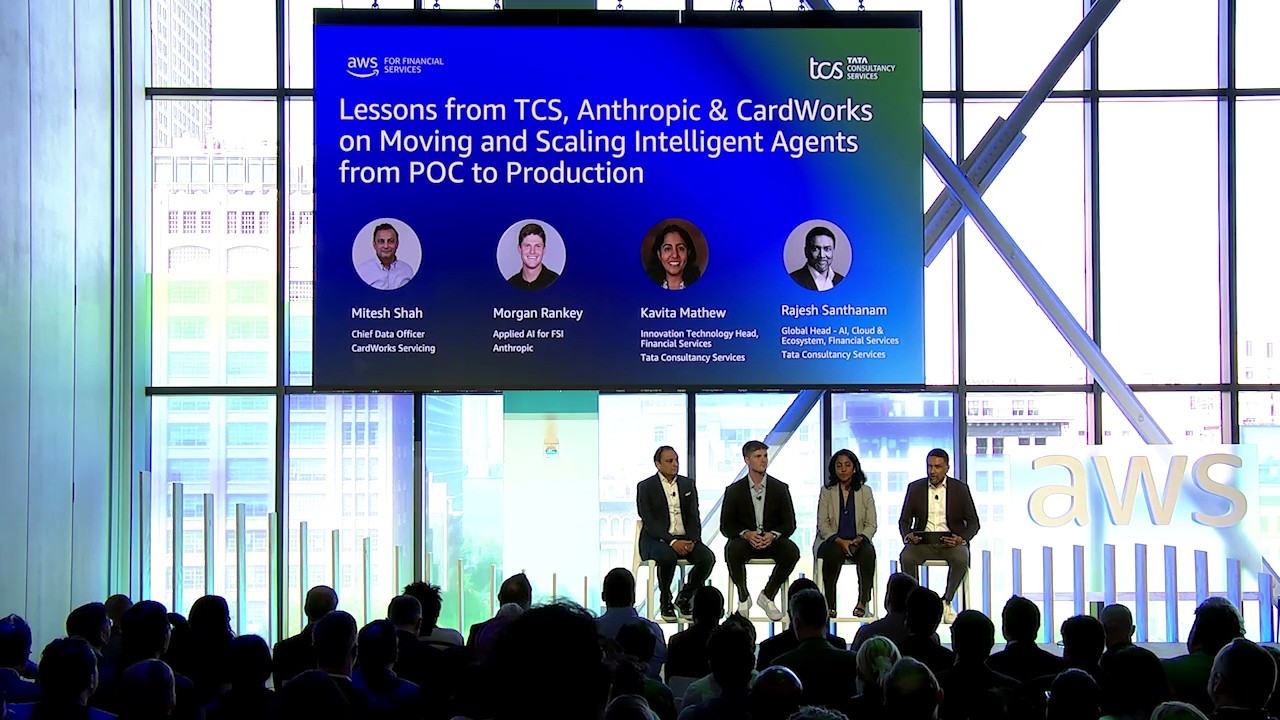
- AI adoption in FSI is rising, yet large-scale production remains a challenge.
- Integration and data readiness account for 60% of AI project effort.
- Top-down leadership and pragmatic prioritization accelerate AI transformation.
- Reimagining entire value chains with AI can yield 70-80% efficiency gains.
The financial services industry is grappling with a significant challenge: translating promising AI pilots into scalable, production-ready solutions. Despite widespread experimentation, many organizations struggle to move beyond initial proofs-of-concept. This panel discussion at AWS FSI NYC 2026, featuring experts from TCS, Anthropic, and CardWorks, shed light on the core impediments and offered actionable strategies for successful AI adoption and transformation.
Kavita from TCS highlighted the 'Martec's Law' phenomenon, where technology advances exponentially, but organizational adaptation lags. She identified several critical challenges: integration, which can consume up to 60% of project effort; data readiness, as many enterprises lack AI-ready data and robust data lifecycle management; the need for cross-functional teams including business experts and platform SMEs; and effective AI governance, emphasizing a centralized control plane for model risk and lifecycle management. Finally, organizational readiness and early business user engagement are paramount for successful adoption.
Morgan Riky from Anthropic emphasized the importance of strong leadership for accelerating AI transformation. He recommended appointing a single-threaded leader for AI at the highest level, with sub-leaders owning specific use cases. This structure fosters ownership and drives momentum. For prioritizing use cases, Morgan advised creating a chart based on complexity and business impact, starting with low-complexity, high-impact projects to secure early wins and build internal capabilities. He also stressed the critical role of involving security and compliance as partners from the outset, rather than as an afterthought, to avoid delays and roadblocks.
Mitesh Shah, Chief Data Officer at CardWorks, provided a compelling real-world example of accelerating intelligence. His team, serving the subprime credit card market, leveraged AWS and Snowflake with Anthropic's Claude to analyze the impact of oil prices on delinquency rates. What once took modelers a week to collate data and build criteria, now takes just five minutes using AI agents. This dramatic reduction in time allows for rapid decision-making, demonstrating the power of AI to transform traditional analytical processes. CardWorks is also exploring generative AI to convert legacy SAS code into modern SQL/Python for cloud migration, addressing the challenge of legacy system integration.
The panelists converged on a powerful message: to maximize AI's potential, enterprises must shift from merely embedding AI for incremental productivity gains to fundamentally reimagining entire business processes with an 'AI-first' approach. This means aiming for 70-80% gains by designing humanless processes and then strategically identifying points for human intervention. A 'graduated autonomy' approach for AI agents, starting with human oversight and progressively increasing autonomy based on performance, coupled with robust centralized control planes and guardrails, is essential for building trust and managing risk in autonomous systems. Ultimately, the goal is to leverage AI not just to do things faster, cheaper, or better, but to create entirely new value and transformative impact within the enterprise.
“If you want to shift the value equation from productivity and efficiency to really create a business value, you have to look at business transformation.”