- Fintech leader WEX leverages AWS Agent Core for internal productivity.
- Developed 'Chat GTS' and 'Agent Builder' to democratize AI.
- Achieved significant cost savings and increased developer velocity.
- Implemented a robust three-layer governance model for AI at scale.
In the rapidly evolving landscape of artificial intelligence, B2B fintech company WEX has taken a proactive stance, building a secure and scalable agentic AI platform. Faced with internal productivity challenges and a highly regulated industry environment, WEX partnered with AWS to develop a solution that not only streamlines operations but also empowers its workforce to innovate responsibly.
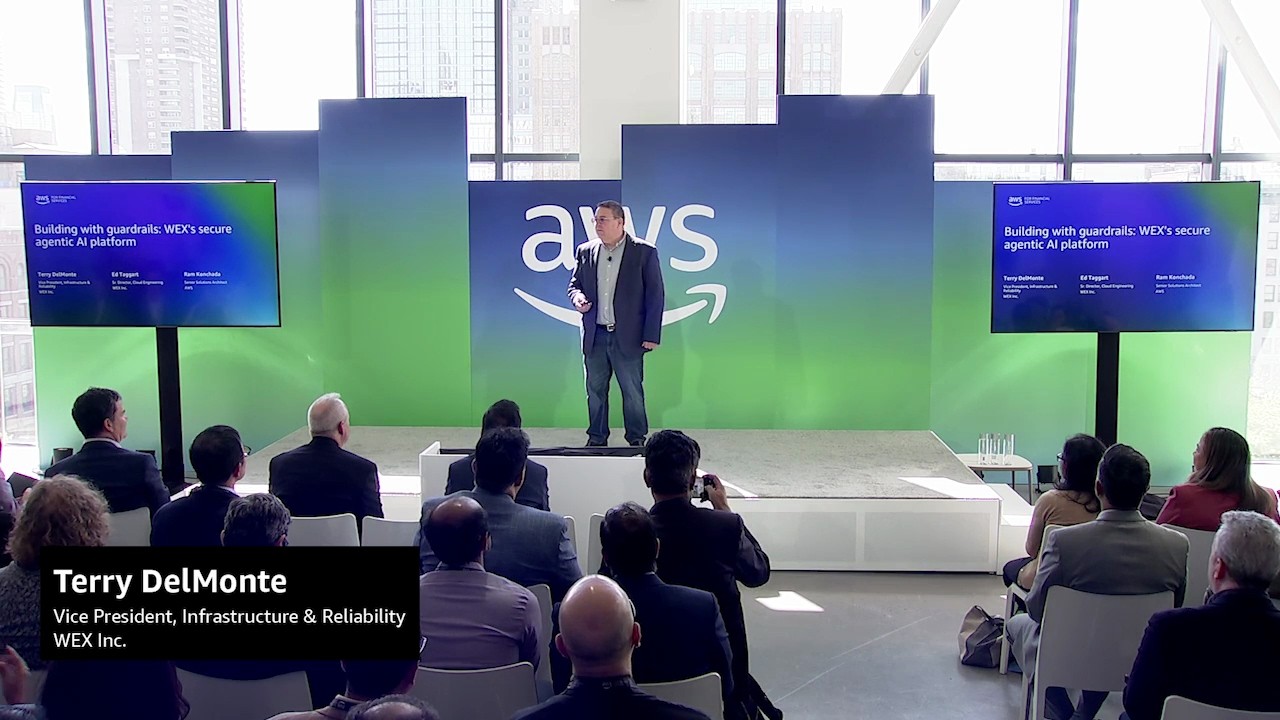
Terry Del Monte, Vice President of Infrastructure and Reliability at WEX, initiated the ambitious goal of creating a "virtual engineer" to handle over 40,000 annual tickets and reduce toil. This vision extended beyond simple knowledge access, aiming for an agent that could take decisive action with appropriate controls and guardrails. A key objective was to democratize AI contributions, enabling any technical employee to build and deploy agents, and even creating an "agent builder" to assist in this process.
The initial rollout of "Chat GTS" demonstrated early success, handling network reachability queries and email blocklist management. However, scaling this initiative and integrating identity and access management proved to be a significant undertaking. The collaboration with AWS and the adoption of Agent Core and Bedrock became the pivotal moment, providing the necessary primitives, security, controls, and guardrails to accelerate development and ensure compliance. This partnership allowed WEX to migrate its corporate chatbot, Finn, to the new platform in just six weeks, avoiding a contract renewal and demonstrating immediate value.
Ram Guntada, Senior Solutions Architect at AWS, highlighted the critical governance framework underpinning WEX's agentic platform. This framework comprises three layers: a governed registry for agent tools, a robust access layer utilizing 'on behalf of' (OBO) identity for precise permissions, and end-to-end observability through OpenTelemetry. These layers ensure that every agent action is traceable, auditable, and confined to the user's permissions, providing a strong defense-in-depth strategy crucial for a financial institution. The agent core policy, distinct from Bedrock Guardrails, deterministically controls what agents can do, while Guardrails manage model output.
The business outcomes have been substantial. WEX now has over 6,500 employees using agents running on Agent Core, with thousands of weekly interactions. The platform has already saved hundreds of thousands of dollars in software costs, and over 60 developers are actively building new agents. By the end of Q2, WEX plans to roll out agent-building capabilities to its entire 1,500-person developer group. Looking ahead, WEX aims to implement the OBO capability more broadly and integrate agentic engineering into the entire AI SDLC process, from product management to deployment, further enhancing developer velocity with human oversight.
“Agent core policies really control what agents can and cannot do, while Amazon Bedrock Guardrails, it controls what a model can say. So, it is these two independent enforcement layers gives an organization a good defense in depth.”
- Terry Del Monte, Vice President of Infrastructure and Reliability at WEX