
- AI slashes product launch times from months to days.
- Human judgment and empathy remain irreplaceable in financial services.
- Strategic workflow optimization is crucial before AI implementation.
- Business-led initiatives are key to successful AI adoption and ROI.
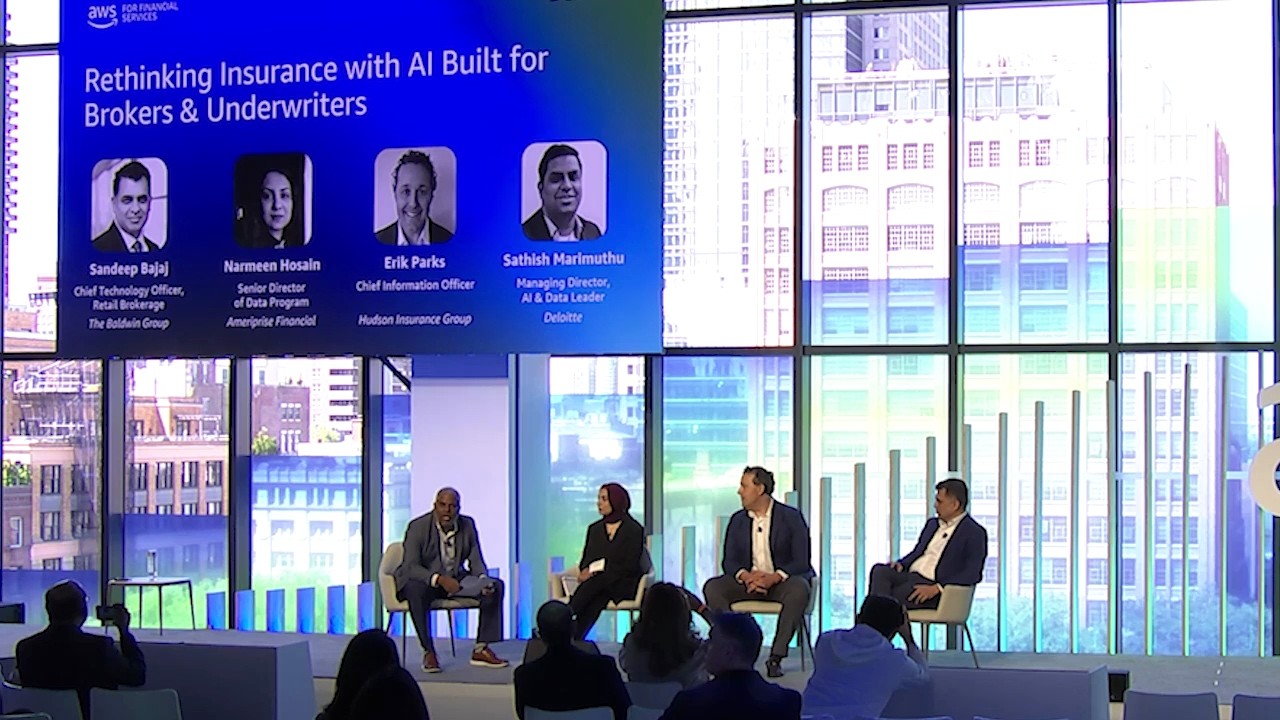
The insurance industry is on the cusp of a profound transformation, driven by the rapid advancements in Artificial Intelligence. A recent panel at AWS FSI NYC 2026, featuring leaders from Deloitte, Baldwin Group, Ameriprise Financial, and Hudson Insurance, shed light on how AI is not just an efficiency tool but a strategic imperative, fundamentally altering operations for brokers and underwriters.
Sandeep Bajaj, CTO for the Retail Division at Baldwin Group, highlighted the dramatic acceleration AI brings, citing a new product launch that typically takes 3-5 months, completed in just 3 days with AI. This speed is achieved by reimagining workflows and focusing on the cross-section of human judgment and data, where AI provides predictions and insights, freeing up key resources like advisors and client executives to focus on client relationships.
Nermin Hussein from Ameriprise Financial emphasized that while AI offers immense productivity, the human element of empathy and sound judgment remains paramount in financial services. Ameriprise's decade-long AI journey focuses on advice insights for advisors, ensuring that technology augments rather than replaces the crucial human touch. Similarly, Eric Parks, CIO for Hudson Insurance, discussed balancing speed and innovation, particularly in specialty markets. His strategy revolves around Minimum Viable Products (MVPs) – 'win fast, lose fast' – to quickly test solutions with brokers and wholesalers, ensuring rapid market entry and alignment with business needs.
Modernization efforts are not just about implementing AI, but about preparing the entire ecosystem. Sandeep stressed the importance of challenging existing workflows and avoiding the mistake of automating bad processes, a lesson learned from past RPA implementations. This involves building an 'AI-ready' data foundation and a plug-and-play architectural approach to navigate the volatile tech landscape. Nermin further elaborated on the necessity of a robust data foundation and a semantic layer to make data easily consumable by both humans and AI, driving not just analytics but also operational excellence.
The panelists converged on the critical importance of adoption and governance. Sandeep underscored that AI must be embedded within business workflows, not merely offered as an optional tool. He envisions an organization where all 5,000 colleagues are 'AI developers,' empowered with tools like Anthropic, but supported by comprehensive training and governance. Eric reinforced the idea of optimizing business processes first to ensure better ROI and business adoption, highlighting that technology leaders must act as psychologists to overcome friction and foster a culture where business problems drive AI solutions.
“AI is something that has to be business-led. Business needs to be engaged right from the get-go. And we are providing the We are We We have now become an enablement organization.”
- Satish Marimuthu, Leader, Insurance AI and Data Practice at Deloitte