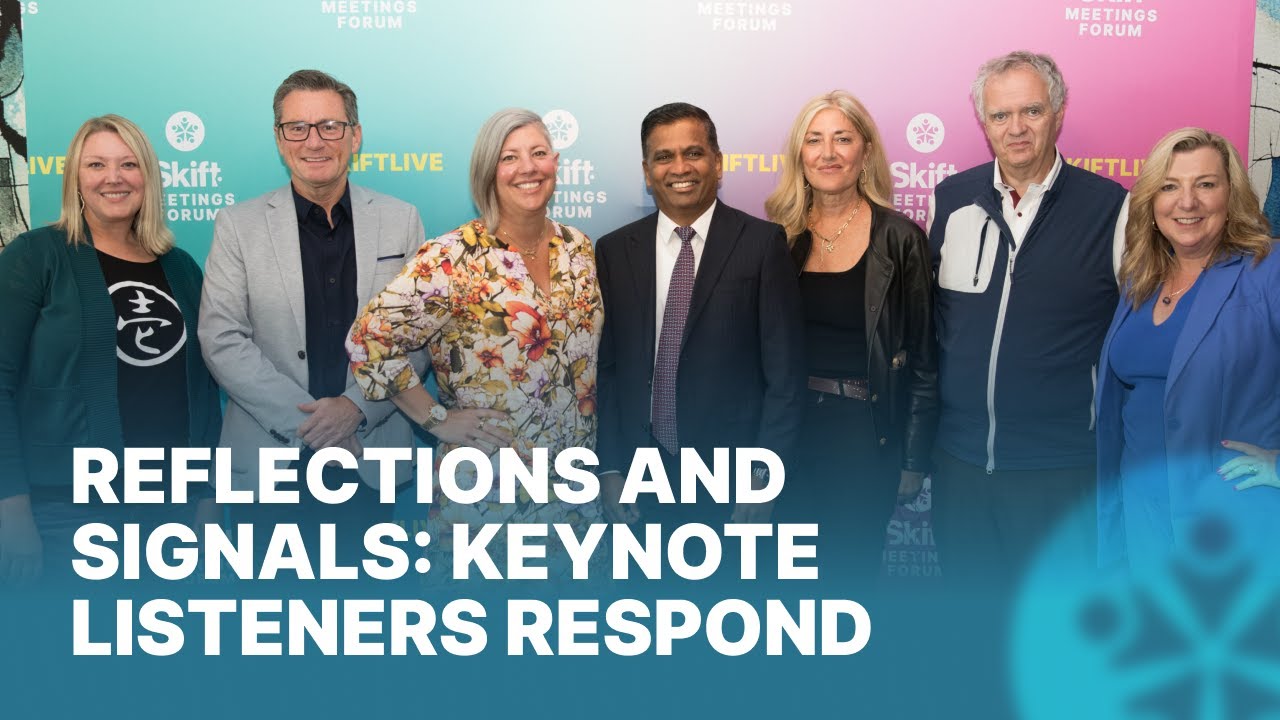
- Top association CEOs share their key takeaways from a day of intensive learning.
- Community, value, and intentionality emerge as central themes.
- Leaders commit to concrete actions to evolve event strategies.
- The call for 'participants' over 'attendees' sparks a paradigm shift.
In a dynamic session titled 'Keynote Listeners: Turning Insights into Action,' a panel of seven esteemed event industry leaders distilled a day's worth of discussions into critical takeaways, offering a clear roadmap for the future. The consensus? The time for passive consumption is over; it's time for deliberate action and a renewed focus on the core human elements of events.
Sento Goponath, CEO of ICCA, underscored the pervasive theme of community. He observed that across diverse event types and geographies, community remains the 'fundamental base' of the industry. This isn't just about large-scale events, but about embedding community in every aspect, from badge production to global congresses. His organization, ICCA, is already putting this into practice by transforming entire cities like Porto into their congress venue, integrating local communities through CSR, culinary experiences, and social events.
Nicola Kner, CEO of ELX, echoed the sentiment of community, adding a layer of resilience. She highlighted that the industry has navigated numerous challenges, from financial crises to geopolitical issues, and will continue to thrive through strong community building. Kner emphasized that community must exist beyond isolated event moments, advocating for continuous engagement through monthly calls and digital sessions. Her actionable takeaway? A member survey to deeply understand what 'value' means to each of ELX's 262 members, ensuring tailored delivery.
Martin Bole, CEO of IAPCO, introduced a powerful linguistic shift, advocating for the term 'participant' over 'attendee.' For Bole, an 'attendee' passively observes, while a 'participant' actively engages and contributes. This distinction is crucial for understanding the 'why' behind gatherings and delivering true value. He plans to integrate this 'why' into IAPCO's training academy, encouraging faculty to mold content in real-time to satisfy participants' evolving needs. Cameron Curtis, CEO of LGBT MPA, pushed this further, suggesting event organizers must anticipate and provide what audiences 'don't know they need.' Her organization, for example, implemented 'photofree zones' in educational sessions, recognizing that not everyone is openly out and might shy away from cameras—a nuanced approach to inclusion.
Perhaps the most direct challenge came from Liz Lean, an event marketer, who candidly stated, "I heard all the same crap we've been talking about for 20 years." Her call to action was unequivocal: stop nodding heads and start forming task forces to implement solutions. Vinnie Pledo, CEO of CISO, offered practical strategies, emphasizing that "serendipity can be planned" through intentional networking and strategic 'white space' in event schedules. Amy Calvert, President and CEO of the Events Industry Council, wrapped up the session by stressing the 'gift of being present.' She urged leaders to coach their communities on active listening and intentional engagement to maximize event experiences, fostering human connections and building trust at a time when it's needed most.
“I heard all the same crap we've been talking about for 20 years. Stop talking about it to each other and nodding our heads and come up with a plan.”
- Miguel Neves, Editor-in-Chief at Skift Meetings