- Boom Supersonic's XB1 broke the sound barrier, proving private sector innovation.
- Solved the "sonic boom" problem, leading to US flight legalization.
- Pioneering software-like iteration for hardware development.
- Vertical integration and passion-driven culture redefine aerospace.
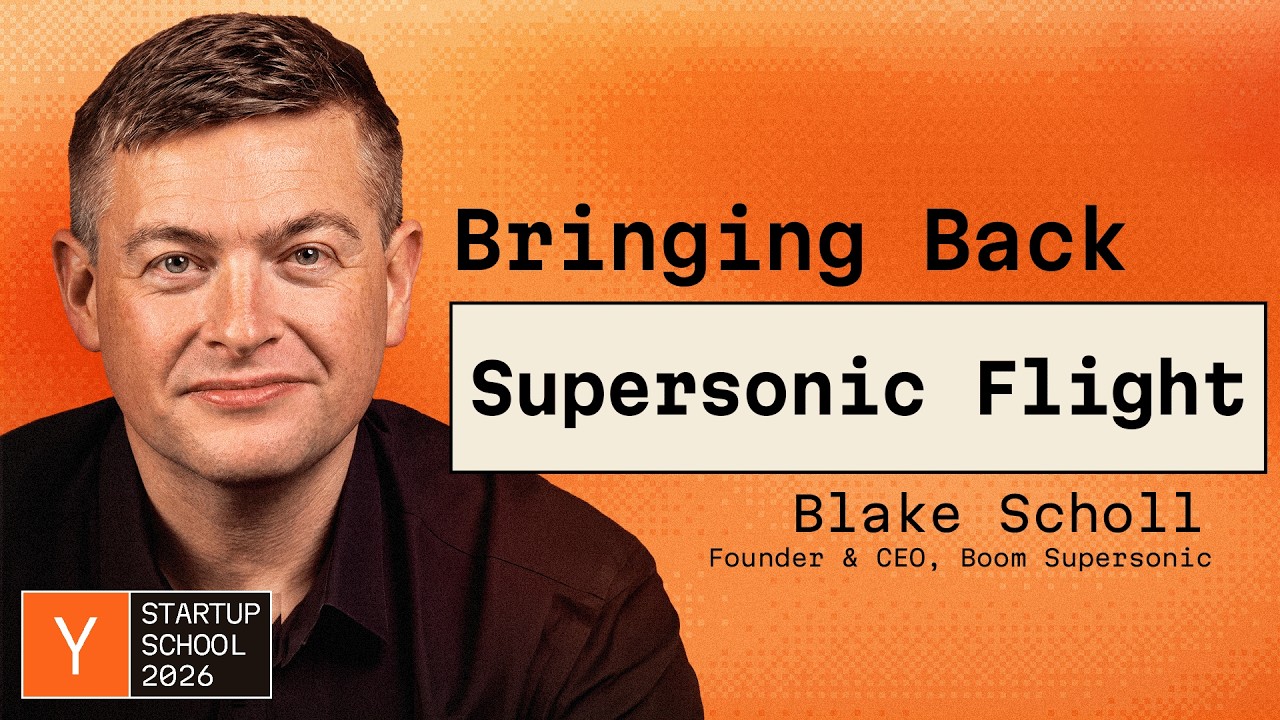
In a world where technological progress often feels stagnant, Blake Scholl, CEO of Boom Supersonic, is challenging the status quo. His mission? To bring back the awe-inspiring speed of supersonic passenger travel, a future once thought lost. Scholl's journey from a software engineer to an aerospace visionary reveals a powerful narrative of ambition, resilience, and unconventional strategies in a traditionally slow-moving industry.
Scholl opens by lamenting the regression in air travel since 1969, when humanity landed on the moon and flew the Concorde. Today, commercial flights are no faster than they were half a century ago, and the industry is plagued by slow development cycles. This stagnation inspired Scholl to pursue a "lifetime goal of breaking the sound barrier" and reintroduce supersonic passenger travel. He envisioned a world where crossing the Atlantic in three and a half hours could unlock new cultural and economic opportunities, akin to how jet travel transformed tourism and global commerce in the 1960s.
Boom Supersonic's approach to this monumental task is rooted in applying software development principles to hardware. Recognizing the slow, integrated iteration cycles of traditional aerospace, Scholl's team developed tools like "Makeboom" and "Bladeunner." These systems allow engineers to digitally simulate entire aircraft designs and engine blade changes in minutes or hours, dramatically accelerating the design-test-iterate loop. Furthermore, Boom has embraced vertical integration, building its own machine shops and test assets to bypass slow external suppliers, enabling them to go from digital design to prototype part in just 24 hours.
One of Boom's most significant achievements has been solving the notorious "sonic boom." Through careful design and flight testing of their XB1 prototype, they demonstrated "mock cutoff," where the sonic boom makes a U-turn in the sky and never reaches the ground. This technological breakthrough directly led to the legalization of supersonic flight in the US, proving that innovation can indeed change regulations. Scholl emphasizes that this was achieved by "just building the thing and communicating why it's okay," rather than waiting for regulatory approval.
Beyond technology, Scholl stresses the importance of passion and mission. He recounts Boom's near-failures, including a moment with only seven days of cash when the board advised shutting down. His refusal stemmed from a deep belief in the importance of their creation. He advocates for founders to "pick a problem that you want to go solve in the world and don't worry too much about the answer to why now." This ethos extends to hiring, where he prioritizes passion over pure experience, and to fostering an environment where young engineers are encouraged to "go build real things" and seek wisdom from experienced individuals without being constrained by outdated thinking.
“Go build something you love. Go build something that should exist in the world. Leave this planet better than you found it.”
- Blake Scholl, Founder of Boom Supersonic