- NVIDIA's RTX Spark transforms PCs into autonomous AI agents.
- Microsoft deploys the world's largest Grace Blackwell supercomputers.
- Vera Rubin CPU designed for low-latency agentic AI workloads.
- GitHub commits surge 3x, signaling AI's growing utility.
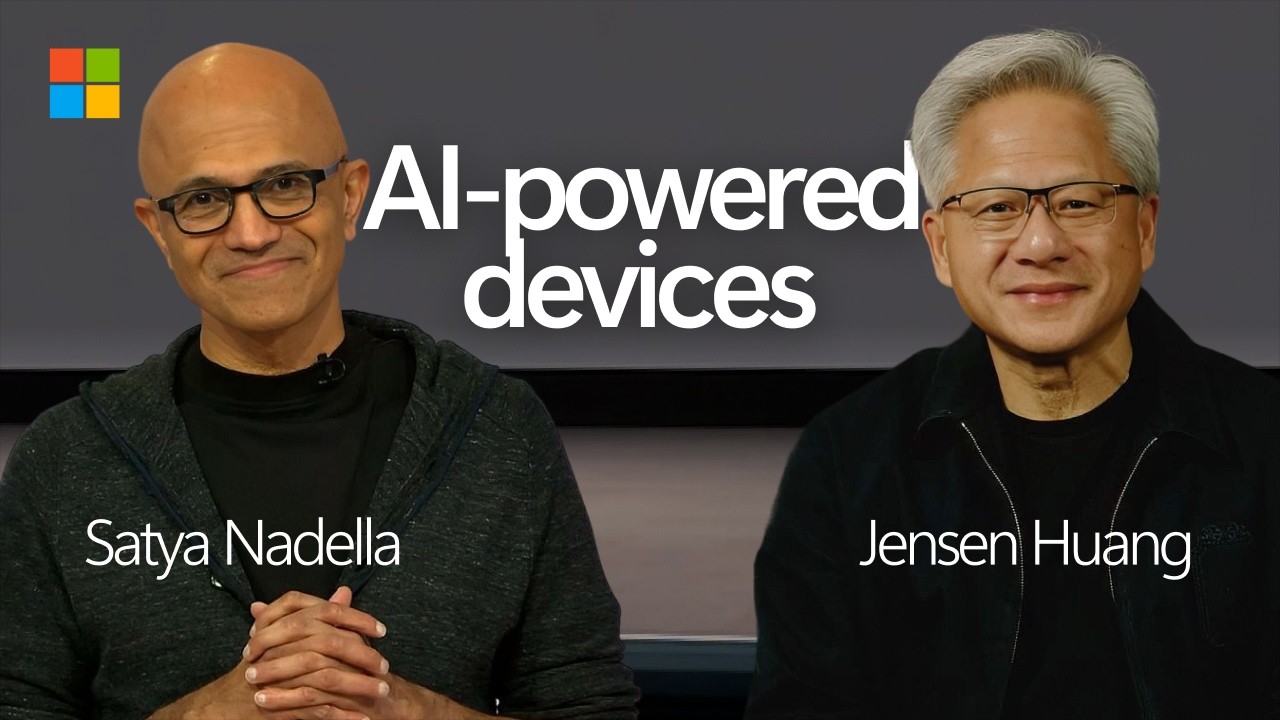
At Microsoft Build 2026, a fireside chat between NVIDIA CEO Jensen Huang and Microsoft CEO Satya Nadella illuminated the rapid evolution of artificial intelligence, from deeply personal computing experiences to the massive, agent-driven architectures powering the cloud. The discussion centered on the groundbreaking collaboration between the two tech giants, delivering "unmetered intelligence" across devices and data centers.
The vision for the "personal AI." Huang described a 3-year journey with Microsoft to transform the PC. With RTX Spark, a PC becomes an autonomous agent, capable of executing complex tasks like coding or design modifications remotely. This shift from a personal computer to a "personal AI" is powered by NVIDIA's new chip, boasting a petaflop of AI performance and 128GB of memory, capable of running 200 billion parameter models locally.
Scaling AI in the cloud. The conversation then shifted to the data center, highlighting the joint effort in building the first supercomputer for GPT models. Huang detailed the progression from Ampere (pre-training) and Hopper to Grace Blackwell, which focuses on post-training, reinforcement learning, and reasoning models. He proudly noted Microsoft's deployment of the world's largest and fastest Grace Blackwell systems, including the "magnificent" Fairwater system – a liquid-cooled, closed-loop engineering marvel that boosts token generation rates by 30 times over Hopper while being environmentally friendly.
The agentic future with Vera Rubin. The next frontier, according to Huang, is agentic AIs, and for this, NVIDIA created Vera Rubin. Unlike previous CPUs designed for human patience, Vera Rubin is revolutionary, built for the "impatient" demands of agents requiring extremely low latency. This architecture mirrors the agentic systems running on RTX Spark, but on a much larger, distributed scale in the cloud, emphasizing confidential computing with encrypted data at rest, in transit, and in use.
Ecosystem acceleration and developer opportunity. Both leaders underscored their commitment to fostering a vibrant AI ecosystem. Huang revealed NVIDIA's extensive software efforts, including integrating models and tooling into Microsoft Foundry and accelerating data warehouse workloads. He pointed to a "parabolic" increase in GitHub commits (a factor of three in recent months) as clear evidence that agentic systems are now "useful" and driving "productive work," leading to an unprecedented demand for compute. The goal is to GPU-accelerate all Azure tools to ensure agents receive fast, intelligent, and profitable token generation.
“The PC evolved from being an incredible tool to now being a tool that's used autonomously by an AI assistant.”
- Jensen Huang, NVIDIA Founder and CEO