
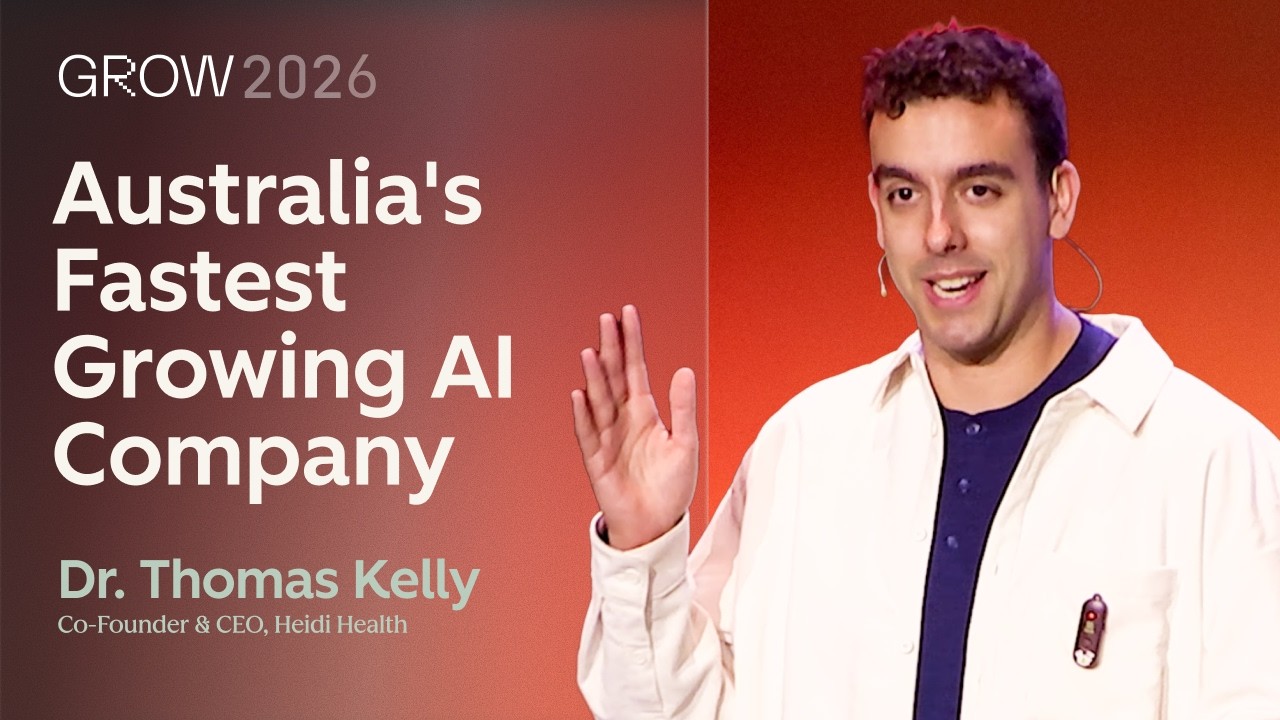
- From near bankruptcy to multi-million dollar valuation in two years.
- Pioneered a product-led growth strategy in a traditionally top-down industry.
- Leveraged user advocacy to penetrate enterprise markets.
- Transformed a constraint (being an Australian startup) into a superpower.
Heidi AI's journey to becoming Australia's fastest-growing AI company is a testament to radical pivots, user-centric design, and an unconventional go-to-market strategy. Founder Tom reflects on how a near-fatal misstep led them to discover the true power of product-led growth in the challenging healthcare sector.
Initially, Heidi AI embarked on a traditional enterprise sales model, developing a complex AI-infused telehealth platform during the COVID-19 pandemic. Despite securing contracts with C-suite executives, the product failed to gain traction with its ultimate users: busy doctors. The platform, burdened with compliance dashboards and administrative gates designed for buyers, added friction to already frantic workflows, leading to widespread user dissatisfaction and the product becoming 'shelfware.' This misstep pushed the company to the brink of collapse, necessitating significant layoffs and leaving them with only six months of runway.
The turning point came with the launch of ChatGPT, which rendered Heidi's proprietary machine learning models obsolete overnight. This forced a complete re-evaluation and a bold pivot. Instead of trying to build a comprehensive platform, Heidi stripped its offering back to a single, overwhelmingly valuable function: an AI scribe that could automatically transcribe patient visits and write clinical notes. Crucially, they made this core product free. This decision, initially terrifying to their CFO due to the $1 per note compute cost, was a calculated risk to acquire users without a marketing budget, treating server costs as their primary distribution investment.
The free, frictionless product immediately resonated with burnt-out clinicians, saving them hours of administrative work daily. This utility created an organic viral loop, with doctors enthusiastically sharing Heidi with colleagues. Once users experienced the indispensable value, their retention soared to 90%. This user-driven adoption then paved the way for a commercial model, offering paid features like customization and EMR integration. The success in Australia, where independent GPs have purchasing autonomy, further validated this product-led growth (PLG) approach, enabling Heidi to expand globally by following existing user demand.
Heidi's story highlights three key lessons: never confuse the buyer with the user, leverage constraints as strategic advantages, and align go-to-market strategies with a profound mission. For Heidi, that mission is to solve the global healthcare capacity problem by building an AI care partner that extends the reach and increases the capacity of clinicians, rather than replacing them. This deep commitment to impact, combined with a product that users 'fight to keep,' has been the true engine of their unprecedented growth.
“The real question is not who signs the contract. The real question is who loves your product so much that they would fight to keep it.”
- Thomas Kelly, Co-Founder & CEO of Heidi Health