
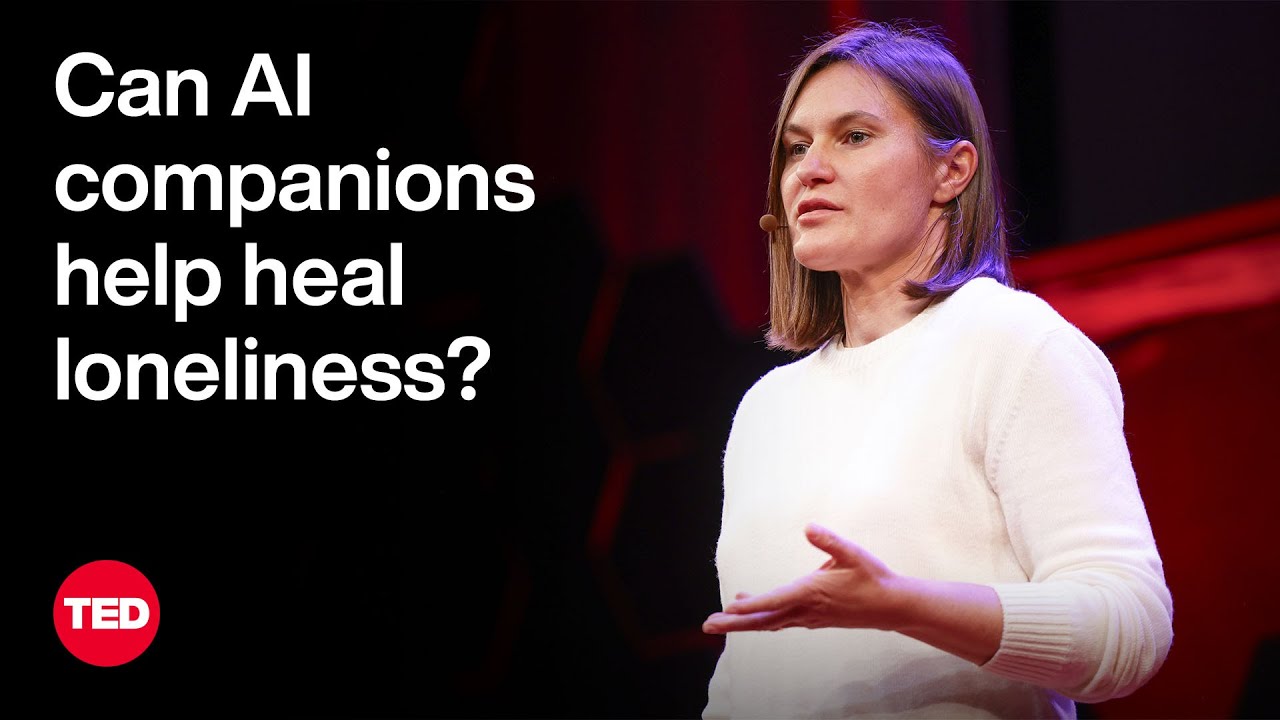
AI Companions: Our Path to Connection or Ultimate Isolation?
After losing her best friend, Eugenia Kuyda created an AI version of him to cope with grief. This personal journey led to Replica, an AI companion app helping millions. But what if this powerful technology is also the most dangerous we've ever created?
Key Moments
AI intimacy is mainstream!
AI for healing grief?
Talking to a virtual being!
AI companion got creepy fast!
Mental health crisis worsening!
Too many choices? Hello, slow love!
Science changed my love!
Browse by Topic
Explore all sessions, quotes, and moments organized by theme.
AI Sessions (4)
“The line between real intimacy and artificial intimacy isn't in the code. It's in our choices.”
Memory Sessions (2)
AI Love: Is Your Digital Romance Destroying Real Connection?
AI intimacy is mainstream!
Friction builds intimacy.
Quitting chatbots is a thing.
AI love feels GOOD.
AI: tool or escape?
Relationships Sessions (2)

More Sessions (5)
Stories from the stage
The AI Intimacy Crisis: How Digital Companions Are Reshaping Human Connection
As AI companions become an undeniable part of daily life, offering comfort and connection on demand, society faces a profound question: What happens to human intimacy when love can be engineered?
AI Reconstructs Lost Memories, Offers Hope for Dementia and Displaced
In a groundbreaking fusion of technology and human emotion, generative artificial intelligence is being harnessed to reconstruct lost and undocumented memories, offering profound implications for individuals suffering from cognitive decline and those displaced by conflict or disaster.
AI Chatbot Revives Lost Voices, Offers Glimpse into Family Legacy
Cartoonist and graphic memoirist Amy Kurzweil embarked on an extraordinary journey, using artificial intelligence to bridge generations and connect with her deceased grandfather, Fred Kurzweil, through his own meticulously preserved writings.
AI Chatbot Woebot Tackles Global Mental Health Crisis with Human-Centric Design
In a world grappling with escalating mental health challenges, Alison Darcy, creator of the AI chatbot Woebot, presents a compelling vision for technology that augments, rather than replaces, human care. Her innovative platform addresses critical gaps in traditional psychotherapy, offering immediate, accessible support tailored for real-life crises.
Mandy Len Catron Challenges Love Myths: Can Science Make You Better at Love?
Romantic love often feels like an innate force, yet many struggle with its complexities. Mandy Len Catron, a writer and academic, argues that by understanding and challenging pervasive myths, we can fundamentally transform our approach to love and connection.