Rethink Everything: The AI Revolution in Financial Services!
The AWS Financial Services Symposium 2026 keynote, led by Scott Mullins, Managing Director Worldwide Financial Services at Amazon Web Services, painted a vivid picture of an industry undergoing a fundamental transformation. The central message: it's time to "rethink everything" as artificial intelligence rapidly reshapes how financial institutions operate, innovate, and serve their customers.
“You can't build tomorrow's applications and products on yesterday's dogma and legacy technology.”
- Scott Mullins, Managing Director of Financial Services at AWS
Uncover how AI is fundamentally reshaping financial services, from investment research to customer engagement. Learn from industry leaders on building AI-native enterprises and modernizing legacy systems for unprecedented agility.
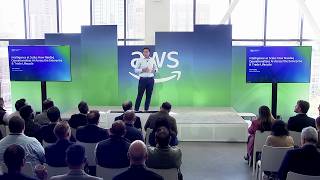
>> Good morning and welcome to the 2026 AWS Financial Services Symposium right here in New York City. I'm Scott Mullins and it's my privilege to lead the financial services organization at AWS and more importantly to serve as the host for today's event. We are delighted that you have chosen to invest your day with us and we're determined to ensure that you get a good return on that investment. Now, looking at the video that we played just now, you might have found yourself chuckling when you saw some of the innovations that have changed the way that the financial services industry works over the previous decades. As the industry has progressed in line with consumer demands, more and more you've been able to turn what was once thought extraordinary into ordinary. For example, we may not think of check writing as all that innovative anymore because well, we all hate writing checks today or we've just stopped doing it all together. But the substitution of a piece of paper for physical cash represented a major step in the expansion of the financial system. And as hard as I try, I still have to order a checkbook every four or five years cuz there's one or two vendors that want a check. Today, when we think about innovation in
our industry, what's different is that new technology isn't just driving incremental change in one particular area like trading or payments. Instead, it's impacting every corner of the industry all at once, which is making it so much easier to turn new ideas into actions as quickly as possible. New technologies are driving us to think differently, but they're also allowing us to act differently, which is driving a fundamental organizational reorganization of our industry. This is comparable to the introduction of electric light in the late 1800s. When Thomas Edison established the Pearl Street Station power plant in 1882, not too far from here where we are today in the financial district, electricity wasn't just a better way to light a room. It represented a way to reorganize every single industry on Earth. The main difference here is that it took electric light 40 years to do it. Whereas today's technological changes are moving much, much, much faster. And we're seeing this speed today with financial institutions across every market segment and in every region, reinventing themselves with AWS. And nowhere are we seeing faster speed of adoption than with AI. AWS is the infrastructure powering new forms of intelligence. We've put advanced capabilities, including sophisticated AI agents, and the choice of industry-leading models within reach of every single AWS customer, and not just the largest players. And the industry is seizing the opportunity to adapt these new capabilities. All the customers that you see on the slides behind me represent but a fraction of the financial institutions who are running agents on AWS today. And that progress has begun to change the industry in some really profound ways. For instance, let's take investment
research. The complexity and duration of tasks that you can solve with a generative AI is growing exponentially, while the cost to do so is plummeting. And that signifies a paradigm shift for research. Now, you can assign different agents working under a supervisory agent to access a range of data sources, to spin up multiple models, and run them in parallel. Analyzing data, both structured and unstructured, is so much easier with natural language interfaces and visualizations. You don't have to be a trained data scientist anymore to test sophisticated hypotheses. Research agents can even propose novel strategies and generate ideas for investors, and not just execute simple tasks. New technologies are democratizing advanced capabilities while offloading undifferentiated heavy lifting. And this is a pattern we're seeing across the industry. Underwriting and lending are becoming much more automated. Financial advice is becoming more proactive instead of reactive. Customer service is becoming more personalized, and payments are moving autonomously between machines instead of between humans and businesses. And we're going to hear more about that right after this session. Now, it's not that the financial services industry has been slow to harness new technology to evolve. It's that today new technology is changing how far we can go and more importantly how fast we can go. The industry now finds itself at a bit of a crossroads. We've come a long way, but how do we keep getting better and better at serving financial consumers? Well, first getting better requires us to ask ourselves some hard questions to make sure that we're thinking about AI strategically and we're not just bolting it onto the side of existing products or processes like a widget. That approach will not yield the return on investment that organizations require. So, we need to ask ourselves questions
like do we have the right governance structure to scale AI responsibly? Is our data estate ready for all of this? Do we have the ability to orchestrate our agents or are we going to keep running them in silos? How are we evolving software development? Is our workforce ready for the way that work works now and the way it will work in the future? Now, some of these questions are technical in nature, but most of them are not because implementing AI across the enterprise isn't a purely technical effort. It includes people and process changes that are fundamental to how companies operate. And it's critical to ask these questions because we won't get anywhere we want to go by doing things the way that we've always done them. You can't build tomorrow's applications and products on yesterday's dogma and legacy technology. When it comes to transforming ideas into products, we've created multiple pathways to help you succeed based on your specific needs, resources, and most importantly your goals. You can buy ready-made agents, you can build your own custom agents, or you can work with experts including AWS partners or the AWS joint AI innovation center to develop brand new agents. And in terms of turnkey solutions, AWS is helping organizations compress the gap between thinking and building. These are just some of our more recent launches and you can see that they cover a wide spectrum of capabilities running from product development, operations, to security, and then all the way to customer experience. Today, we're going to hear from customers on how they are using these and other tools to do what they couldn't do before or to do things in a much more efficient and effective way.
One of these tools that customers are really excited about is Qiro. Qiro is our AI-powered IDE that we launched last year and it's allowing organizations to rethink what they can build, how they can build, and who can be a builder. Qiro makes it much easier and faster to move from concept to production. It turns natural language prompts into detailed specs and then into working code, documentation, and tests. You can build new proofs of concept quickly without sacrificing production readiness and iteration is easy so that you can build exactly what you envisioned. Qiro enables thinkers to become builders. It provides access to skills that were previously out of the reach for folks who lack deep technical expertise. And for that reason, I believe that Qiro is going to unleash a new wave of creativity across the industry as we turn more knowledge workers into builders. Now, of course, customers aren't just
using AWS agents to change the way they build products and run their businesses. They're accessing the latest models through Amazon Bedrock and they're building their own solutions. And here, I want to reiterate a core differentiator at AWS when it comes to AI and that's choice. From the outset, we have put choice at the center of our approach to AI and that hasn't changed. In fact, the options available to our customers have only increased and keep increasing. As we move further into the agentic era, model choice becomes even more important as each model brings unique strengths, reasoning, and understanding. Now, picking the right model mix directly impacts agent performance, reliability, and cost. According to Gartner, by 2028, the majority of enterprises will use more than 24 different AI models from multiple vendors. Now, I'd like to spend some time talking about two specific model providers because our relationships with both have recently changed in ways that are really meaningful to our customers. First, we've recently announced an expansion of our strategic collaboration with Anthropic. AWS customers will now be able to access access the full Anthropic native Claude console through their existing AWS account with no additional credentials, contracts, or billing relationships to manage. This is making it easier for customers to access the models they love so they can build AI applications that solve real-world problems. Second, you may have seen that last week AWS and OpenAI are expanding our partnership to bring the latest OpenAI models to Amazon Bedrock. We'll also be making OpenAI's coding agent Codex available, and we've launched Amazon Bedrock managed agents powered by OpenAI, which enables customers to quickly and easily build production-ready agents in the cloud. It's a really exciting time for our industry as more and more advanced capabilities become available, and the barriers to accessing those capabilities gets lower and lower and lower. But as we move towards a more agentic and autonomous industry, we need to keep in mind that AI applications are still applications. Like all applications, they require
actionable data, strong security, comprehensive resiliency, and of course, high availability. More than ever, it's important for organizations to be able to trust their systems and applications to do what they aren't supposed to do and not to do what they aren't supposed to do. We need to make sure that these systems and applications operate at peak levels of performance and productivity. And we need to build on these investments in performance to find new ways to serve financial consumers, like all of us. This morning, as we explore the opportunity to rethink everything in the industry, we'll anchor our discussion on three key themes. First, building foundations for the future. Second, continuing to reimagine critical systems. And third, elevating every experience for consumers. Today, I'm delighted to have three customers joining me on stage to share their experiences across these themes. Dr. Joanna Pena managing director and head of technology research and innovation at DTCC, Raghu Parthasarathy, vice president and head of cloud services and app modernization at The Hartford, and Andy Bigenheimer, executive vice president and corporate CIO at US Bank. So, let's get started.
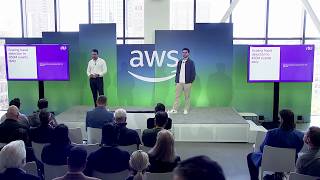
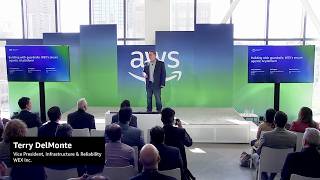
We all know from our own experience that changing the way that we work can be hard, particularly in an industry like ours that prioritizes consistency, compliance, and security. But, we owe it to ourselves to ask if there's a better way, especially when new capabilities are coming online seemingly every single day that are allowing us to open up the aperture of what risk management looks like. Not only is AI allowing us to rethink what we're doing today, but it's allowing us to rethink what we've already built, so that we're ready for what comes next. Today, that means making sure we're taking advantage of new capabilities to improve security and compliance processes, while ensuring that builders can safely access the tools that they need to build new applications. Going even further, that means re-examining the software development life cycle to make sure engineers are focusing their expertise and energy where they're needed most. WEX is a great example of a company that is using AI to enable its builders to innovate quickly and safely. WEX built an enterprise-grade agent platform using Amazon Bedrock agent core that democratizes agent building across their engineering teams. The platform provides a secure, isolated environment and a framework to assist engineers with the creation, testing, and deployment of new agents. While the platform accelerates agent creation, Agent Core's built-in guardrails ensure that users can't access information that they aren't authorized to access. Now, in addition to ensuring strong governance over access to powerful AI capabilities, an emerging challenge that the industry is tackling is how to manage AI companions and agents as they perform increasingly critical activities. activities. SS&C is addressing this challenge by developing capabilities to manage AI-driven work. SS&C built a production-grade AI framework that processes billions of tokens monthly across 35 AI agents, all within enterprise risk and compliance boundaries. They've implemented a three-tier governance architecture built on Amazon Bedrock that enables real-time policy enforcement and deterministic controls over agent actions. Now, these are capabilities that SS&C is now making available to their own customers as well as their own teams. The industry is collectively rethinking how its builders build and who can be a builder. DTCC is an organization that is seizing this moment to rethink its software development life cycle to ensure security and enhanced productivity, all while driving innovation at pace. I'm delighted to welcome my friend Dr. Donna Powell to the stage to tell us more. >> All right. Thank you so much, Scott. And how inspirational this morning was. Do you hear me? Yeah? Everyone hear me okay? Um So, uh so my name is Donna Powell. I'm going to be talking a little bit about our AI strategy. I'm going to be talking a little bit about our prioritized use cases. And then I'm going to walk you through kind of our overall path in SDLC. So, at DTCC, our long-term ambition is to become a fully AI-native enterprise, where intelligent systems are driving modernization, resilience, efficiency, and global financial markets, essentially delivering seamless essentially delivering seamless post-trade services. post-trade services. We spent a lot of 2025 building AI foundations, which included onboarding multiple tools, extending training programs all across the firm, scaling adoption, launching homegrown tools, and also strengthening governance. So, our 2026 priorities are really about getting a little bit more narrow and doubling down on the key priorities. So, doubling down on productivity, improvements across all of DTCC. That includes systems modernization through AI-augmented software development, which we'll be talking about, intelligent document processing as well, because the most immediate defensible use case for AI is its ability to reduce manual effort and increase capacity without proportional headcount growth. The second one is advancing key client-facing priority use cases with business leaders. So, that includes key client-facing AI conversational platforms and other initiatives. Um, so in an industry where trust and accuracy and turnaround times are really critical, AI of course becomes a catalyst for delivering more proactive, transparent, and intelligent services to our clients. The third one is to continue to empower our people and democratize AI across DTCC. We're partnering with HR and multiple other business lines to do that. And by developing an AI-ready workforce and culture, we're building a culture of AI fluency across all levels, all personas, um equipping our employees with the tools and the skills to harness AI safely in their roles. Um And so, of course, our foundational tech stack, uh DTCC IQ, is going to help us enable those priorities now and in the future. Um so, DTCC IQ, it's a foundation upon which DTCC advanced AI initiatives will be delivered and are currently being delivered. Um so, this is an end-to-end tech stack. It's flexible, interoperable across DTCC's AI tooling, it's modular and scalable, and it's rooted, importantly, in a robust governance framework. So, DTCC IQ, um is meant to be logically unified. It's meant to be as future-proof as possible, um an AI ecosystem that serves a diverse set of internal users and enables rapid product experimentation, development, and data access. Um DTCC IQ leverages AWS and our Snowflake infrastructure, as well as a foundational capability layer. We partner very closely with AWS on this. Um and it also provides connectivity across a wide range of uh DTCC AI solutions and tools. Uh we have a number of different platforms, um including an AI app marketplace, AI engineering tools and utilities, integration, and interoperability tools such as MCP and APIs for LLM gateway. Uh we have governance and guardrails, um and data and services connectivity. Um so, the aim for our AI ecosystem is really to achieve as much scalability as possible, resilience, acceleration of upskilling across the firm, uh but importantly, a strong responsible AI layer, governance, and rich user experience. Um and in the design, of course, for future flexibility, we want to um aim for easy swapping of best-in-breed tools. Um, and so, of course, this is going to be the foundation for how we are able to um essentially uh create use cases and uh and and develop initiatives that are going to be cross-cutting uh across the firm, which brings me to our uh use case um summary. So, we're moving from simple use cases to larger-scale, much more heavy-hitting programmatic initiatives at DTCC, where we can show substantial long-term success. And so, this slide shows uh a short list of use cases we're pursuing firm-wide. These use cases were prioritized after reviewing a backlog of about 400 different use cases, where approximately 30 were shortlisted um for feasibility, desirability, and impact based on uh a lot of different uh research methods, secondary research, and deep-dive interviews. And uh finally, our AI Council uh prioritized about five of these uh use cases uh for final review for heavy firm-wide focus. And the one I'd like to speak to uh today is AI-augmented uh software engineering. Um Um So, let me provide a bit of an intro to um the AI SDLC.
the AI SDLC. Uh so, Uh so, embedding AI in the software delivery life cycle processes at DTCC is really one of our big rock opportunities to improve delivery efficacy. Um by way of background, with the advance of AI coding assistant tools, uh DTCC undertook a POC in this space at about the beginning of 2024. Um there was a pretty extensive process to select the best tool. I think we probably looked at five or six um enterprise tools. Amazon Q Developer was selected. Uh, probably most of you are aware it's a GenAI powered assistant for building and operating and transforming software. It assists engineers with a variety of activities across the software delivery life cycle. Runs natively on AWS with access to DTCC code repositories. We selected Q based on superior security and privacy scoring that's paramount at DTCC and also customization ability for DTCC repos and the viability of future tool evolution. And also of course our investment with an established partner such as Amazon. And after selection of that tool our focus was really very structured around rolling out education to empower our engineering teams. So we established a 14-week training program initially. This was focused on our application development and testing engineers. And we exceeded our goal to train about over 80% of the cohort in the first quarter of 2025. Training included and this is just really important because in order to drive adoption you really have to to dig deep into the training programs. Um, it included instructor-led sessions, self-paced learning. It was augmented by office hours to support ongoing engineer questions. We established a center of excellence with ambassadors to drive transparency across the IT organization as capabilities evolved and we also had superusers that were embedded in squads to drive adoption in teams. After the initial rollout we expanded the training to focus on infrastructure engineering and the broader community. So with the tool now in the engineers' hands for 12 months we gathered useful insights on adoption and productivity alongside some key lessons. Um so approximately 1,800 engineers or 85% of them use Q daily. Uh from a productivity perspective, we've observed consistent about 40% improvement in productivity from daily users compared to infrequent users. And we also observed uh lots of improvements uh from historically manual engineering tasks. So for example, what used to take Java upgrades, let's say 100 days, now takes 10 days. Uh just as an example. It's essentially 10% of the time that it used to take. Um So we also we we noticed a lot of positive things, but also um we took away some some insights. So it was fantastic to empower teams to innovate um on solutions, but we also, you know, realized there were a lot of similar prompts being created across squads. There's an opportunity to kind of consolidate and get common tools um across uh across the board. And we also needed to invest in MCP uh in order to increase context. So that moves us to um essentially our um our SDLC AI factory. So this the shift from suggestion to commit really marks a fundamental change in software develop uh development uh in our operating model. And this signals a move from AI as a supportive assistant to AI as an accountable agent. And we're executing this transition deliberately through our AI SDLC factory depicted here um to sustain adoption momentum while reshaping governance controls and also productivity measurement. So the SDLC factory is DTCC's structured initiative to operationalize agentic AI across the software life cycle while maintaining human in the loop um at appropriate stages for controls. Um it it has a number of features including MCP infrastructure. Um, Kiro also enables significant augmentation of software development, which enables Agentic SCLC by contributing to code generation, test creation, documentation, much, much more. We leverage AWS Bedrock uh agent core, which powers multi-agent orchestration, and of course governance is foundational. Um Um And so, we also, let me move to our impact. Um, so Um, so this is this is obviously key uh to ensuring that we're we're measuring performance uh in an objective way. So, our approach to measuring AI impact in software delivery intentionally follows a progressive maturity model. In 2026, we're actually transitioning from adoption to productivity measures with insights at the individual engineering level. Um, and that's enabled through a tool called Jellyfish. And as AI evolves from just assistive tooling to more delegated execution, our focus is going to be on the control plane foundations. Um, so a couple of metrics that we're um consistently measuring um on a on a frequent basis include productivity. So, we're looking at the increase of uh the average number of code commits by developer by 25%. That's our target. Quality, we're increasing test code coverage requirements to 85%. Um, another quality measure is to reduce open defect aging target to 15%, and um, along automation, we're increasing test automation metrics for modernization to 93%, and we also are looking at velocity. We want to improve squad throughput by 25%. Um, so all in all, our partnership with AWS has been just phenomenal um in terms of enabling us to achieve all of these targets, and we're very excited about our measurable trajectory forward and our deep partnership with AWS and enabling our success. So, thank you very much.
>> Thank you, Jonna, for sharing not just your vision for the transformation of software development at DTCC, but for your approach to executing that vision. Legacy processes and systems should not hinder any of our ambitions. We've reached the point where financial institutions no longer need to devote resources to maintaining systems that aren't allowing them to innovate on behalf of their customers. AI is enabling financial institutions to modernize systems that were previously thought to be too old, too large, too expensive, or just too hard to convert to cloud native. And what's especially exciting is that the range of different modernization patterns that financial institutions can now pursue is expanding every day. Experian is a great example of a company that is harnessing new capabilities to move mission-critical legacy applications and infrastructure to AWS in a timely and scalable manner. In the UK, the Experian data office used AWS Transform to modernize seven legacy .NET applications, achieving a 40% reduction in developer effort and saving approximately 300 engineering days across all seven projects. Now, there are only about 260 working days in any given year, and so if any of you were told that you could save a full year's of about one person's work, I imagine you would take somebody up on that offer. AWS Transform's agentic capabilities helped automate 687,600 lines of code transformation, improving application performance across the board while freeing Experian's engineers teams to focus on a higher value projects. Itau Unibanco, Latin America's largest bank, also turned to AI to help modernize its technology platform so that it could better serve customers in a highly competitive market. As it embarked on its modernization journey, the bank found that traditional modernization approaches were too slow, particularly when it came to its aging mainframe systems. Many of these systems lacked formal documentation of business logic, which required weeks of manual analysis. AWS Transform has helped the bank extract business rules from multiple systems and understand their context so that modernized applications would retain critical business logic. Pairing AWS Transform and Kyro helped reduce testing efforts by 30% while improving their test coverage. Later today, you're going to hear from Itaú how modernization paved the way for new and more interactive ways for their customers to engage with their accounts. Now, please join me in welcoming Raghu to the stage to share how The Hartford is modernizing applications at scale with the help of AWS Transform.
>> Good morning, everybody. You heard it hear me loud and clear? All right. Um I'm Raghu, uh vice president and head of cloud services at The Hartford. Uh for those who do not know us, uh we, The Hartford Insurance Group, are a 216-year-old are a 216-year-old 28 million-dollar property and casualty insurance company. Uh Uh we sell our products to um commercial business, personal insurance, which includes auto, home, and property. Um we also sell employee benefits. So, if you are a beneficiary of a short-term or a long-term disability benefits from your company, uh there is a possibility that we could be the insurance carrier behind. Uh we are number one uh in the nation uh in selling insurance for small businesses. We are number one in insurance disability in force. We also are number one in combined paid family leaves. Over the history rich history of our time, we also have ensured some key marquee landmarks such as the Abraham Lincoln home and the Golden Gate Bridge. So, So, everything starts with a why. So, why move to cloud? We started our journey to cloud approximately four to five years ago. And around the same time, our CEO and our senior leadership gave came back with this a very aspirational growth trajectory of doubling the the organizations market cap, if you will, point in time. At that time, you were a $20 company. To attain such growth, business agility is a key. Business agility is the one which could give that growth and more important make it profitable and also help us with the sustainable growth. To have such business agility, we were very well aware that technology is a key enabler and a key differentiator to provide the business agility. And the transformation of technology at the core foundation of it is cloud. Right? And as we were doing this, at the same time, we were also at a decision point where we need to make huge capital investments to refresh our technology in order to reduce our tech debts and also deal with of the security impacts that we had point in time. So, we decided we decided at point in time to take this capital investments and take a leap to simplify and to modernize in cloud. And this was very intentional and by design. We did not want to build a data center in cloud, but we want to adopt cloud and harness the power that cloud provides. So, we want with want to simplify the environment. We want to modernize the environment and we want to become more and more cloud native. And doing this, we also wanted to enhance the experience of our users if you will both from an engineering experience standpoint and from a developer experience standpoint. So, we adopted an extreme automation methodologies ensuring that every deployment of application that's happening on cloud goes through a pipeline based adoption or as an IAC code. There is no more single user deployments and there configuration drift as many of you would know is a big problem in enterprises and the way to avoid the configuration just to have parity across the environments is to force automation and ensure that the pipeline based deployments happen. While doing this, we were also transforming the operating model. So, we got out of the traditional operating model of having standard production supports at multiple layers and an incident happens, multiple people in the call trying to figure out what went wrong. So, we want to diminish the line and we went forward diminishing the line across the stacks introducing reliability engineering teams and the reliability engineering concept to ensure that reliability engineering overlaid with ML ops gives the power of self-healing and recovery much faster. So, how we approached modernization, right? So, from a the approach perspective, we started with the application planning. Right? This is This is the key factor for we trust that we did right for the success of the program that we have having right now. So, we looked at critical business applications, we looked at the capabilities across these different applications. We got these capabilities together, we rationalized so we don't take the baggage along with us to the cloud. We assess the current state architecture. We looked at both functional and non-functional parameters of these applications and the needs of these applications if you will. When we designed the target state architecture, this is where by design we became very intentional that the target state architecture is not a replica of what we have on on from and there are multiple strategies to move to cloud and if you have already done many of you might already know that. But in our strategy we are very very intentional about like let's adopt cloud the cloud way and not build the data center as I told you earlier and make sure in the target state architecture we are adopting very cloud native. We introduced what we call as the modernization scoring and we went from one through five. One is the full scale modernization all the way to the stack. Looking at our monolithic applications giving the microservices architecture if you will. Moving away powering the compute of these applications to the regular CPUs of the VMs of the EC2s but more going into the functions of the serverless architectures serverless architectures itself. serverless architectures itself. So that was like and also adopting like even at a database level like instead of going on an Oracle and EC2 how do we harness the power of something like a post crystal order. So that kind of had like a modernization one score and if you look at a modernization five score it is more of a lift and shift strategy that we had. But we ensured that the modernization five score does not exceed more than 10% of the assets that are moving into the cloud. And when we went to the modernization scoring the mobilization as I told earlier happened completely through automations through build pipelines and through IAC scores. So So um as we did this when we started this back in 2023 this was primarily built on automations and IAC scores uh but as uh people before me spoke spoke from DDCC uh obviously over the last two years uh AI acceleration has changed the way we do software development life cycles. The cost of intelligence with AI has actually gone down and the quality of intelligence has gone up. I'm pretty sure you all would agree with that. Right? Uh we had the traditional model of a developer a tester a business analyst coming together. So AI has helped us quickly change how do we do AI first engineering all the way from intelligent product workflow management to intelligent development workflows and intelligent operations as well. This actually has given the force multiplier for us to migrate to cloud faster. Today on an average we have reduced our development life cycle by 20% of our user productivity or the developer productivity has significantly significantly gone up. Also, for technologies when we started the program, which we thought are going to be the technologies which is going to fit our 10% of lift and shift, example such as dot and applications on IAS, with the help of AWS transform, we were able to migrate off dot net into core, and now they are running on Linux platform. So, AWS made that possible as well. We are also rethinking our mainframe modernizations as well. The lead time reduction is a significant value which we translated back to. Uh, from an idea to implementation perspective, earlier we have we are roughly around 100 days before from an idea which went into a GA one for implementation. We have a very significant target of reducing that back by 50%, and we are all already on track towards that goal, if you will. The modern applications, I'm pretty sure like as in the agentic world, as all these speeds and agilities are coming in, the cyber risk is coming in as well. Uh, and in the context of the cyber risk, I think the mind shift mind shift now needs to move from vulnerability management to threat prevention. And in a threat prevention world, the shared responsibility with a partner like AWS is significantly important, right? The ability for us to not only to react and respond, but also to prevent, which is what we are moving away from. Um, I was reading an interesting article the other day where it tells like the like earlier, the time of infiltration to data exfiltration was roughly around 3 to 4 days, but now which has been reduced to 72 minutes, right? Which means our threat prevention needs to be at around like 20 minutes for us to ensure that we protect our company. So, modern applications, as we scale up and migrate to cloud, is a huge power in bringing this in. Right? Right? So, what's target state? When we started our entire migration journey, our idea was about not exceeding the data center, but let's put applications which are of more value for us on cloud. But as we move through the power of these tools such as AI has actually shifted our strategy from only moving limited set of applications to actually exiting data centers. Earlier this year, we successfully exited our secondary data center and uh we are already on track in starting exiting our production data center with the target of getting out by next quarter this year. So, uh the power of tools and the partnership with AWS has actually moved away uh from being on data centers uh into an exit strategy. Obviously, outside of our application assets, we have also started adopting business services. We are a big from We are a big consumer and we migrated off our earlier platform into AWS Connect, which is our contact center strategy in this point of time. Uh layered that with AI, we are already seeing significant business improvements on that. Uh along this journey, AWS has obviously has been a great partner. Uh they have these smart key programs. If you're not uh consumed that, I would strongly recommend to do that such as the ACDC programs, which helped us commercially to ensure that we balance uh our investments when we get into the cloud. And also they have these smart key EBA programs uh which helps us accelerate very focused on uh solution-based accelerations, which helps us move to the cloud faster. Uh so, that's the story of Hartford. Thanks for listening and uh have a great learning today. >> Thanks Raghu for sharing both your experience. Uh and as we've seen, modernizing core systems is essential to serving customers how they want to be served. At Amazon, we like to say that customers
are divinely discontent and that they always seem to want more from us. And that puts organizations in the position of playing catch-up, which can actually be a really good problem to have to solve. New technologies are helping financial institutions keep pace with evolving customer demands. A theme that we've tracked throughout this session is that new technologies are shortening the gap between thinking and doing. And doing means building on behalf of your customers. Organizations today can offer their customers greater choice in the services they provide, while also offering greater choice in how they engage with their financial institutions. Increasingly, this means giving customers greater control over the experience that they want. And of course, sometimes what you really want to do is to connect with a human, especially when it comes to personal or family matters. When this is the case, you want to connect on your own terms, which means quickly and effectively. And legacy systems can make this extremely hard. Canada Life's fragmented contact center was causing 5-minute average wait times across 21 of its business units. By deploying Amazon Connect customer, the company achieved a 94% reduction in wait times and a 92% reduction in average speed to answer within the first 6 months of adoption. Integrating AI capabilities, including call summarization and automated authentication across their entire operation, improved user experience for Canada Life's own agents. Average handle time shrank 10% and employee engagement scores climbed 5% higher than the national average. But interacting with a human isn't everyone's first choice. Sometimes putting power in the hands of consumers means giving them the option to not engage with another person at all. And Robinhood is a great example of this trend. Robinhood has deployed a generative AI-powered customer support agent on Amazon Bedrock and Amazon SageMaker to handle in-app support requests at scale for more than 27 million funded customers. The agent responds to common account questions autonomously, resolving 65% of all incoming customer queries without human intervention, and enabling scalable contact center operation as the company continues to grow. Now, I cited these two very different examples of customer experience transformation to highlight a basic point. Rethinking the customer experience today means striking the right balance between automation and the human touch. And one reason we've seen such tremendous adoption of Amazon Connect customer across the industry is that it helps financial institutions navigate this delicate path. To explore this point further, please join me now in welcoming Andy Bigenheimer, who's going to share how US Bank's modernization of their contact center has paved the way for reimagining the customer experience.
>> Thank you very much, and thank you for the time to tell our story with regard to how we're transforming the customer experience. It is a incredibly exciting time to be in banking, and I'm pleased to be here to to share our story. So, maybe first to start to give a little context around US Bank and our customer base, we've got about 13 million consumer clients, 1.4 million business clients, 500,000 wealth clients, and 48,000 corporate institutional clients. And increasingly, those customers have diverse needs and expectations that we continue to strive to serve. In addition to that, we have 70,000 employees who work together every day to provide amazing capabilities, amazing services to to our to our customers. But we know that our client base is changing. You know, the expectation around customers having a relationship with a single bank uh, for the entirety of their uh, financial life um, is changing. And so, we know now that customers have choice and tend to spread their relationships across multiple banks. Um, we also know, as Scott said, that there's uh, some preference around how they engage with us. Um, ensuring that we have solid digital capabilities that enable our customers to self-service, but also recognizing that many of our customers still have the desire and the need for that human connection and that human touch when it comes to complex decisions or complex situations that uh, that they may be dealing with. And so, balancing all of that is a a critical component um, to how we uh, think about innovation in our uh, contact centers. And what we recognize is that yes, we are competing with one another from a banking perspective, um, but the reality is we're also competing with that last great experience experience that our customer had uh, regardless of whether it was with their bank or another organization. But again, our mission remains the same. We all love technology. It's amazing right now to watch and uh, follow how quickly technology is changing and innovating and we're all thinking about creative ways about how to bring that into our organizations. But in the end of the day, uh, it all comes back to starting with the customer and recognizing how we use technology to improve that uh, that customer experience and that customer journey. And whether that's uh, when they come into our branch um, to um, you know, look for service and allowing us to deepen the relationship in a very human way, or whether it's through our uh, digital capabilities that uh, allow them to do amazing things with ease uh, on their own when they need. Um, and then of course, our phone channel, which is incredibly important as we look to transform uh, what has historically been a frustrating experience for customers when they need to you know, break down and dial that 1-800 number into a differentiating wow experience in our ability to help them efficiently and effectively. And then of course ensuring that there's consistency across those channels so that the handoffs are seamless and that the customer doesn't have to repeat themselves or re-explain themselves in terms of you know, what they what they need. So why did US Bank choose Amazon Connect? And I'll say initially if I'm being honest, it was a technology project and a technology decision to create a more common and simplified ecosystem for our 100 plus contact centers. And it has turned out to be so much more for us. First the enablement of the Omni Channel capability and ability to to share and retain context across our various channels. Secondly, the platform centric approach you know, allowing us to bring new experiences and new capabilities to our customers in days, weeks, sometimes even hours when the situation calls versus the you know, the the month and quarter timeline to which we have historically been able to deliver. Scalability is important and we tested this very early on in our journey with Amazon Connect. You may know we had an acquisition of Union Bank and over the weekend we increased volume and customers by 10 to 15%. And because we were able to scale the platform so effectively, our time was focused on helping support our new clients and our new customers that we were welcoming into the US Bank family as opposed to worrying about infrastructure and how to ensure that we were handling the volume of of that those interactions that were coming in. Um open architecture for integrations, again, uh ensuring that we are able to connect with other vendors and partners in other parts of our organization to create those experiences. And then obviously the enablement of AI experiences. I think when we first started AI was maybe a glimmer in our eye and while the uh um enablement of uh our ability to bring AI solutions to the market more quickly uh with our connect platform has been incredible. So, what does that look like for us? Um you know, we handle 15 million calls a a month, 65 million uh talk minutes uh seamlessly uh without uh you know, any um capacity concerns or issues. We bring real-time context sharing to those interactions um and we uh improve our first-time uh resolution ensuring that customers never have to repeat themselves um you know, when they are asking us for service or help. So, what does this mission really look like in practice? Uh real example of, you know, Alex who's um checking uh the mobile app and sees a transaction that he doesn't recognize and um and uh needs to get some help. And so, you know, directly within the app being able to um click a a link to be able to either connect with an agent live or via the text channel. Um because again, this is another one of those examples that depending on the nature of the situation can be very stressful. And so, having an agent who's uh uh there and available uh at the um click of a button who uh is able to quickly uh reassure the customer that we're there to support them and help them and walk them through a process in a very efficient manner. Uh enabling then Alex to check the status of that uh situation um electronically at any time as the uh situation might call. And then bringing that all the way back through to the branch channel where, you know, Alex may come into the branch um and uh the banker is aware of that situation. Again, another opportunity to reassure that we've got them and that we're taking care of them, but also pick up on any um uh product enhancements or other types of conversations that had occurred via the other channels is incredible. We've come a long way and we've done a lot of amazing work um to improve the lives of our customers, but we are just getting started. Um so, as we think about our future vision and how we're going to look to continue to drive the uh experience of our customers using Connect. First, the um the move from uh you know, closed to open. Um bringing in multi-language support in a very seamless way in a seamless environment, getting out of the uh click maze of of the legacy IVR experience. From reactive to proactive, we know so much about our customers and we know so much about um you know, uh their experiences and their spending habits and patterns. And so, for us to be able to anticipate when they might have a question or concern, reach out proactively, and create that wow experience that creates an efficient and effective um uh communication channel with the customer. Obviously, generic to personal. The more that we know, the more we can tailor what our customers are interested in, what they need, and to be able to um meet them where they are. Um service to sales. Uh this isn't all about selling new products and pushing new products, but we do have insights that help us to understand how product enhancements or uh different products might um help a customer um you know, meet reach their financial goals. And then, managed to autonomous um in terms of, uh, enabling a more agentic, uh, capabilities, more, uh, automated ways for us to be able to to assist our customers. And so, all of this, uh, which is, um, supported by uh, strong governance, um, human in the loop where where necessary, and enabling us to, you know, build towards our goals of more end-to-end agentic capabilities. But again, we continue to ask ourselves every with with all of these investments and innovations, you know, does this improve the experience of the customer? And that really drives, uh, all of the focus and energy that, uh, we, um, we put into our technology investments. So, what would I leave you with? First, I think, um, you know, the importance of meeting the customer where they are, ensuring that, uh, we are able and in a position to support our customers wherever they are, whenever they need, in whichever channel is most, um, uh, convenient and preferential for them. The second is the, uh, customer-first approach to AI enablement. I think we're all, um, aware of the efficiency opportunities that we can bring to our organizations through AI, um, but, you know, I think the the first mindset for us is really around how does this AI capability, uh, bring value to the customer? And lastly is just prioritizing that platform-first approach and just recognizing the the value that we get, you know, going from, you know, 100 different disparate call center platforms to one, uh, platform which is enabling us to bring more consistent, um, a universal, uh, uh, experiences to our customers, uh, when they, um, you know, when they need us. And so, with that, I thank you all for listening and I thank you for, um, giving us the time to tell our story. Thanks, Scott. >> So, thank you Andy for sharing US Bank's story and your perspective on what really is the future of customer engagement. Andy, Raghu, and Joanna has provided us with a blueprint for rethinking everything from software development to legacy systems to customer experience. But, we're really just at the beginning of what's possible in the re-imagine of our industry, which is going to require both machine and human intelligence. Together, we're going to rethink the functions at the heart of the financial services industry. We'll rethink how we make payments. We'll rethink how we make investment decisions. We'll rethink how we price and manage risk. We'll rethink how we extend credit to businesses and consumers. And together, we're going to rethink the way that the work works across every corner of the industry. Thank you for your time this morning, and thank you for dedicating today to learning together. So, learning how to change our thinking is why we're here today. And now, let me tell you how we're going to do that. From here, we'll continue with our plenary session with a presentation from Preethi from our Amazon Bedrock Agent Core team. She's going to share how AWS and our partners are working together to build the agentic future of our industry. We'll then enjoy a networking break before we split into four separate sessions focused on the latest trends across the industry. From there, we'll shift into our three partner breakout sessions before going to lunch. Then in the afternoon, we'll pivot to our customer-led breakout sessions, after which I hope you'll join us for our reception this afternoon. Now, we have a lot of content to share with you today, but we're going to make it really easy for you to find the sessions that you want. So, please download the AWS Events app via the iPhone or Android QR codes that you see over here and select the Financial Services Symposium 2026 from the menu. From there, you can explore the agenda and build your your own schedule by favoring upcoming sessions. You can also opt in the push notifications that will inform you when upcoming sessions are about to begin, so you can grab a great seat. And one final note, every session will conclude with a QR code. Scanning that code will take you to a survey in the AWS Events app. We covet your feedback. We channel that feedback directly into the design of this event and our Financial Services Symposium series around the world every single year. So, please give us some feedback. I want to thank all of our guests who are speaking today. We have an amazing lineup of industry leaders and we could not deliver this event without your storytelling. I also want to thank our sponsoring AWS partners without whom this event would not be possible. And specifically, I want to give a shout out to our three platinum partners, Deloitte, HCL Tech, and TCS, whom you'll hear from directly this morning in their breakout sessions. Now, we're going to be together all day. If you need anything throughout the day, please don't hesitate to ask an AWS employee who's going to be wearing an orange lanyard or some of our staff members will be wearing orange t-shirts. If you can't find any of those, come find me. I'll help you find what you're looking for. Now, please join me in welcoming Preeti to the stage for some exciting news. Let's talk about capabilities, Preeti.
>> Good morning, everyone. I'm Preeti and I lead the product and engineering for Amazon Bedrock Agent Core. And the foundation of AWS agentic AI portfolio. I'm excited to be here today, not just to share what we are building, but how we can shape this agentic future together. As Scott just showed us, agentic AI isn't just changing how financial changing financial services, it is also helping us think about how to act on those ideas and transform the entire industry. And that's exactly where we are placing our biggest bets at AWS here. Over the past few years, we have seen agents evolve from simple rule-based generative AI assistant that simply responded to prompts to goal-driven agents capable of multi-step reasoning and task completion. And to now, fully autonomous agents that can execute complex workflows, make decisions, and collaborate with little to no human oversight. The number of resources these agents can use is also growing every week. Agents aren't using a single tool anymore. They are dynamically discovering and composing dozens of tools per task, and they are doing this autonomously. What makes this possible is reasoning. Reasoning is what elevates an agent from simple tool executors to intelligent decision makers, giving them the capability to break down complex tasks, select the right set of tools and sequence them, and continuously adapt to new information. But reasoning alone is not enough. What you need is purpose-built agent infrastructure that helps these agents operate at scale, securely, reliably, and with full accountability. That's exactly why we built Agent Cores. A platform to build, connect, and optimize agents at scale with security enforced at the infrastructure layer that agents cannot bypass. Agent Core provides the foundational services needed for agents to operate in production. Identity access control, runtime execution, metool connectivity, memory, metool connectivity, memory, observability, and many more. And it is open by design. Any model, any framework, any protocol. Whether you're launching your first agent or your thousand, you will the system that scales with you, eliminates the infrastructure complexity, while maintaining enterprise-grade security and enterprise-grade security and reliability. reliability. And we are not stopping here. In the past few weeks, we have launched significant new capabilities to Agent Core. Agent Core policy and evaluation is now generally available. And we have launched several new services in preview. Agent registry that helps you discover, govern, and reuse agents across the organization. Agent Core Harness that helps you define an agent by specifying the model, instructions, and tools, and run it immediately with zero orchestration code. And Agent Core optimization that helps you complete the loop of evaluate, observe, and improve, delivering recommendations to boost agent performance and quality, and allows you with two methods of validation. Let's see how our customers are innovating with it. Customers across the industry such as Cox Automotive, Thomson Reuters, PGA Tours are building with Agent Core. PGA Tour is transforming the content system and life claim monitoring. And we have Cox Automotive who are deploying AI agents for fleet automation, automatization, vehicle shopping, and auction handling. And these aren't just isolated experiments. These are These are areas where we are continuously innovating and it represents a broader shift in the industry. And to understand why this moment is different, it helps to look at how agents themselves have evolved. Today, agents accomplish tasks by dynamically discovering and composing tools, calling APIs, querying databases, pulling content, invoking services all in real time. But here's what is changing. Not all of these tools and services are free of charge. As agents begin to consume paid endpoints, licensed content, and premium services as part of their execution loop, they just don't need the ability to act. They need the ability to pay. Tool providers, content platforms, and API services are well suited for pay-per-use pricing built for agentic consumption. We are talking about fractions of a cent per call, built in real time, and no human in the loop. We see a future where billions of agents are autonomously making microtransactions to access paid and points content all in real time. But, here's the problem. Today, when an agent hits a paywall, it stops. Not because it cannot reason through the task, but it has no way to pay. The payment systems we rely on today are designed for humans, clicking buttons, confirming pop-ups, and entering card numbers. They've never never designed for autonomous agents making thousands of sub-dollar transactions per hour. Let me put that into perspective. Every paid service your agent needs access to requires a separate account, an API key, and a billing relationship. If your agent touches 20 services, that is 20 bespoke integration, each with its own registration, credential management, and invoicing. The complexity does not scale linearly, it compounds. And once agents are transacting autonomously, the governance challenges multiplies. Spending limits need to be enforced per session, per user, per time window, and they need to be enforced deterministically, not left to the agent's judgment. Because when an agent spends money on your behalf, you need full observability, what it spent, why it spent, and whether it should have. Add it all up, you're talking about months of engineering effort to bring this all together with deep payment expertise, and the stakes are high. A misconfigured payment flow doesn't just produce a bad answer, it moves real money. Credential exposure, unauthorized Credential exposure, unauthorized transactions, and uncontrolled spending are risks that require security to be built into the payment life cycles from the start and not layered on. And what we keep hearing from developers is simple and direct. Give me a solution that does all of this. Connects to wallets, orchestrates payments, enforce spending limits, and provide full observability, and don't make me build this from scratch or choose a protocol. In a world where every autonomous agent carries regulatory obligations, the infrastructure must be right from the get-go. And that's exactly the problem we have set out to solve. I'm excited to announce the launch of
Amazon Bedrock Agent Core Payments, a new capability available in preview starting today. And we have built this in partnership with Coinbase, which provides the wallet and the payment facilitation, and Stripe, who provide the wallet support. So, what does this unlock? Agents can now autonomously access and pay for APIs, MCP servers, web content, and other agents all within the execution loop. Developers don't need to adopt a separate payment stack. They continue building on the same Agent Core platform with the same identity, policy, gateway, and observability that they already rely on. This integration is what makes it powerful. Payments isn't a bolt-on. So, how does this work? The payment flow is built on X 402, an open HTTP native protocol for instant stablecoin micropayments. When an agent hits a paid endpoint and and it receives a HTTP 402 payment required response, the system authenticates the configured wallet, executes the payment, attaches proof, and delivers content all within the execution loop. With Agent Core Payments, developers can enable agentic payments under few minutes with just a few lines of code. You can also set this up on the Agent Console. On the console, On the console, you will create a payment manager that helps you create a top-level resource that coordinates all the payment operations for your agent. You assign an IAM role or a job token for controlling access. Then you attach payment connectors such as Coinbase or Stripe Premium. Credentials are stored in agent identity, the same system handling the agent authentication. Agent Core handles the auth and the token life cycle automatically. A few clicks, a few minutes, your agent is ready to transact. The payment manager orchestrates the payment flow, payment limits, and for session budgets, and every transaction is fully traceable on Agent Core console. Now, let me bring this into the financial services specifically because this is where it gets powerful. Imagine a research agent tasked for analyzing stock performance. It needs access to real-time prices, earnings data, analyst sentiment, and all of these are sitting behind paywall points. Without payment capability, the agent returns stale or incomplete answers, or developers need to build specific billing relationships. With Agent Core Payments, the agent now hits the paywall point, retrieves the cost of the assets, and the instructions to pay. The agent then authenticates via the configured wallet, and checks for the budget availability, makes specific payment for each transaction, attaches proof of the payment. The merchant endpoint validates the payment and delivers content. All of this happening within the agent execution loop. When the budget runs out, the payment is denied at the infrastructure layer. The agent doesn't decide whether to respect the limit. Agent core enforces it. No runaway spend, no override. So, what was once a maze of credentials, seat licenses, and access management is now fully automated in a budget controlled workflow. Purpose-built for agent e-KI. And where are we headed? The builders we are working with span across the entire industry. Because anywhere you hit an agent paywall, whether it is licensed research, proprietary data sets, metered APIs, the problem is the same. And as the payment platform evolves, so does the scope. So, beyond micro payments, the same infrastructure will support and power end-user commercial transactions, such as booking flights, reserving hotels, and completing purchases across different merchant platforms. The problem is universal, and now so is the solution. The developer experience stays consistent across all of these phases. What changes isn't how you build, it's the breadth of what your agents can pay for. And we are not building it alone. You will hear from our launch partners, Coinbase and Stripe, presenting today's agenda on how we are partnering with them to power the future of agent e-commerce. And if the research agent resonated with you, make sure you visit the AWS booth at the Expo area to drive deeper into these capabilities. Enterprises across media, financial services, and legal, including Warner and Warner Brothers Discovery, National Australian Bank, LexisNexis, and HCLTech AI are actively exploring how agent-to-agent payments can power their agent e-commerce strategies. Agent-to-agent payments gives these organizations the governed scalable infrastructure they need to transact seamlessly in the moments that matter the most. Micro-payments is the first step. We're starting where we see the strongest pull. Agent-to-agent commerce. But the vision extends well beyond that. Deeper integration with payment ecosystem partners, support for additional protocols, buyer intent verification, and end-to-end observability across the full transaction life cycle. And that's what we are building towards. Agent-to-agent core is used to deploy is used to deploy an agent every 10 seconds. That's not a statistic, it's a signal. A signal that the era of agent AI isn't coming, it's here. Agents that can reason, plan, and act can now transact. And at AWS, we are not building for where the industry is, we are building for where the where we are going from here. And we will be continuing continuing to innovate on your behalf every step of the way. So, let's build this future together. Thank you very much.
Top Moments
Agentic commerce is here!
Customer service revolution!
10x productivity boost!
Cloud-native transformation!
Faster than ever!
AI's next big challenge!
AI for everyone!
Up Next