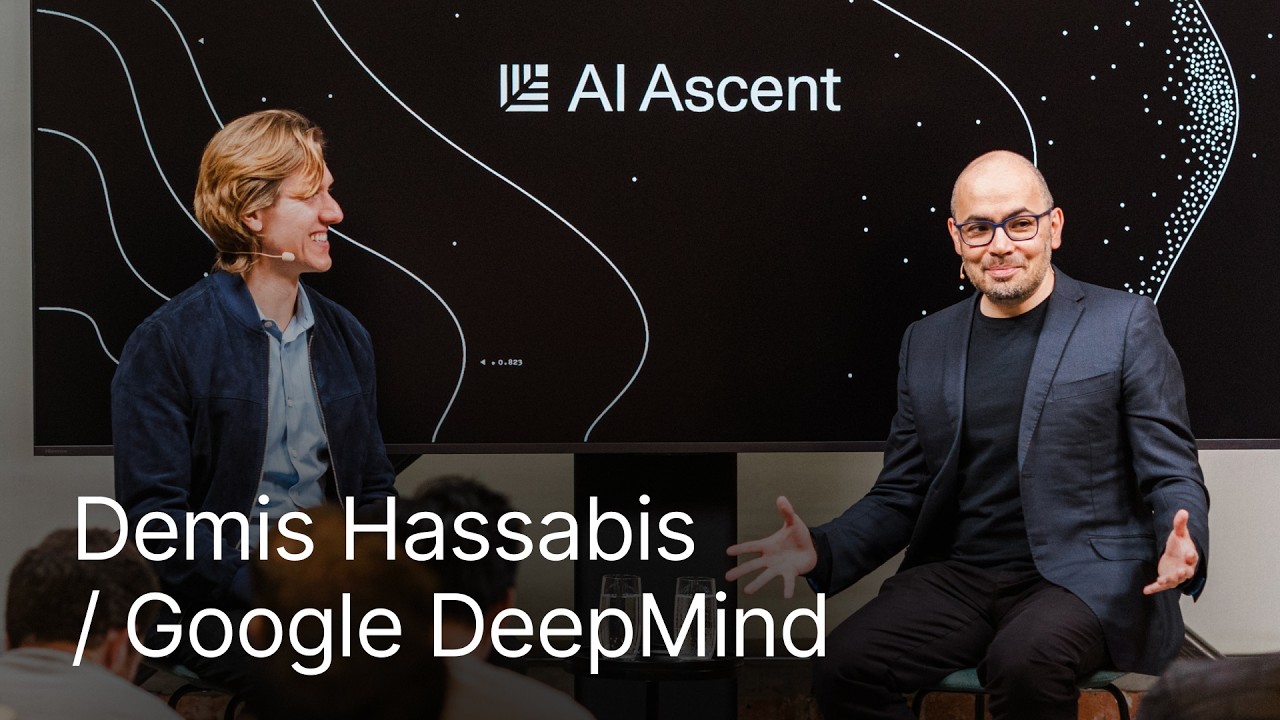
- DeepMind's audacious mission to 'solve intelligence' is advancing rapidly.
- AI, exemplified by AlphaFold, is already revolutionizing drug discovery and scientific understanding.
- Hassabis envisions AI creating entirely new sciences through hyper-accurate simulations.
Demis Hassabis, CEO of DeepMind, offered a compelling glimpse into the future of Artificial General Intelligence (AGI), asserting that the field is 'three quarters of the way' to achieving this monumental goal. His journey, marked by early success in gaming and a deep dive into neuroscience, laid the groundwork for a vision that many once dismissed as 'sci-fi.'
Hassabis, a former chess prodigy and gaming entrepreneur, revealed that his path was always guided by a singular, long-term ambition: to build AI. From his teenage years, he saw AI as the most important and interesting endeavor, strategically choosing studies and ventures, like his first company Elixir Studios, to eventually enable the creation of DeepMind. He recounted the skepticism he faced in 2009 when founding DeepMind, with academics 'rolling their eyes' at the mention of AGI. However, DeepMind pressed forward, combining nascent deep learning with reinforcement learning and leveraging emerging GPU compute power, feeling like 'keepers of a secret' on the cusp of a major breakthrough.
DeepMind's mission statement is clear: 'step one solve intelligence i.e. build AGI. Step two use it to solve everything else.' This philosophy underpins their significant investment in 'AI for Science,' a division that formally began after the AlphaGo victory. Hassabis highlighted AlphaFold, which solved the 50-year grand challenge of protein folding, as a prime example of AI's transformative power in biology. He detailed the work of Isomorphic Labs, a DeepMind spin-out, which aims to leverage AI to dramatically reduce drug discovery times from years to mere months or even weeks, potentially making personalized medicine a reality and bringing 'all disease in reach.'
Looking beyond current applications, Hassabis posited that AI will not only accelerate existing scientific fields but also create entirely new ones. He expressed particular excitement for 'AI for simulations,' envisioning hyper-accurate virtual models of complex emergent systems like economies or even virtual cells. This capability would allow scientists to run countless controlled experiments, leading to new fundamental laws akin to physics, transforming currently uncertain domains into rigorous sciences. Philosophically, Hassabis views information as the universe's most fundamental building block, suggesting that AI, as an information processing system, holds a profound key to understanding reality itself. He remains confident in his long-held prediction of AGI by 2030, emphasizing that the journey should focus on building AI as an incredibly intelligent tool first, before tackling the deeper questions of agency and consciousness.
“Our original state uh mission statement at deep mind was step one solve solve intelligence i.e. build AGI. Step two use it to solve everything else.”
- Demis Hassabis, CEO of Google DeepMind