- Waymo has completed over 20 million fully autonomous rides, with half achieved in the last seven months.
- The Waymo driver is 13 times safer than human drivers in preventing serious injury collisions in its operating cities.
- A multimodal 'Waymo Foundation Model' powers the system, augmented with structured representations for unparalleled safety and scalability.
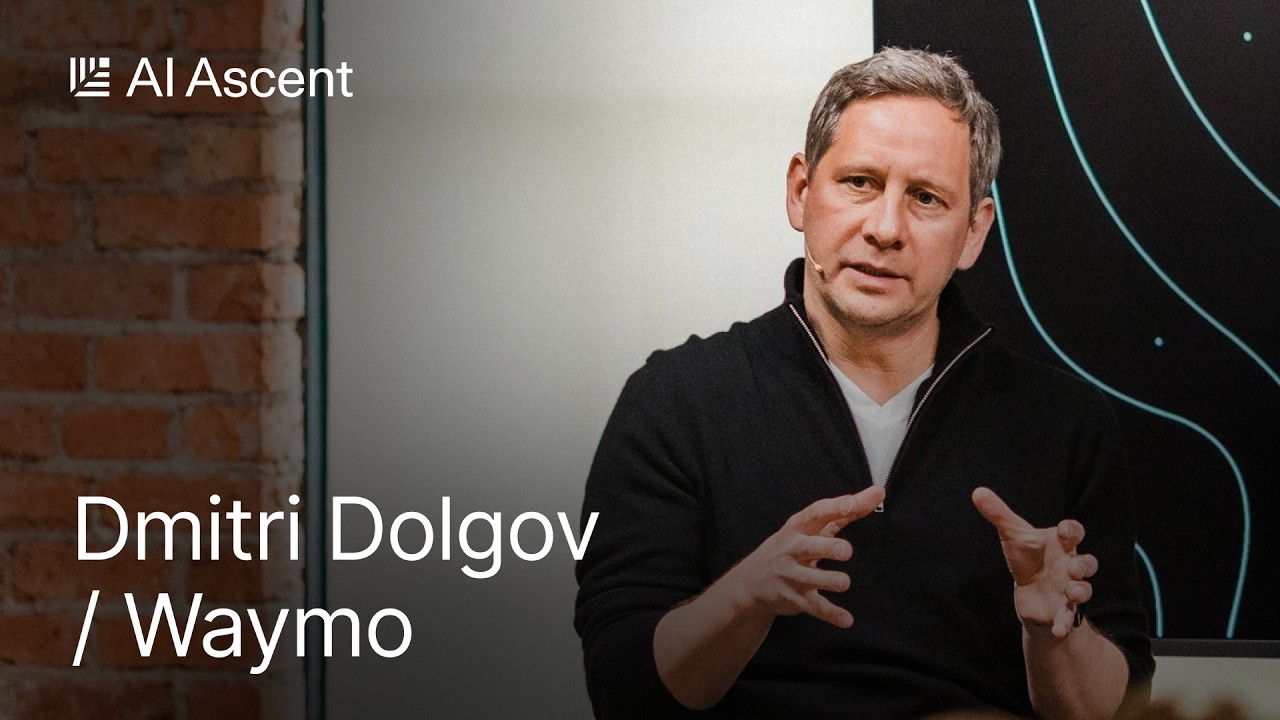
Dmitri Dolgov, a pioneer in autonomous vehicle technology for over two decades, shared Waymo's journey from its ambitious beginnings to its current exponential growth, emphasizing the critical role of persistence, a unique AI architecture, and an unwavering commitment to safety.
Dolgov, who started his journey in AI and autonomous vehicles with the DARPA challenge in 2005, described his initial attraction to the field as a 'light switch moment.' He was drawn not just by the technological complexity but by the profound mission to improve road safety globally. This deeply held belief became the bedrock of Waymo, which began as the Google self-driving car project in 2009. Early days were marked by intense dedication, with the small team working around the clock to achieve audacious goals like driving 100,000 miles in full autonomy and completing challenging 100-mile routes without human intervention.
Waymo navigated the tumultuous AI hype cycles, particularly in autonomous vehicles, where many competitors faltered. Dolgov attributes Waymo's resilience to understanding that while it's 'easy to get started,' achieving a real product with 'superhuman performance' is incredibly difficult. This long-term perspective, coupled with a mission-driven focus on preventing the 1.19 million annual road deaths worldwide, provided the stamina to persist. Today, Waymo's core AI is powered by its 'Waymo Foundation Model,' a multimodal world action language model that integrates data from various sensors like lidars, radars, and cameras. This end-to-end model is critically augmented with structured intermediate representations, enabling crucial runtime validation and richer training, which Dolgov states is essential for achieving superhuman safety at scale, unlike basic end-to-end systems.
The company's commitment to innovation extends to hardware, with the sixth-generation Waymo Driver focusing on performance, simplification, drastic cost reduction, and high-volume production. This advanced hardware, paired with the sophisticated AI, has enabled Waymo to achieve exponential scaling: 10 million rides in the last seven months alone, bringing the total to over 20 million fully autonomous rides. Waymo recently launched in four new cities on a single day, expanding its footprint across the US and with plans for international service in London and Tokyo. Dolgov highlighted the tangible impact on safety, revealing that the Waymo driver is more than 13 times safer than human drivers in preventing serious injury collisions, preventing a serious injury every 8 days.
Dolgov shared a compelling anecdote where the Waymo driver, at an intersection, detected a pedestrian's footsteps under a bus using lidar, anticipating their emergence and reacting defensively to prevent an incident. This 'mind-blowing' capability underscores the system's advanced perception and predictive power. For Dolgov, Waymo isn't just a product; it's a daily part of his life, with his children even preferring Waymo rides over those driven by humans. As Waymo moves into a phase of 'rapid parallel global commercialization,' its foundational principles of technical brilliance, unwavering persistence, and a deep-seated safety culture continue to drive its mission to make roads safer for everyone.
“The Waymo driver is more than 13 times safer than a human driver when it comes to serious injury causing collisions in the cities where we operate.”
- Dmitri Dolgov, co-CEO of Waymo