
All Articles

Public Sector's AI Revolution: Driving Transformation with Data at Scale
The public sector, often perceived as lagging in technological adoption, is undergoing a profound digital transformation. Driven by the urgent need to deliver more with less and meet rising citizen expectations, government agencies are embracing advanced data analytics and artificial intelligence. This shift is not just about technology; it's about fundamentally reimagining how public services are delivered, enhancing security, and fostering unprecedented collaboration.

Securely Running Databricks on AWS GovCloud: A Deep Dive for Public Sector and Regulated Industries
In an era of escalating cyber threats and stringent data regulations, public sector organizations and highly regulated industries face immense pressure to secure their data workloads. This session explores how Databricks, running on AWS GovCloud, provides a robust and compliant environment designed to meet the most demanding security standards, including FedRamp High and DoD Impact Level 5.

Government Agencies Harness Data & AI for Unprecedented Public Service and Security
The public sector is undergoing a profound transformation, driven by an urgent need to leverage data and artificial intelligence for better citizen services, enhanced national security, and operational efficiency. Leaders from agencies like the FBI, Department of Defense (DoD), Department of Veterans Affairs (VA), and Hennepin County shared their journeys at the Data + AI Summit 2021, highlighting both the immense potential and the significant challenges in this digital evolution.
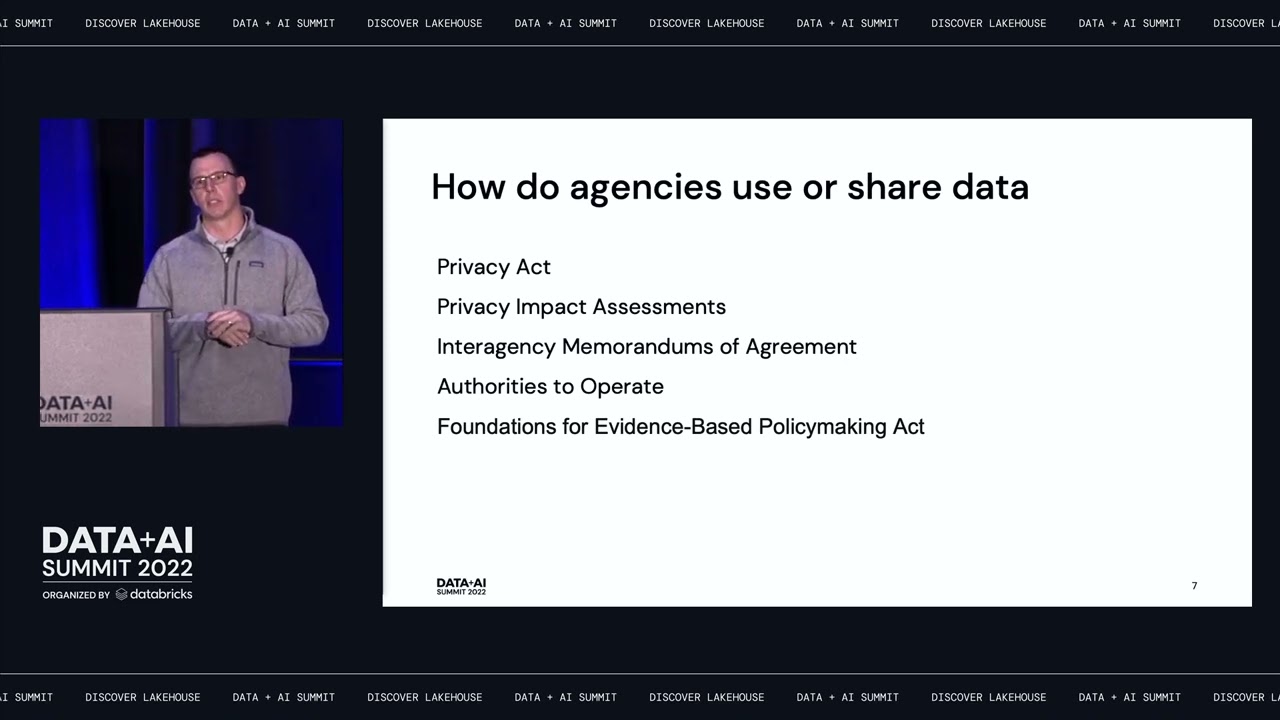
Securing the Future: Implementing Robust Data Security and Policy Frameworks in the Public Sector
In an era of unprecedented data generation and complex societal challenges, public sector agencies face a critical dilemma: how to leverage vast datasets for public good while rigorously protecting sensitive information. This session, featuring Dave Thomas from Deloitte and Danny Holloway from Immuta, dives into the intricacies of implementing effective data security and policy frameworks, transforming traditional 'need to know' paradigms into dynamic 'need to share' capabilities.
Unlocking Public Sector Potential: The Lakehouse Platform and FAIR Data Principles
In an era demanding rapid, data-driven decisions, public sector organizations face immense pressure to modernize their data infrastructure. This session explores how the Lakehouse platform, built on the foundational principles of FAIR data, provides a robust and transparent framework for governments to transform their data into actionable insights, ultimately improving citizen outcomes.
Transforming Public Sector: The Imperative of a Modern Data Estate
In an era of rapid digital transformation, public sector services are under immense pressure to evolve. Citizens expect the same hyper-personalized and responsive interactions from government as they receive from private companies, while agencies grapple with the challenge of doing more with less. This paradigm shift necessitates a fundamental modernization of government data estates, moving beyond outdated infrastructures to embrace agile, secure, and insightful data architectures.

Public Sector Embraces Data and AI for Transformative Impact
The public sector is at a pivotal moment, actively embracing data modernization and artificial intelligence to tackle complex challenges, enhance citizen services, and streamline operations. From federal defense to state and local health initiatives, agencies are demonstrating how strategic data platforms and AI can deliver unprecedented impact, even amidst inherent bureaucratic complexities.
CDC's Data Revolution: How an Accelerator Methodology Achieved 10X Faster Public Health Visualizations
The Centers for Disease Control and Prevention (CDC) has unveiled a transformative accelerator methodology that is reshaping how big data is visualized and utilized in public health. Spearheaded by John Boer and his team, this initiative, known as CDC Data Hub, has overcome significant hurdles in data engagement, governance, and performance, leading to dramatic improvements in delivering critical health insights.
Washington State Pioneers Unified Data Strategy for Superior Government Services
The State of Washington is setting a new standard for public service by implementing a robust, unified data strategy. This initiative, powered by platforms like DataBricks, aims to transform how government operates, ensuring more accessible, equitable, and effective services for all residents.

Databricks and AI Power Unprecedented Transformation in State Services
A pioneering state, spearheaded by a visionary governor, has embarked on an ambitious journey to redefine public services through the strategic implementation of data and generative AI. This initiative, launched with an executive order in September 2023, showcases a fearless commitment to innovation, partnering with private sector leaders like Databricks and academia to deliver long-lasting benefits to its residents.

LA County's Data Revolution: Balancing Innovation with Robust Security
Los Angeles County is embarking on a transformative journey to unify its vast data landscape, aiming to extract unprecedented value and enhance public services. This ambitious initiative treats data as a strategic asset, moving beyond traditional siloed systems to create a cohesive and intelligent data environment.

Unified Governance and Enterprise Sharing: The New Imperative for Data + AI Success
In an era where data is paramount and AI is rapidly reshaping industries, organizations face the dual challenge of securing highly sensitive data while simultaneously fostering an environment of open sharing and rapid innovation. This session, featuring insights from Databricks Solutions Architect Luke Bilbro and a panel including data leaders from the World Bank and Petrobrass, unveiled a blueprint for achieving unified governance and enterprise sharing for data and AI.

Navigating the AI Frontier: Reducing Risk and Boosting Public Services
In an era where artificial intelligence is rapidly transforming industries, its application in the public sector and healthcare presents both immense opportunities and significant challenges. Rebecca Nissan, a Delivery Solutions Architect specializing in healthcare and life sciences, highlighted the critical need for 'trustworthy and trusted' AI. This means not only building systems that are technically sound but also ensuring that end-users, from clinicians to citizens, have confidence in their capabilities. The session delved into practical frameworks and real-world perspectives on how to responsibly innovate with AI.

Reinventing Government: How Data Intelligence and AI are Transforming Public Services
In an era demanding agility and efficiency, government agencies face an uphill battle against outdated data infrastructure and fragmented information silos. This session, 'Reinvent Government in a Data Intelligence Era,' presented by Eric Papawitch of Databricks and Ricky Aurora of Minnesota Metro Council, unveiled a transformative approach using the Databricks Data Intelligence Platform to overcome these challenges and accelerate the adoption of data and AI in the public sector.

Public Sector Embraces Data & AI: A New Era of Efficiency and Innovation
The public sector is undergoing a profound transformation, driven by an urgent need for enhanced efficiency, improved services, and robust data intelligence. A 'renaissance' in data strategy is sweeping across federal and state agencies, propelled by executive orders and directives that mandate a data-first approach to mission outcomes. This shift is not merely about technology adoption, but about fundamentally reimagining how government operates to serve its citizens better.

The World Bank's Blueprint for a Unified Enterprise Data Serving Layer with Databricks
In an era where data-driven decision-making is paramount, organizations grapple with vast, disparate datasets and a myriad of applications. The World Bank, with its mission to end poverty and boost shared prosperity, faces this challenge on an unprecedented scale, managing over 30 petabytes of data across 10,000 applications. This session delves into their journey to establish a unified enterprise data serving layer, leveraging Databricks as the central nervous system for their data ecosystem.
CMS Forges an AI-Native Future to Revolutionize Healthcare and Combat Fraud
The Centers for Medicare & Medicaid Services (CMS) is embarking on an ambitious journey to become an AI-native organization by 2026. This transformation is not merely about adopting new technologies but fundamentally reshaping how government delivers value, enhances patient care, and safeguards taxpayer dollars against pervasive fraud.
AI and Databricks Revolutionize Peatland Restoration for Natural England
Natural England, in collaboration with Defra and Databricks, is pioneering a groundbreaking approach to peatland restoration across England. By harnessing the power of Artificial Intelligence and advanced data platforms, they are dramatically accelerating efforts to map, protect, and restore these crucial wetland habitats, which are vital for biodiversity, water quality, and climate regulation.
Gainwell Technologies Revolutionizes Health Data Management with Databricks on AWS
Gainwell Technologies, a leader with five decades of experience in public health program delivery, is leveraging the power of Databricks on AWS to transform how health data is managed and utilized. This strategic adoption is not only enhancing operational efficiency but also directly impacting health outcomes for millions.