Data Governance & Security
Covers strategies and technologies for managing, securing, and governing data assets within the public sector, including compliance with standards like FedRAMP and ensuring data privacy and interoperability.
Viral Moments
29
Trust, speed, clarity
Democratizing data access!
Centralized data reality
Major Compliance Win!
Avoid this common pitfall
SQL for permissions
Trust is fragile
Simple, secure, powerful platform
Data privacy unlocked
Data silos no more!
No data left behind
Culture change for data.
Incomplete data no more.
Beyond technical solutions
Open data sharing
Trust is paramount
AI for data governance.
Public sector challenges
Secure sharing, faster results
Unlock data, collaborate freely.
Federation challenges
Automate data management
Mapping 4000+ systems!
Centralizing data access
Legacy tech, data growth
Staggering scale, cyber threats
Fragmented data, huge problem.
Prove your data control
Centralized data bottlenecks
Key Quotes
8
“We can't be reckless, but we can't be fearful about experimenting and being innovative.”
“Data has become democratized and the tools have lowered that barrier to the point where we now have more actors that that have problems that they can address with the right tech technologies and the right rules around the information they have.”
“We are rich in data and poor in information. With supporting all these countywide applications, we have the entire County's financial data and administrative data, but are we able to answer the questions that come from the board or from any other programs that you know we are working on readily available?”
“You can have the best generative AI in the world if you don't store these things in a way that's meaningful and useful then you really lose a lot of its value.”
“Anything you build is easy to follow and there is a pool to follow because you know there is a value of those decisions and those actions.”
“If you have your data available and discoverable and accessible in a centralized, protected platform that is enabled for AI, ML, and all these futuristic and forward-looking applications that you want to build, then probably you can sacrifice here and there performance on an integration scenario.”
“don't get caught up in that analysis paralysis phase that you know you are overthinking about the security policies which do not align with your data needs”
“With that we can confidently say that AWS is one of the most secured cloud provider.”
Chapters
75
Articles
8
The State of Washington is setting a new standard for public service by implementing a robust, unified data strategy. This initiative, powered by platforms like DataBricks, aims to transform how government operates, ensuring more accessible, equitable, and effective services for all residents.
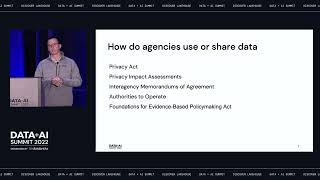
In an era of unprecedented data generation and complex societal challenges, public sector agencies face a critical dilemma: how to leverage vast datasets for public good while rigorously protecting sensitive information. This session, featuring Dave Thomas from Deloitte and Danny Holloway from Immuta, dives into the intricacies of implementing effective data security and policy frameworks, transforming traditional 'need to know' paradigms into dynamic 'need to share' capabilities.
The public sector is at a pivotal moment, actively embracing data modernization and artificial intelligence to tackle complex challenges, enhance citizen services, and streamline operations. From federal defense to state and local health initiatives, agencies are demonstrating how strategic data platforms and AI can deliver unprecedented impact, even amidst inherent bureaucratic complexities.
The Centers for Disease Control and Prevention (CDC) has unveiled a transformative accelerator methodology that is reshaping how big data is visualized and utilized in public health. Spearheaded by John Boer and his team, this initiative, known as CDC Data Hub, has overcome significant hurdles in data engagement, governance, and performance, leading to dramatic improvements in delivering critical health insights.
In an era demanding rapid, data-driven decisions, public sector organizations face immense pressure to modernize their data infrastructure. This session explores how the Lakehouse platform, built on the foundational principles of FAIR data, provides a robust and transparent framework for governments to transform their data into actionable insights, ultimately improving citizen outcomes.
In an era where data-driven decision-making is paramount, organizations grapple with vast, disparate datasets and a myriad of applications. The World Bank, with its mission to end poverty and boost shared prosperity, faces this challenge on an unprecedented scale, managing over 30 petabytes of data across 10,000 applications. This session delves into their journey to establish a unified enterprise data serving layer, leveraging Databricks as the central nervous system for their data ecosystem.
Los Angeles County is embarking on a transformative journey to unify its vast data landscape, aiming to extract unprecedented value and enhance public services. This ambitious initiative treats data as a strategic asset, moving beyond traditional siloed systems to create a cohesive and intelligent data environment.
In an era of escalating cyber threats and stringent data regulations, public sector organizations and highly regulated industries face immense pressure to secure their data workloads. This session explores how Databricks, running on AWS GovCloud, provides a robust and compliant environment designed to meet the most demanding security standards, including FedRamp High and DoD Impact Level 5.
Sessions
9