Databricks Lakehouse Platform
Focuses on the core Databricks platform, its architecture, and integration with cloud providers like AWS, showcasing successful implementations and migration strategies for public sector entities.
Viral Moments
21
Freedom from vendors
Future of data is here.
Centralized data reality
Major Compliance Win!
Avoid this common pitfall
Faster answers, better care
Simple, secure, powerful platform
Scaling Databricks correctly
NoSQL to Lakehouse success.
SQL for permissions
AI model transparency
No data left behind
Caching secrets revealed
150+ customers, 10,000+ users!
Open data sharing
Unlock data, collaborate freely.
Federation challenges
Automate data management
Future-Proof Your Data!
Centralizing data access
Testing Databricks limits
Key Quotes
12
“Peatlands hold more carbon than all of the other vegetation types in the world combined.”
“Generative AI has come to traffic management in the state in a way that does not exist in any other state in America.”
“If you just decentralize without governance, it will become a mess.”
“We are only able to get to 20% of our data. Our data is we can't even process all of that data that's currently coming in. There's no capacity, there's no horsepower processing power at all to do any of this stuff.”
“You can have the best generative AI in the world if you don't store these things in a way that's meaningful and useful then you really lose a lot of its value.”
“With the unmatched power of Databricks and the Lakehouse for public sector, governments now have one simple, secure, and powerful platform for all their data, analytics, and AI needs.”
“Anything you build is easy to follow and there is a pool to follow because you know there is a value of those decisions and those actions.”
“If you have your data available and discoverable and accessible in a centralized, protected platform that is enabled for AI, ML, and all these futuristic and forward-looking applications that you want to build, then probably you can sacrifice here and there performance on an integration scenario.”
“Data is the new ammunition in our arsenal that improves decision making and connects the DoD's boardroom and battlespace.”
“By using AI to take that natural language and pull out the semantically correct details, index them, and provide them to the pharmacist improves not only the accuracy, allows them to quickly get answers, taking things down from 45 minutes down to less than 10.”
“AI has moved from hype to business requirement. You must deploy AI at scale.”
“With that we can confidently say that AWS is one of the most secured cloud provider.”
Chapters
76
Articles
12
Natural England, in collaboration with Defra and Databricks, is pioneering a groundbreaking approach to peatland restoration across England. By harnessing the power of Artificial Intelligence and advanced data platforms, they are dramatically accelerating efforts to map, protect, and restore these crucial wetland habitats, which are vital for biodiversity, water quality, and climate regulation.
A pioneering state, spearheaded by a visionary governor, has embarked on an ambitious journey to redefine public services through the strategic implementation of data and generative AI. This initiative, launched with an executive order in September 2023, showcases a fearless commitment to innovation, partnering with private sector leaders like Databricks and academia to deliver long-lasting benefits to its residents.
In an era where data is paramount and AI is rapidly reshaping industries, organizations face the dual challenge of securing highly sensitive data while simultaneously fostering an environment of open sharing and rapid innovation. This session, featuring insights from Databricks Solutions Architect Luke Bilbro and a panel including data leaders from the World Bank and Petrobrass, unveiled a blueprint for achieving unified governance and enterprise sharing for data and AI.
In an era demanding agility and efficiency, government agencies face an uphill battle against outdated data infrastructure and fragmented information silos. This session, 'Reinvent Government in a Data Intelligence Era,' presented by Eric Papawitch of Databricks and Ricky Aurora of Minnesota Metro Council, unveiled a transformative approach using the Databricks Data Intelligence Platform to overcome these challenges and accelerate the adoption of data and AI in the public sector.
The Centers for Disease Control and Prevention (CDC) has unveiled a transformative accelerator methodology that is reshaping how big data is visualized and utilized in public health. Spearheaded by John Boer and his team, this initiative, known as CDC Data Hub, has overcome significant hurdles in data engagement, governance, and performance, leading to dramatic improvements in delivering critical health insights.
In an era of rapid digital transformation, public sector services are under immense pressure to evolve. Citizens expect the same hyper-personalized and responsive interactions from government as they receive from private companies, while agencies grapple with the challenge of doing more with less. This paradigm shift necessitates a fundamental modernization of government data estates, moving beyond outdated infrastructures to embrace agile, secure, and insightful data architectures.
In an era demanding rapid, data-driven decisions, public sector organizations face immense pressure to modernize their data infrastructure. This session explores how the Lakehouse platform, built on the foundational principles of FAIR data, provides a robust and transparent framework for governments to transform their data into actionable insights, ultimately improving citizen outcomes.
In an era where data-driven decision-making is paramount, organizations grapple with vast, disparate datasets and a myriad of applications. The World Bank, with its mission to end poverty and boost shared prosperity, faces this challenge on an unprecedented scale, managing over 30 petabytes of data across 10,000 applications. This session delves into their journey to establish a unified enterprise data serving layer, leveraging Databricks as the central nervous system for their data ecosystem.
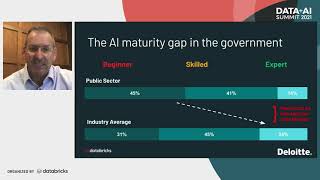
The public sector is undergoing a profound transformation, driven by an urgent need to leverage data and artificial intelligence for better citizen services, enhanced national security, and operational efficiency. Leaders from agencies like the FBI, Department of Defense (DoD), Department of Veterans Affairs (VA), and Hennepin County shared their journeys at the Data + AI Summit 2021, highlighting both the immense potential and the significant challenges in this digital evolution.
Gainwell Technologies, a leader with five decades of experience in public health program delivery, is leveraging the power of Databricks on AWS to transform how health data is managed and utilized. This strategic adoption is not only enhancing operational efficiency but also directly impacting health outcomes for millions.
The public sector is undergoing a profound transformation, driven by an urgent need for enhanced efficiency, improved services, and robust data intelligence. A 'renaissance' in data strategy is sweeping across federal and state agencies, propelled by executive orders and directives that mandate a data-first approach to mission outcomes. This shift is not merely about technology adoption, but about fundamentally reimagining how government operates to serve its citizens better.
In an era of escalating cyber threats and stringent data regulations, public sector organizations and highly regulated industries face immense pressure to secure their data workloads. This session explores how Databricks, running on AWS GovCloud, provides a robust and compliant environment designed to meet the most demanding security standards, including FedRamp High and DoD Impact Level 5.
Sessions
13