Unlock Billions: How Public Sector is Crushing Challenges with AI!
The public sector is undergoing a profound transformation, driven by an urgent need for enhanced efficiency, improved services, and robust data intelligence. A 'renaissance' in data strategy is sweeping across federal and state agencies, propelled by executive orders and directives that mandate a data-first approach to mission outcomes. This shift is not merely about technology adoption, but about fundamentally reimagining how government operates to serve its citizens better.
“AI has moved from hype to business requirement. You must deploy AI at scale.”
- Mike Daniels, VP and GM, Public Sector, Databricks
Discover how public sector agencies are transforming operations with modern data architectures and AI. Learn from experts and leaders on leveraging data intelligence to drive efficiency, enhance services, and achieve critical mission outcomes. This session reveals the future of government innovation.
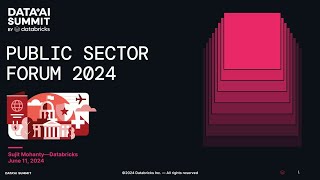
public sector forum. I'm Mike Daniels. I'll be kicking things off with just a few comments. Uh you can see the agenda here. We'll go through this. Uh, we promise it won't take any more than about an hour and then we'll have you out of here. Now, I thought I'd start by saying thank you. Thank you to all of our many customer partners for everything you do with us, for your trust and your commitment to developing datadriven enterprises. We are honored to be part of your journey. I'd also like to offer another thank you and that's to Deote and AWS as for sponsoring this event today. Uh many thanks for their commitment to the public sector community as well. And on the partner theme, I thought we'd take a moment and recognize our incredible partner community for everything they do to help our customers achieve success. Our partner network plays a critical role in accelerating idea to execution. And I thought I'd take a moment to call out two exceptional partners here. First, Deote, our federal partner of the year. Deote's helping us drive data bricks impact across a diverse set of federal agencies. And then secondly, our state, local, and education partner of the year is Slalom. Slalom has quickly emerged as a go-to partner to drive data bricks impact across the entire SLUD marketplace. And really, thank you to all of our partners for their work with Data Bricks and for making impact in the public sector community.
Switching gears, I think it's important to note that we are now operating in an environment that has changed significantly. We're actually experiencing a renaissance of sorts around data strategy and public sector. The demand for a modern data architecture is coming top down both federally and at states. There have been a number of executive orders and OM directives driving investment in and focus on achieving real data intelligence. This push from the federal government in many states is focused on facilitating collaboration, understanding benefit or service eligibility and driving clarity around mission cost and performance to achieve efficiency. Really, as a backdrop, there's never been a better time for all of us to be working together to achieve a modern data estate. And at the same time, you have this push for data state modernization. We're also in a world where you must take advantage of AI at scale to achieve mission outcomes. The gap between what your current state is and what your could be state is with AI has never been greater. AI has moved from hype to business requirement. And you must deploy AI at scale to drive real return, to absorb reduced staffing and budgets, to achieve the mission efficiency needed, to accelerate analytics and the ability to understand and adapt to changing policy and requirements. And the fulcrum that that all rests on that AI and it leverages to achieve operational scale is a modern data state strategy. Again, there's really never been a better time for all of us to be working together on this and supporting these data and AI initiatives in public sector is real policy and funding. The core of being able to meet the policy with real governance and the accountability necessary is driven by the data intelligence platform. The funding landscape is now shifting
from cloud first and system modernization to a data first and data and AI innovation. Our ability to work together to achieve these policy objectives and access the funding necessary to do so has never been greater. In short, to accelerate the curve of innovation in an era of AI and meet policy and societal needs of the future, every agency must become data and AI first.
Now, we know this is hard, but the agencies that adopt the modern data strategy are going to succeed. We understand it's a journey, and we're investing in that journey with you. We believe our endto-end data intelligence platform is the key to removing obstacles and unlocking potential. Now, there's many things that are unique about data bricks. Uh, but I did want to draw your attention to three critical architectural features that continue to set us apart from the competition.
Number one, our open architecture, and that's open across every component of the platform. Number two, our commitment to data governance built into every aspect of the platform. And finally, our ability to democratize data across your enterprise and between enterprises. Data Bricks has been partnering with the public sector since 2017. We established our federal LLC in 2018 and we are committed to providing our full solution stack across all compliance regimes so that we are able to meet you where you are and we will continually make progress against these objectives. We are well penetrated across public sector including all branches of government as well as federal systems integrators, government service and contract providers, higher education institutions and nonprofits. And finally, we are deeply committed to creating partnerships with key public sector solution providers to accelerate value for you as a whole. And we're focused on core outcomes that matter across public sector, including data first, mission improvement. And that's really aimed at enhancing decision confidence and fidelity. Reducing cost and enhancing services, which is improving both sides of the efficiency equation. Identifying fraud, waste, and abuse to protect resources for the mission. and achieving scale and security to deploy transformative technologies like AI while mitigating risk. Next up, I'd like to ask Sujit Bahhatne to speak a little bit more detail about our platform focus. Suge. Oh, thank you.
Thanks, Mike. Appreciate that. Um, and uh, over the next uh, 48 hours, you guys will be hearing a lot of these same themes that I'll be covering in these next 10 or so slides. But really kind of how do we do this with the art of the possible? How do we make public sector really become, to Mike's point, enabled with data and intelligence deeply infused inside our agencies, unlocking some of the most critical outcomes that we're trying to achieve here. Um, and it it starts with that those talk about those three kind of key primitives. open architecture, open formats. And one of the key things around being able to unify and own your data is leveraging two of the biggest open standards right now from a storage perspective. So ultimately, Delta and iceberg being able to intermingle and being able to um properly support both formats interoperably fully. And so that allows you to adopt the core data formats that are right for your organization. Eliminate unnecessary multiple copies of your data logically being able to handle that storage. Break free from any lock in or control as required. So you mentioned that from a storage perspective. Now let's layer on governance. Proper governance that helps you protect and understand your data. And it starts with Unity Catalog. And it's really being able to unify capabilities across every use case, not just focus on traditional cataloges which may only focus on security, access control, auditing and only do it at the table level. There's so many other things you got to think about as well too. Collaboration as Mike talked about. So being able to interare data between agencies and inside of an agency. So being able to discover that do secure open data sharing data quality. So the term lineage is actually something that you guys will hear quite a bit over the next couple days. Being able to do quality monitoring as far as enabling a lot of these use cases. What's happening with that data quality in order to train models which I'll talk about in a sec. Um that becomes really really key. And then insights cost controls being able to have business semantics. Those become extremely critical especially when we start talking about the different use cases we'll be supporting. And then uh it comes down to being able to get the right data into your platform. So into data bricks and do that without hassle. And so that's where lakeflow and so you will see some announcements come out around data bricks lakeflow. And so that's the ability to do data pipelines around connecting handling jobs ingestion as well. There'll be some announcements over the next uh tomorrow and on Thursday as well. But really it starts with efficient ingestion connectors. Public sector, the federal government, there's an ecosystem of vendors over the past decade that have really solidified architectures, formats, and being able to tap into that data becomes such a big unlock for these agencies. organizations like Salesforce, Workday, Google, SharePoint, SQL Server, Service Now, they're part of the common that exists for agencies in today's uh uh public sector ecosystem. So, being able to efficiently ingest that, being able to handle pipelines, so making sure that they're reliable at scale, and then being able to unify orchestration from a jobs perspective to be able to handle analytics and also AI. And then this all comes together as a data bricks intelligence platform. So we talked about open standards for storage governance that is extremely key u again based on open source uh technologies and then our vertical capabilities. We already talked about lakeflow but AIBI
being able to do business intelligence with artificial intelligence on top being able to rapidly ask insights against your data being able to handle data warehousing. So data bricks SQL was our fastest growing product line ever inside of data bicks uh north of nine figures right now and rapidly growing to be a 10 figure business all up. of being able to modernize legacy data warehouses. It's one of the most opportune market opportunities not just for our partners here in the room but also for our end customers. Getting rid of that legacy tech and then being able to finally go to this era of artificial intelligence with our mosaic AI solutions being and I'll talk about that being able to fine-tune models deploy models serve them up properly all the all the models that exist in the in the current ecosystem and do it securely. So open architecture, data governance, data democratization, those become the key things around why data bricks is the number one platform for public sector and also our federal customers protecting your data. So it starts with a trusted platform. So from the ground up ensuring that we've done the design, the operational controls, the transparency to provide trust. This is something we've done since the incubation of data bricks. uh we were we've been an Inktel portfolio company for a number of years now. Uh and that really goes from supporting all the different federal agency requirements. So security is so fundamental to us being able to meet regulatory requirements as well infrastructure workload data security controls. We'll talk a little bit more about that with the standards around FedRAMP DODDI5 and also the built-in security features uh being able to handle things like continuous monitoring having the lockdowns in the operating environments that run your clusters it becomes so critical with a platform like data bricks and so kind of like I mentioned
data bricks on AWS govCloud you know we're pleased to announce that we are federai and DOD IL5 today uh so a year ago I I stood here saying we were anticipating this day come on let's get some hands clapping for this. This is this is such a big unlock and and the thing that I think everybody in the company is really proud of is these regions all look the same. And what I mean by that is what we're doing across our commercial fabrics federate moderate high dod5 you get the same features as we go forward roadmap wise. So what you build low go high becomes so critical and we'll continue this as we go forward in the higher fabrics but it enables DBSQL. So being able to do data warehouse modernization EDW modernization catalog governance when I mentioned data bricks enhanced security and compliance that's being able to have that ESC capability directly in the operating environment. So continuous monitoring fips compatible libraries all harded in the clusters. So there's nothing that you have to do in order to meet your compliance profiles required to inherit federate pi DOD5 or go even further as required. Operated by US citizens on US soil supports ITAR and a whole slew of other authorizations and certifications. Data bicks has made the investment for our public sector customers and for our federal market opportunity and so we're here to help. So definitely reach out if you have any questions on any of this. And so the we've talked a lot about product um but I think those precursors are so critical when we talk about democratizing your data to
enable something like genai. So this is such a large potential for the market and I think we're just scratching the surface. You're seeing some stats here. 74% of public sector organizations they're investing or experimenting with jai lms. I think many are trying to find their journey. You can see some of the use cases are being brought about. Real-time data analytics, automation, automation and efficiency, predictive maintenance, quality control. We're just getting started. We already have customers that are leveraging data bricks for their outcomes, their capabilities, their solutions, and their goals. Our North Dakota University system had some phenomenal outcomes around document search summarization as well. uh efficiencies that were either 100% type improvements in time or 2x the speed around document search. So that was over 3,000 specific system documents that they were able to collapse. They actually trained multiple models. They leveraged uh our DBRx model and they've since improved that as well too. uh VA has done some procurement optimization as well leveraging large language models to handle and assess functionally for uh equivalent products which really has helped for cost savings cost savings and efficiency especially in today's market so critical with the demands of a for agencies. So what does all this mean? Like we we talk about enabling all this with data bricks. This is why it becomes so so critical. It's not just saying, "Hey, we're going to go use some large language models." Well, how are you doing that securely? So do you have complete control of your data, complete control of being able to use something like a vector search. So your your knowledge base is completely contained inside data bricks, not training an external database of of repository of information. So you're reducing potential privacy and reputational risk. production quality. So being able to be accurate, safe, being able to build applications that support Gen AI and do it with those guardrails and then do it at lower cost. So being able to train those models, fine-tune them, and really be able to achieve outcomes at a scale that's on your data and with your controls, your rules. So really the value and and you'll see this again as I said Wednesday and Thursday is we're the only endtoend platform for all of your Gen AI use cases whether using out of the box models doing rag fine-tuning pre-training the entire Mosaic platform solution we start talking about model serving being able to moni monitor those apps as well with lakehouse monitoring being able to have like a knowledge base like with with vector search we just recently updated the code inside vector search It's exponentially faster from what we had in the market right now. It's the fastest solution available and mosaic AI training as well which is an area that we've been doing for multiple years. And then this all comes together. The the answer is you have a purpose-built genai platform. You own and control the data. You've got governance, security, and controls as required tied to your agency needs. And you saw the compliancy levels that we discussed and many more coming over the next couple years. built-in quality and quality is such a key word as we start going forward here. Quality of your data, quality of the platform, quality of outcomes and cost efficiency as well. It's one of the most important things that we have. So, I know I kind of give you a quick crash course on data bricks, the value proposition for public sector, but I think it's best to really hear it from our customers and and also some of our experts. So, we'll have to welcome Molly uh to the uh forefront here with uh several of our customers here. and Molly is our our director of industry solutions. Thank you. [Applause] [Applause] Great. Uh thanks Suj for the warm
welcome and I'm really excited to be here with everyone today. Uh we have a great panel for you. First we have Dr. Sanjie Sharma who can come on up. Not only is he a board certified cardiothoracic surgeon, but he also serves as the medical director for Tri West Healthcare Alliance. We also have Miss Tena Skuw who leads the Navy's data and digital transformation efforts and they're going to be talking to you about how they've worked with data bricks to modernize their data platforms um and currently will be leveraging AI to drive mission outcomes Sorry. Hello. Oh, perfect. We found it. Sound okay now? All right. So Sanjie and Tena to start us off, would you mind telling us a little bit more about your role, your organization's mission, and the key challenges you guys are trying to solve? Yes. So, oh, very loud. Okay. Um, there is a lot there are a lot of challenges that we're trying to solve, but our organization is specifically focused. So in the FM, the financial domain space, we're really looking at how do we bring data to our customers, making it transparent, making it usable, and making sure that that data is readily available for auditing purposes, but also for programming, for operations, and ensuring that that data is available in a way that everyone from an analyst to our SCES's can get have access to it from a day-to-day standpoint, from understanding what missions are really critical for us to answer questions about every day but also understanding from the problems that we face with silos. So historically we've had data silos that existed but if we have data that's available on a day-to-day basis now at a five minute a five minute mark we can now make datadriven decisions that um affect the organization today tomorrow 6 months from now and we can do that more efficiently and at speed. Terrific. Thank you. uh at Tri West uh we are the government contractor for Triricare to provide uh management for uh health care for active duty mil military and their beneficiaries. uh we took on that role this January uh 4.3 million new subscribers January 1 and uh we're working to get them all into the system and get the health care that they need in a timely manner and uh appropriately. So that's like the biggest hurdle for us. Um currently uh as a military spouse myself I'm very excited by both by the work that both of you are doing. Um, my husband spent a few years at a hospital. He served in the army and was was injured. And I just remember those few years. There was mischief waits. Um, the doctor when the day Dylan was discharged came in with three copies of his whole medical record because he couldn't promise me that the VA would get it. He had had multiple surgeries and the box wouldn't it wouldn't even fit in a regular cardboard box. It was like this ConX container and I was like wobbling going to the going to the parking lot and the idea to me that a VA doctor who's already over scheduled would ever have time to read everything was hilarious at that point in time. So thank you guys for the work you're doing. We're all really excited about it. Uh Tena, prior to data bricks
deployment, what were the key data and AI challenges like the obstacles that you're facing? And I know the Navy has many so please feel free. There are many. So uh prior what was this AI? So prior there there the biggest obstacle was making sure that our financial data didn't exist in silos. It was siloed off from legacy data systems. All of these different um financial systems would require us to go into different endpoints to receive that data and that data may come in from a weekly batch file or um sometimes monthly batch files. So it just really depended on the system, the level of um security of that system, but there could also be data in SharePoint sites that were required. And so for an analyst being able to present those findings and those outputs in a manner that the leader that leadership can say, hey, we need to make a decision on a monthly basis. Now they can make those decisions on a daily basis. Is is phenomenal. is a big transformation from where we were. Um I remember being at the Navy when I was a contractor three years before. Uh and this when I joined I asked immediately like what's the tech stack because I already knew um that prior it was extremely hard to sometimes make the decisions that were needed on the fly. And those decisions would be needed in a way in a way that leadership would ask well why can't we get this data? why can't we have that report? And now having data outside of a silo, but in a system where everyone can log in, sign in, see the tables, understand when they're coming in. Um, we have transparency on our jobs. We have transparency um when the tables come in from from your able to look at what the tables are, seeing uh the data definitions of those tables, seeing the cycle of when they're updated. That's a different level of transparency we never had. And it of course we always want to make sure everything is auditable. So that has been something that previously was extremely hard to do and it gave our auditors a lot of angst. I can imagine. Dr. Chararma, you're at a slightly different point in your data bicks journey. Um data bicks has been deployed by the IT system at Tri West for claims automation uh for claims processing. Right now you're looking to leverage more AI. Can you talk about your plan a little bit? Sure. Um, my hope is uh to implement an AI project around prior authorizations. Uh, we deal with probably on average 500 uh new cases on a daily basis. Uh, that's done predominantly manually. We do have some automation based on CPT codes and ICD10 codes. uh but predominantly gets uh manually worked uh with a first level reviewer being a um nurse and then if it's a denial or a complex case it comes to a second level review. Um I think uh prior authorizations are it's a a fantastic use case. Uh we have an authorization there's guidelines that just say yes or no. uh it would be very straightforward and it would help increase productivity and definitely uh both nursing and physician uh job satisfaction because as a heart surgeon I would pull 12 14 hour days and I'm doing the same as a medical director and I did not think that that was going to happen but happy to do it but I think there's a much better way to to use technology to help us be more productive Um, Tena, building on Dr. Chararma's
response, as you look forward, how are you thinking about the role of generative AI and AI agents within the Navy? And are there any near-term use cases that you're excited about? There are a lot of use cases. Um, when we think about, you know, everyone in here filed their taxes, right? I hope so. Um, so when you go to file your taxes now in many tax platforms, you can just write out, hey, I want to file my taxes for this year. And it'll say, hey, upload your documents. And it starts to process your taxes in natural language. You don't have to go through the step-by-step processes. It's actually having a conversation with you. So in our organization where we have individual financial analysts uh we have auditors internal auditors who are doing validation and verification of our programmatic data our operational data our financial data there needs to be some level of generative AI that can help augment a lot of that workload currently um and you'll hear in my session tomorrow you know we've been able to bring back so when you think about you file your taxes you want to get you want maximize your refund. We also want to do that with the Navy, right? We want to maximize the amount of money that we we want to maximize the amount of money um that is not returned back. So, if we are awarded um $3 billion, for example, we want to make sure we're not returning the three billion, but we're actually prioritizing the programs that need those funds and that fund those funds are going back out to those programs that are high priority. So if we've been able to complete a program under budget, we want to make sure where do we give those funds to programs that really need those budgets. So generative AI and we've been piloting this with our audience and just getting different buyin from different stakeholders, you know, having the ability to assess risk and have a score on, hey, we believe this program is high risk of deobligation, meaning we need to give that money back. So if we are able to take someone's task of you're usually spending six or seven hours a week on something and now that's down to 20 minutes because now you're looking at and assessing a risk score and doing your evaluation based on that risk score. Now we've given you time back but we've also given programs money back and that money can go back into sailor pay bonuses retention recruitment um homes. We want to make sure the homes for the sailor's families are in shape and in order. We want to make sure our ships and our our planes are in order as well. So it's generative AI has really fueled what we've thought was possible into the art of the possible for us. Can you just
to double click in that can you tell us a little bit about the business value that you guys have driven from the data bricks implementation and all the work you've done? Um how much money you saved and improper payments? It's it's impressive. There's there's uh a lot of different metrics. Uh we have an annual report that we released every year. Um and the annual report is available on the second half website. And you know for me in the machine learning uh space you know we are able to look at $211 billion in unlquidated obligation unlquidated transactions and obligations that we're able to validate. we're able to see um inactive funds meaning funds that during the active year that we are we need to use them almost 700 million that we are able to repurpose and give back to organizations and one year in our first year of just testing a model uh we saw 1.1 billion dollars in total that we were able to give back. So that from having an organization have a tight budget to saying we challenge you to use this model to get it back to get back 5% that you usually return. That was big and many organizations met that challenge. That's terrific. Dr. Sherman, do you have any thoughts on how much money or quantitative metrics could be saved by the by leveraging AI for claims automation or or any agent deployment? I imagine it's a lot of manpower hours. I I think in terms of manpower hours, uh easily 30%. Yeah, I think uh in terms of uh just simply prior authorizations dealing with that many with our current uh manual or FTEEs, you know, we're it's six months into business and we're on a current basis. We're keeping current with our tasks, but that's everybody working in the organization. And I think if we were able to be more productive in in my opinion, I think it'd be a tremendous ROI. Um, I think the there's probably members of the audience here that are on various aspects of the journey of data bricks.
Do you guys have any advice for your peers as they're first starting out with data bricks? my team uh would say for me I always start with uh we do a lot of demos. The reason we're able to get so much buy in because I share the journey. I share when we fail. I share when we succeed. I share when we're lost, when we're curious. And they really love that part of coming to those office hours every other week and seeing what's happening. And it's not just the data science team, it's the data engineering team, it's our analytics team. And one of the biggest pieces I would share is don't think about solving the business problem from the plat from a platform perspective. Think about what the business problem is and then start to think through that business problem and really understand what are the outcomes that you currently have and what are the outcomes that this platform could bring you. And once you understand that it allows it allows you to be more flexible in the solution. I have people who come to me and they say, "We have this issue. We need AI to solve it." And I'm like, "It's actually a analytics issue." But in that uh we're able to, you know, educate on what AI does and how it works and how sometimes you just may need a um a dashboard and that may solve the problem. Also looking into it, you know, understanding your environment. If you are in an environment that's a shared space like we are understanding the cost and the ramifications of that you know we've been able to assess that our costs are tremendously high we thought they were tremendously high but um when we were looking at what those costs were and we built out a dashboard to monitor the jobs and what the usage was and what the configuration what those what clusters we were using we ended up saving 1.25 25 million just in this past fiscal year alone because we set up job monitoring and doing it in an environment where we're moving to E2. We're not there yet. We're we're in PVC. We had to do that in a way that was creative. So that did not exist. But we our levels of creativity and innovation and of course wanting to be auditors and saving uh allowed us to bring those opportunities to the to the Navy and it allowed us to think a little bit more flexible be a bit more flexible in our solutions. Absolutely. Thank you. And I would just say that to get buy in from really every part of your company. Um I think for me you know I'm going through the process of proposing a project having buyin from IT security leadership and then also staff and I think it's been fantastic fantastic for the organization to learn um to hopefully grow in the future and and be more productive. Well just one final question um you've worked with data bricks for a while now. What is the most impactful use case that you've both seen specifically? I would say right now it's going to be our riskbased sampling model. It started off as a deobligation model as a prototype. You know, could we classify if something was um going to be deobligated or not? But then it ended up being an opportunity for us to have a memobacked process for riskbased sampling of different contracts and documents. And that in itself was major. It drew in multiple customers, multiple stakeholders and it has the highest impact that I've seen to date. And and I and just starting my journey. What I would say is the the people that I've worked with have been just nothing but gracious in terms of assistance, education. U it's been fantastic. Terrific. Well, thank you so much for joining us and telling us about the wonderful work that you're doing. We really appreciate it and thank you to the audience for being here. Um I'll introduce my colleague and good friend, our regional vice president, Todd Schroeder. [Applause] [Applause] Uh, I get I I get the great pleasure of
bringing us home here and I've got a couple really really important updates in here. Um, but I I want to try to summarize a little bit of what we just went through today because we talked about kind of a big vision. Uh, lots of market imperatives that are suggesting, you know, time is now to move kind of back to the data tier for innovation. Um but I think we all live and work in very complex environments, lots of moving priorities, budgets, uh very complex architectures that exist today. Um and all of them have sense uh you know kind of locuses of control. And uh a customer told me this one day uh and it stuck with me that they had adopted this lakehouse first mindset and they didn't know it at the time. But years later after having adopted that mindset, they find themselves and their organization in this kind of doop that is faster than how they've ever uh sort of transformed their technology stack before. And so, you know, to to give you all uh something that you can take away and hopefully take back to your organizations is really just a mindset. I think traditionally speaking, when we think about improving the mission services that we deliver, there's a way that we all think about that as organizations. We think about them from contracting and procurement and buying technology and implementing technology and testing that technology and that kind of goes on and on. But in the end, I think all of us can can can agree that it modernization or transformation that has has uh lasted for a long time was always in the spirit of being better in the mission, producing a better outcome to the constituents or the citizens that we serve, being better about how arduous it might have been for our employees to get that work done. And that all happens at, you know, kind of the data level. It's just about processing information and getting the service or benefit delivered um on time or perhaps ahead of time. The way we had to do that in the past was adopt you know cloud adopt SAS applications build systems and business processes in those applications. And over that period of time let's call it the last decade what we ended up with is a very fragmented data estate. So it actually moved us away from getting really good at processing information to deliver benefit or service, but we can move right back to that. And so I think there's never been a time where like our ethos is so aligned with the market's ethos in terms of simplification and like speed of mission delivery and it it got easier and can be applied at every project level. So like when I think about this and again this comes from a customer it's really any project that is in flight or planning to be uh you know started can adopt a lakehouse first or a data first imperative. Any system that needs to be overhauled, transformed, adjusted or reconfigured can adopt a lakehouse first mindset. uh any user be it a adjudicator in a line of business be it a data scientist can benefit from a lakehouse first mindset and and those those things are the very things that produce the output. It is processing information faster, providing that information intelligently to the people that need to approve it, deny it, move it to the next person, and not rely on kind of overweight, um, software applications. And so, um, with that, I think that it's worth noting like the ecosystem is starting to understand this, too. When we look at where our partners are kind of building these these solutions on top of built on data bricks they're taking a kind of version 2.0 approach to what they used to uh architect many technologies together to offer kind of a mission solution. Accentra Federal uh 3SI Deote and TRDA are all offering missionspecific built-on applications on data brick that are that are applicable to very very specific types of um you know adjudication claims uh financial management systems or otherwise. So please do spend some time getting acquainted with these things. These are growing faster and faster. I don't think a year ago this was an idea. Today it's real and we see a lot of you know transformation happening in the ecosystem in terms of how people are leveraging your data estate platforms to offer business capabilities that are really relevant to your program lines. Another really really important update. This is the one I was talking about. I'd love to see all of you right out right down the hallway where the Rivian car is for a um uh an industry networking reception. There'll be drinks and uh some food and everything and we can continue the conversation there. So, I don't want to stand in between you and that fun and the festivities that I'm sure will go on through the evening. Um and join us. There's there's a couple other government specific sessions uh throughout uh the week. Um, we're trying to bring those stories of success and mission impact uh to all of you um as kind of bites that you can take home and hopefully put to use u in your own agencies.
Top Moments
Billions Reclaimed!
Major Compliance Win!
AI is a MUST!
Data First Funding!
No More Data Silos!
Data Strategy Revolution!
Future-Proof Your Data!
Up Next