Event Leaders Spill Secrets: Stop Talking, Start Doing!
In a dynamic session titled 'Keynote Listeners: Turning Insights into Action,' a panel of seven esteemed event industry leaders distilled a day's worth of discussions into critical takeaways, offering a clear roadmap for the future. The consensus? The time for passive consumption is over; it's time for deliberate action and a renewed focus on the core human elements of events.
“I heard all the same crap we've been talking about for 20 years. Stop talking about it to each other and nodding our heads and come up with a plan.”
- Miguel Neves, Editor-in-Chief at Skift Meetings
Uncover the critical takeaways from top event industry leaders. Learn how they're transforming conference insights into tangible actions, from fostering community to planning for serendipity. Get ready to rethink your event strategy.
shake off the the hours of standing and the chocolate chip cookies and all the great stuff that you were doing. Just shake it off for a second. The the room's a little emptyer now, so you have a little bit of space to shake it off. Maybe move your arms a little bit. Move your legs. That's great. Now, bear with me for a moment. Close your eyes and take three deep breaths. Just feel inside those deep breaths. You might not have taken a deep breath all day. I know I haven't. Good. You might be a little tired. Hopefully, there's some ideas, some conversations that you had today that are ruminating in your head. And just have a a moment to think about those. Now, you know that I'm going to ask the keynote listeners to give some feedback in a moment, but I want you to kind of do the same. Keep your eyes closed. Keep your eyes closed. Do the same. Think about something you heard today. Maybe it's an idea, maybe it's a concept, maybe it's an insight, maybe it's a format, maybe it's joy. Something that you heard today. It was like, you know what? I might want to try that. I might want to do that at my events. I might want to implement that in my business. Think about that for a second. Do you have something? Give me a nod if you have something. Just a little shake your head just saying, "Yeah, keep your eyes closed. You're good." Okay, good. Now, I want you to just think about what the first action you're going to have to take to make that happen. What's that going to be? Is that a phone call? Is that a message to your team? Is that an email? Is that a domain name that you want to buy saying, "Hey, I want to run that event. I'm going to go out and buy this domain name." Think about that for a second. All right. Well, thank you for humoring me. Hopefully that was a good way to reset a little bit and maybe there's something that's going to come out of this event that's going to change your business. So sit back down. We're going to go and speak to the keynote listeners now. And this is going to be a complete experiment. So hopefully it'll be great. We've had some some good feedback already. So are we ready? All right. Great. So as you know uh we have seven
association leaders with us today the the keynote listeners and we've asked them to do something really hard which is to sit and listen and participate and engage and be here with us all day and I'm so happy that they stuck with us and they're here today. This is the the moment of truths. So Sentel would you come out and have a little chat with us? Sentel Goponath the Dr. Sento Gonet the CEO of IKA. >> Thank you for being here with us today. >> Thank you everybody. >> The International Congress and Convention Association. Senel, thank you. First of all, this is my turn to listen. >> Right. So I know this is hard and I appreciate you being here. Tell me one highlight, one thing that you want to point out that you heard today. Maybe it was in the hallway, maybe it was on the stage, maybe it was from a fellow keynote listener. Do you have one thing you can share with us? >> Thank you, Miguel. First of all, thank you for having me here. Wonderful the content from morning listening to great work by you rafat and the entire team I think it's always very refreshing we attend so many events around the world and when it coming to something like this and being with all the leaders around the industry talking having candid conversation is very unique so thank you for that I mean just if I take a minute of your time uh Miguel this is my 14th day I've been first started I started traveling in middle east first then I went to Latin America in Medlin Then I was in Kis South Africa in Cape Town and then now I'm in New York. So I covered four continents in the last 13 days. I'm heading back home today. So just rushing to the flight now. So thank you for having me as the first. One key thing uh looking at it is that uh during
all the conversations be it on the stage or outside what I felt is how much we making our communities integral part in what we do every day. uh beat larger events selling business uh looking at uh transactional relationship uh looking at South by Southwest C2 discussion we had in the morning the common word or the commonality if I may say it's all about communities you know we can't do business without communities we need them and we make them as integral part that's what you keep hearing that our business is doing well in spite of all the geopolitical issues I see across the world now this is not only in North America IA being a global association and tend to travel around the world. Uh in the last two weeks that's where I learned as well. So it's so refreshing coming to skip and seeing that community is part of this is exactly ladies and gentlemen I've heard it around the world. So it's not only here it's it's our fundamental base is our communities in whatever we do >> starting from producing our badges to organizing a 10,000 people event. >> Okay. Sticking with community you have your congress coming up in November in Poru. I think you're planning a lot around that. You're finalizing the planning. So I want to just uh challenge you to say community this is what you picked out. How are you going to action community at the congress and for IKA as an organization? Is there anything that you're going to change based on what you heard today and that highlighting that importance of community? >> Absolutely Miguel I think it's my for me I congress was coming in front of my eyes throughout the day today. That's exactly what we're doing in Porto about 14 different venues spread spread across the cities involving every different community in the city part of the content. So the congress venue is the entire city simple as that having all each one of them uh through CSR activities through culinary experience through social events the entire community is part of it and that's IKA's speciality as about every year on year we look at how we embed the community into what we do now we do about 46 events a year so but the global congress becomes very special because this year's congress embeds the entire community and they all a part of it that was first message we gave to the mayor of Porto So that we need the entire community to be part of it. So breakouts to breakouts we'll be moving from uh venue to venue within the city. So you get to see the culture, you get to experience the people, more importantly the people will see who we are and what this industry all about and how we bring impact to their lives. >> Visible community. Sento, thank you so much for being all the best. Thank you. >> All right. Thank you. >> Thank you everyone. >> Next up we have Nicola Kner whose birthday it is today. So, we're gonna sing happy birthday to Nicola. No, we're not. But let's just give her a happy birthday clap, shall we? >> So, Nicola ELX, CL of ELX, 250 members recently, now a member of EIC. We're going to speak with Amy in a second. So, congratulations. >> What's your highlight, your concept, your thing that stuck out for you? Yeah.
So, just for context, in case anybody doesn't know, ELX, short for Event Leaders Exchange, is an invite only community for global heads of events from large organizations. So, only corporate members. Um, and we're actually 262 um members. >> But who's counting, right? >> I am. Um but um so I I want you to have that context just when for when I share my takeaway. But you know one of the things that stood out to me today was you know when we were talking about the geopolitical issues and the multigenerations in the workforce. This isn't new for us. We've gone through the financial crisis. We've gone through COVID. We've gone through I don't know if anyone remembers many of you are younger but the millennials entering the workforce and what a disaster that was going to be. I thought you were going to say the millennial bug >> and I remember those conversations, but we're really resilient as an industry and we will continue to be resilient. So, I just wanted to share those words of positivity with everyone. But for I think the common theme that came out was community as well here today. Um, a lot of the content resonated with me that we were doing the right things at ELX. Um, and I think community is going to be what makes us thrive to get through the and to be resilient, right? We need to create this sense of place and community for our attendees. I also think we need to think about communities as not just events, right? Like at ELX, we have four events a year. We have monthly calls and activities and digital sessions and so forth. Um, because the no, it's really important that the community exists >> for more than just these moments in time. There were two quotes actually that resonated with me today that I wanted to say. So community is more important than ever in helping people s solve for common challenges. Marilyn said that yes I completely agree and building moments and magic is critical to a successful community which is what Robin said and both really resonated with me and those are what we try to do with Elix. >> And any uh action that you're going to take based on this reinforcement of the idea of community that you're talking about? I'm going to run a member survey. Um, we haven't done we haven't done one of those in a while. And I mean, I come I am my members. I used to be the global vice president of events at SAP. So, I do know what they're dealing with on a daily basis, but I'm not them. >> And so, now we have 262 members. We need to understand what value means for every single one of them to make sure that we deliver on that. >> You're going to be listening to your members. >> Yes, we have to. In fact, uh, just as a takeaway, we just had our annual congress in July. Um, we went we were three times the size of the previous year and we actually proved that we could keep them. We kept kept the magic because we went from a plus 88 to a plus 92 NPS which are those numbers are unheard of. But we took the feedback and as you can imagine with a 100 global heads of events you get an awful lot of feedback. We took that feedback, listened to it, um, and create shared all the feedback out to the community afterwards to say this is what we heard and these are the changes we're making for future events so that you know your voice can be heard. >> All right, thank you for sharing. >> Thank you. Thanks for having me. >> Okay, next up, Martin Bole, the CEO of IAPCO, the International Association of Professional Congress Organizers. And I feel like we should caveat that with explaining exactly what are PCOs and nobody better to do that than you, Martin. Just quickly just define PCOS for an audience who knows who's familiar with the term PCO. >> Some more meeting planning managers in in the states, isn't it? Maybe Canada as well, but professional congress organizers mostly focus on the association business. So whether it's academic, scientific, could be finance, legal, etc. But a lot of what they do is the scientific program management as well as all of the logistics of of managing the event and the conference and it quite often involves both the conference and an exhibition that supports the conference as well. So uh they work with these associations year in and year out to deliver they'll travel with across the globe. Yeah. And our members last year did about 20,000 events. um to total economic impact value we were speaking about earlier this morning was about 19 billion euros billion with a B um so it's a significant number of delegates they manage across the globe >> all right well with that context your
highlight or your concept the one thing that you heard today and please don't say community we need a little variety here >> there is one word actually came from Robin I think it came from Anique as well in Marilyn it was value >> okay >> right and the value that participants and that's another word I want to mention as well because I don't often get the chance to come to the states and I heard everyone on stage today saying attendees and when we're talking about value and we're talking about community I think value is from a participant perspective as opposed to an attendee perspective if you're a participant you're actually actively there you're actively participating in the event as well when you're an attendee to me that name that word sort of is synonymous with sitting and listening I attend a movie. I don't participate in a movie. So, for me, participant and value are two key words and takeaways I' I'd probably like to to mention. And I don't know if anyone's heard of Simon Synynic, >> but Simon talks about the why, right? Understanding the value of why. And if you start with understanding why people are getting together, whether it's for community building, whether it's for science, academia, whether it's to share knowledge, visit a different destination. But if we understand why people are getting together, why are we coordinating this convening of groups of like-minded professionals, then we can understand what the value is for them when they're there and we can deliver that value to them. So that value concept to me, I think resonated loud and clear this morning. >> And how are you going to use that with your community with IPCO from what you heard about value? What are you going to take back? >> So I think we we deliver a lot of educational content as well to our own community. So whether that's through our our in-person edge seminars, our own annual meeting online etc. I think we always have to think about that why. >> So I think even in our we have a faculty our training academy we call them part of what I'm going to instill in those training academy those professionals that are on stage giving that educational content and sharing that knowledge. I think we're going to always ask the why moving forward and I think part of edge seminars for our participants is going to have to be but why are you here and can we mold the content in real time to satisfy their needs when they're there and create that value for them and I think you know there's technology that we can can employ to do that but I think just through being a little bit more flexible and agile in that content and the delivery of that I think we can really create some real added value for those participants. I love it. Congrats and thank you very much for sharing everyone. >> All right, next up, Cameron Curtis, the CEO of the LGBT Meeting Professionals Association. Cameron, >> hello. >> hello. >> Yes, I know you know what I'm going to ask, but LGBT MPA as you call it, right? How many members do you have now? Um, well, we have 2,000 people, but we have uh we changed our membership model a year ago, and so we're up to 125 members in a year, and we have a bunch of partners and growing every day. >> Very good. >> And we were a real a rebuild from the from the ground up in uh in two years. So, >> okay. Well, hopefully everything that you heard today was interesting for that and helpful. >> I have a ton of notes. >> I saw you scribbling the notes, so I'm very impressed. Tell me, I'm gonna have to ask you for one highlight or one concept, one thing that you think would really worth highlighting.
>> Yeah. I mean, I think um the concept of understanding your audience and giving them what they don't know they need. I don't know that we do that enough. I think we are all so busy and there's so much going on and we're in such a rush to plan the event, deliver the event, and we're not thinking about what it is that people what they don't know they need. And so I think that really resonated with me and I think that's something that we all aspire to do and if we slow down, take a breath and then move forward to deliver. I think our events, we talked a lot about value proposition and I think the value comes from taking that moment, giving yourself space to be very intentional. Um because creativity and intention don't require big budgets. That was a second point. See how I worked that in? Sneaky. I like it. >> So, I'm curious about this. How are you going to make this work? Because, you know, Nicholas just said, "Oh, she's going to ask her audience, right? She's going to do a survey." You're talking about giving people what they don't know they need. So, you can't survey them. How are you going to do that? >> I mean, I think you watch, right? I think you watch. One of the things that we've started doing for our events with LGBT and we do a lot of education in conjunction with other organizations is we have photofree zones in our educational sessions because one not everybody is openly out either to their families or at work even in 2025 and they don't want their pictures taken. And so we were watching and we could see people shying away from the camera and standing in spaces where they wouldn't have their photos taken. So, I think we're just going to continue to do that so that we can deliver those amazing experiences. Whether you want to be fully engaged and have your picture taken or whether you want to stand on the side and still engage from a quieter uh perspective. >> Oh, that's super. Thank you for sharing that. I think that's something I I would have not thought about, but you know, it's >> inclusion doesn't have to include a camera in everybody's face, right? >> Correct. Yes. >> Yes. Okay, great. and your takeaway, what are you gonna what action are you going to take with your community based on on what you were talking about? >> I mean, I think we're, you know, we're a very small organization, small but mighty and growing. And I think we're just going to continue listening, engaging more people. Um, we added an ally membership earlier this year because we had allies who were like, well, I want to get involved and why can't I be a member? So, you can't be an inclusive organization and be exclusive. Um, so just continuing what we're doing, which is again watching, listening, and um, continuing to build on everything we learn. Listen, I say things wrong all the time. And I think it's assuming positive intent and bringing that positive intent to everything that we do. And that goes back to Al said, lead with love. See how I worked in another one. And I think that's really important. >> Love it. Thank you so much for sharing. >> You're welcome. Thank you for having me. This has been great. Thank you all. Fantastic. >> All right, three more to go. I think these are great so far. Next up, we have Liz Lean, whose birthday is not today. It is actually tomorrow. So, we can we can say happy birthday to Liz as well. >> Liz Clabichi, your community of event marketers. You had a ticket drop today, I heard. Right. Yes. For your next event. >> I haven't even checked in to see how it went. >> Okay. Very good. So Liz is organizing another secret family reunion where you pay for an event and you have no idea where you're going and you show up at the airport and you fly away somewhere. >> That's right. >> That's really happening. >> It's really happening again. >> Yeah. Last time we did it was 2019 and uh we revealed that we had chartered a plane and took people to Tuscany and there's a few people in the room that were on that trip. So there they are back there. >> So the next one's coming in May of next year. >> Very cool. >> Okay. So share, please share with us your one highlight, your one thing that you heard today that resonated with you. >> Okay. Well, I heard immersive community, creativity, authenticity, outofthe- box ideas, budgets,
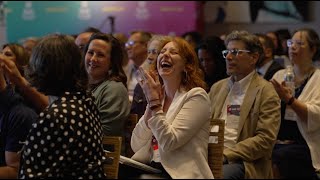
expenses. I heard all the same crap we've been talking about for 20 years. Any and I saw over half of us have been here for 20 years, right? We've been in this. It's the same stuff. So what I'm taking away is that I think all of us keynote listeners who all run communities need to take every single session that we heard today back to our community have think tanks task force. What are we going to do with this stuff? Stop talking about it to each other and nodding our heads and come up with a plan. So that's what I think we need to do and I think Skiff needs to host us coming back with our results from our communities to figure out what we do next. >> Excellent. Well, you've already answered my second question. So, so we're kind of done, but I just wanted to make sure. [Applause] [Laughter] [Laughter] Well done. Very succinct. We are going to cover all these sessions are going to be available online and we're going to do articles about all the sessions that we did today. So, there's going to be plenty of articles on skiff meetings about what you heard today. So, you can share that with your community and >> let's not just consume the content, let's it all need to go do because they were great conversations. You curated incredible people from an amazing breadth of industries. So, it's fantastic. >> Let's find the solutions now, right? So we can count on you to do that. Thank you, Liz. >> Thanks. >> Okay, next up, Vinnie Pledo, the CEO of the Society of Independent Show organizers, Caiso. Number of people from the stage looked at you and mentioned you during the events. I'm sure that was a little uh interesting for you. >> No, it was it was good. And I kind of wish that Cassandra said, "Well, where do we go if we need help?" That she had said, "Well, Ciso, >> you wanted that real plug from the stage." Didn't quite go that far. Okay, Vinnie, thank you for being with us today. What did you hear today that you think you would like to highlight in in your moment here? >> Well, a couple things. First, I was here at the first one. And the difference between the first one and today isn't a difference of degree, it's a difference of kind. So, you and your team should be applauded for that. It really um >> Thank you. Second, I don't know that everybody knows this, but we do have a vehicle in the industry that works on Capitol Hill every day for us. It's the Exhibitions and Conferences Alliance, and they work on visa issues. Along with US travel, they got 50 million to help in the visa problem. They work on workforce issues. They work on tax issues. So, I do think that's important. Now, as far as what did what are the things that I thought today were most important? Um,
serendipity can be planned. Okay, I think that's important. Everybody likes serendipity of events, but serendipity can be planned. >> Um, and sort of the counter to that is white space is very important at events, too. So, I think sometimes there's a fear, and I'm often guilty of it, of overprogramming. And just make sure there's enough white space for us all to interact. >> Yeah. And isn't that like the the first one you mentioned, is that a bit like pushing your luck? you know, people get lucky, but actually if you keep trying, to figure it out, the more lucky you get. >> Yeah. And and you know, the planned networking tables and and trying to make sure and I think the digital doppelganger might have legs to it, right? Trying to make sure that when we walk in, we have built something that fulfills the needs. And early in my career, we would sign NDAs with Microsoft and then by accident on purpose, a lot of what we had in our events were things that Microsoft found important as well. So, >> very good. Okay. So, what are you going to do about this? What are you going to take back to CISO and action in some way? >> Well, I would think probably the hardest thing for us sometimes is the magic of play, right? We have um the majority of our events are CEOs or next generation CEOs and oftent times we kind of overrespect that they don't want to play and um I do think that maybe and my head of operations also she's not really much of a player as a couple of our guys know over here but um just making sure that we are thoughtful when we're building to make sure that we build in enough time for uh play. Okay. So, your next CEO summit, are we going to have ball pits for people to play in? >> Um, let's not go let's not go that far, but >> you're not going to commit to that. >> I think we will work for uh more time that is um structured in a way that's meant to be fun and not necessarily um trying to fill a gap analysis or three bullet points. >> Okay. Well, good. Well, thank you, Vinnie. Thank you for sharing. >> Okay. And last, but definitely not least, Amy Calvert, the president and CEO of the Events Industry Council. Amy has the toughest job of anybody because she gets to go last. Very good. But you have an audience. Yes, we're here. Okay. >> Hello, >> Amy. >> Amy. >> Hi. >> Hi. >> What was your highlight of the day? >> Well, actually, I think the highlight
for me was just um I put this in a pose to you is this actual gift of being present to really sort of be more intentional maybe than I normally would have been coming to an event like this. One of the things that I'm always talking about is that, you know, we're all traveling so much. We attend so many events and still while we're at these events, we're trying to do everything we normally do while we're back in our offices. Uh, and it's really tough to do. It's tough to get everything out of an event experience if you aren't preparing and planning to be present while you're actually at an event experience. So I think for me, you know, I think this is a very generous question that we should all be raising within our own communities, talking a little bit more about how we help our participants potentially get more out of the event experience by coaching them a little bit about this notion of being present and you know what it means to be actively listening to gain more from the experience overall. >> Okay. Now you have a little bit of a different crowd because a lot of the associations that we talked about they are members of your association as associations. So it's a little bit different but is there anything that you're going to do to take back to the events that you organized or how you manage those those members that are associations to also make sure that they're present at your events or your meetings etc. >> Well that's a good question. I >> now there's a challenge right? Ah yeah no you know what I really feel very fortunate that our leaders are present because our mission is very unique to their own. So when they're together in a room talking about what EIC does on behalf of the global business events industry they are very focused on you know the the lane that we are in to help advance the industry. I think one of the interesting and important reminders here today and Al always says this is that you know and for all of you one of the things we always talk about too within our community whether it's the CMP community or whether it's our association members is that none of us need to feel that we need to have been in this industry for you know 20 plus years to lead right and to really think deeply about what it means to lead right now in our industry and how we can all sort of contribute to that broader discussion around you know the impact of business events, why what we do truly matters, you know, this fostering of human connections at a time now where we need that more than ever. You know, that open dialogue, building trust, confidence. >> All right, big big shoes we have to fill and lots to do. Lots to do. Yeah, Amy, thank you for having me. Thank you so much, everyone.
Top Moments
Inclusion without cameras!
Are you a participant?
Community is everything!
Resilience is key!
Leaders are here!
Up Next