Specific Populations & Vulnerable Groups
Addresses the unique mental health needs and challenges of distinct demographic groups, including military personnel, veterans, children, youth, women, and workplace populations.
Viral Moments
42
Listen to our heroes!
Veterans finally finding relief!
Rwanda's trauma-informed justice.
Unbelievable CEO story!
Shocking youth mental health data!
From rock to water
Parents' well-being is vital
Staggering future projections
Community builds resilience
A silent tool for survivors
Teens are struggling
Powerful message for parents
Breaking barriers in care!
Children's silent trauma
Disturbing trend among youth
Mothers experience complex trauma
This is just the beginning
Bridging the access gap
Preventative mental health
Parents are the anchor!
Beyond the obvious victims...
Shocking data on young children
Beyond government: community accountability
Trauma's long-term impact revealed
Caregivers in the workplace.
A shocking policy gap
Doctors bridging mind-body gap
Hidden caregivers at work!
Shocking access gap revealed
A siren, a machine, a frozen employee
Trauma tech overlooks women
War's impact on families
Who isn't reaching out?
Youth seek meaning, not just therapy!
Students transforming communities!
Untapped potential in religious leaders
Gender-specific trauma needs
Beyond the immediate crisis
From parallel to connected
Most companies are unprepared
Anxiety up 30%, eating disorders 13%!
Global solutions for local problems
Key Quotes
8
“Where there is trauma, there is hope. If there was a change for the worse, it means there can be a change for the better.”
“The mental state of the parent is the best predictor for the mental state of the child.”
“"All my life I was like a rock, like a stone... And as soon as you arrive and you understand you have zero control... I realized I need to become water."”
“The story of witnessing trauma is a deeply significant part of therapy, and it doesn't happen in the first moment. The memory of trauma is not encoded like other memories; it is recorded in the body, often fragmented, non-sequential, and sometimes incoherent. The narrative of testimony is therefore a process that sometimes takes weeks, months, and even many years.”
“Education of the mind without education of the heart is no education at all.”
“If we, as a society, take a few years of massive effort to help them get back on their feet, they are the engine that drives us. If we know how to do that, we will all benefit.”
“We believe that if we strengthen the circles surrounding children and youth, we can provide them with tailored solutions.”
“We don't have to frame it as trauma. We can frame it as something else or something like let's help the mental.”
Chapters
100
Articles
8
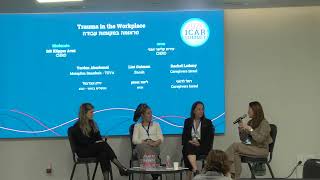
In the wake of recent national crises and ongoing societal challenges, Israeli workplaces are confronting the pervasive issue of trauma, not just among those directly affected, but across the entire workforce. A recent panel discussion highlighted innovative approaches to foster resilience and provide essential support.
A recent panel of leading mental health and child development experts convened to shed light on the escalating mental health crisis affecting children and teens, revealing a landscape where silent struggles manifest in unexpected ways, from regressive behaviors in toddlers to dangerous substance abuse among adolescents.
The recent summit on mental health and trauma healing concluded with a powerful call to action, emphasizing the need for innovative approaches, collaborative research, and a deep understanding of community-specific challenges. Speakers highlighted a shift in perspective from mere resilience to 'fluidity' in navigating trauma, alongside critical discussions on funding, stigma, and underserved populations.
A recent conference panel shed light on the profound and distinct ways women experience trauma in wartime, challenging conventional understandings of PTSD and mental health support. Experts highlighted critical gaps in care and the urgent need for tailored, gender-sensitive approaches.
In a compelling discussion, a panel of leading experts converged on a critical challenge: integrating trauma-informed approaches into the fabric of society. From educational institutions to corporate offices and healthcare systems, the consensus was clear – understanding and responding to trauma is no longer a niche concern but a fundamental requirement for societal well-being.
While the immediate intensity of the conflict may ebb and flow, the profound mental health crisis among Israel's reservists and their families is just beginning. A recent panel discussion illuminated the staggering long-term costs of prolonged service, revealing a societal challenge that demands urgent, comprehensive attention.
In a landscape where mental health needs are escalating, particularly in vulnerable communities, a recent conference showcase highlighted the transformative power of multi-sectoral partnerships in building local capacity and delivering innovative solutions.
A recent roundtable discussion has set the stage for a transformative approach to mental health and trauma support within Arab-Israeli communities, challenging existing norms and proposing actionable solutions.
Sessions
8